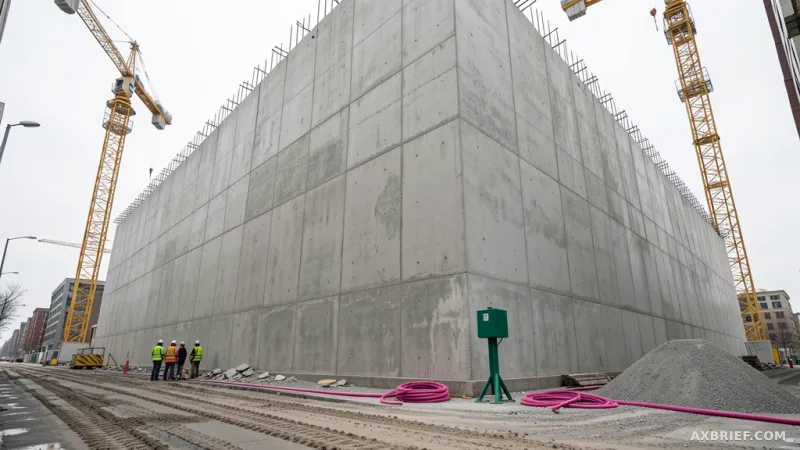
The current era of generative AI is often discussed in terms of parameters, tokens, and floating-point operations. In the boardrooms of Silicon Valley, the conversation centers on the raw compute power of H100 clusters and the efficiency of new transformer architectures. However, beneath the surface of these technological breakthroughs lies a massive, invisible financial engine that is fundamentally altering the balance sheets of the world's most powerful companies. While the public sees the deployment of sophisticated LLMs, the financial reality is a frantic, high-stakes scramble for physical infrastructure that is being funded through accounting mechanisms that keep the true cost of the AI race off the primary books.
The invisible ledger of the AI gold rush
Recent analysis reveals that the hidden debt of US Big Tech companies has ballooned to 1.65 trillion dollars over the last four years, representing an eightfold increase. To put this figure into perspective, this off-balance sheet liability now exceeds the 1.35 trillion dollars in debt officially recorded on their financial statements. This discrepancy is not a result of accounting errors, but rather a strategic use of long-term purchase agreements for GPUs and servers, as well as complex lease agreements with data center operators. Under current accounting rules, these obligations are disclosed in the footnotes of quarterly reports but do not appear as immediate liabilities on the main balance sheet, creating a gap between perceived and actual financial leverage.
Moody's estimates that off-balance sheet transactions have reached 1.2 trillion dollars, with 820 billion dollars specifically tied to data centers currently under construction. These are effectively debt-equivalent liabilities, meaning that once these facilities are completed, the companies will be locked into massive, non-negotiable rental and operational payments. The pressure to secure this infrastructure is so intense that it has triggered a surge in the corporate bond market. According to S&P Global, hyperscalers and key partners like Nvidia issued 225 billion dollars in bonds in the first half of this year alone. This represents a staggering 973.7% increase compared to the same period last year. If this trajectory holds, total issuance for the year is expected to hit 400 billion dollars.
The forced migration to asset-heavy operations
This financial surge signals a profound structural shift in how Big Tech operates. For the better part of two decades, the dominant business model for these giants was asset-light. Growth was driven by software, intellectual property, and scalable cloud services that required relatively low capital expenditure relative to their massive revenue streams. In an asset-light world, a company could scale its user base by millions without needing to build a corresponding physical factory for every new customer. The margins were high because the physical burden was minimized or outsourced.
AI has shattered this paradigm. The requirement for massive amounts of specialized silicon and the physical land and power to house it has forced a transition to an asset-heavy model. Moody's notes that the unprecedented level of investment and capital procurement required for AI infrastructure is driving this change. Companies can no longer grow simply by writing better code; they must now secure physical territory and hardware in a competitive global market. This shift means that growth is now inextricably linked to massive debt and physical depreciation, moving the industry closer to the capital-intensive nature of traditional manufacturing or utilities.
This transition is happening at a precarious moment for global finance. The US Treasury's budget deficit for the current fiscal year is projected to approach 2 trillion dollars, creating a crowded market where government bonds and corporate bonds are competing for the same pool of private investors. In previous cycles, the Federal Reserve acted as a primary buyer of government debt, absorbing much of the pressure. Now, with the Fed stepping back, the entire burden of funding these deficits and AI ambitions falls on private investors. Capital Economics warns that if the current trend of debt accumulation continues through the second half of the year, the ratio of corporate and government bond issuance relative to GDP will reach its highest level since the pandemic era.
The coming bottleneck of capital and cost
Private investors are already beginning to price in the risks associated with this rapid leverage. S&P Global reports that hyperscalers are now paying higher premiums compared to risk-free bond yields, a clear signal that the market is becoming fatigued. Investors who once viewed these companies as stable cash cows are now wary of the speed at which they are increasing their leverage to fund the AI arms race. The perceived safety of these firms is being tested by the sheer scale of their capital expenditures.
While Moody's maintains that the balance sheets of the major hyperscalers remain robust enough to avoid immediate credit rating downgrades, the macroeconomic environment is tightening. As Joseph Brusuelas, chief economist at RSM, points out, when government and private debt issuance flood the market simultaneously, the inevitable result is a rise in lending rates. This creates a feedback loop where the cost of building AI infrastructure increases exactly as the capital to fund it becomes more expensive.
For the broader ecosystem of AI developers and enterprises, this financial tension will eventually manifest as a cost increase. The capital expenditure of the hyperscalers is not a sunk cost; it is an investment that must be recouped. As the cost of borrowing rises and the asset-heavy model puts pressure on margins, the cost of cloud computing and AI API tokens will likely rise. The era of subsidized, cheap AI infrastructure is ending, replaced by a reality where the physical cost of the chip and the power plant is passed directly to the end user.
This shift from software-driven growth to infrastructure-driven debt marks the end of the asset-light era for Big Tech. The race for AI supremacy is no longer just a battle of algorithms, but a battle of balance sheets and borrowing capacity.