The modern interface between human intent and machine execution remains stubbornly primitive. Despite the exponential leap in reasoning capabilities provided by large language models, the primary way we communicate with these systems is still through the mechanical friction of typing on a glass screen or the linear constraints of spoken word. This latency—the gap between a thought forming in the mind and the AI receiving a prompt—represents the final bottleneck in the human-AI loop. The industry has long sought a way to bypass this physical layer, but the challenge has always been the noise of the human brain.
The Scaling Law of Neural Decoding
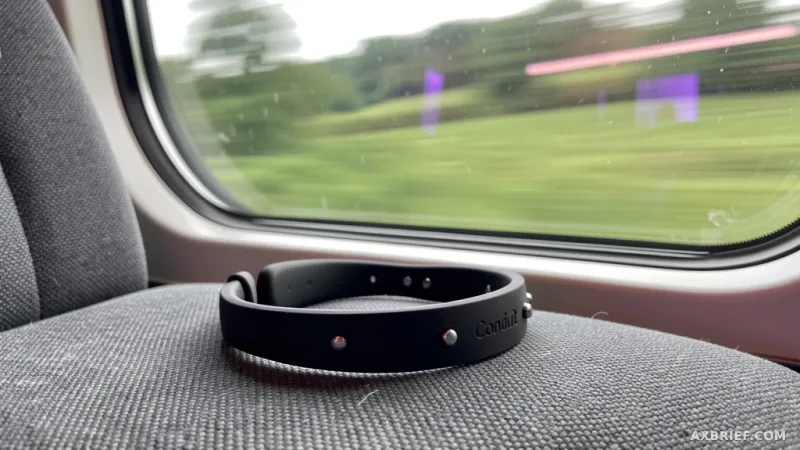
This landscape shifted on July 24, when Naomi, a researcher previously embedded in the Alignment team at OpenAI, joined the brain-computer interface startup Conduit as a founding researcher. Conduit is not pursuing the surgical precision of implanted electrodes, but is instead focusing on a non-invasive approach to thought-to-text translation. The goal is a telepathy model capable of converting neural data, captured via a wearable headband, directly into digital text.
Rather than attempting to hand-engineer a complex biological map of the brain, Conduit is adopting a philosophy known as the Bitter Lesson. This approach posits that leveraging massive compute and data scaling consistently outperforms human-designed algorithmic shortcuts. In practice, Conduit has shifted its focus toward a scaling strategy that prioritizes the volume of neural data over the sophistication of the initial decoder. The team has already identified a tangible scaling law within their research: a linear correlation between the log value of data collection time and the cosine similarity of latent space predictions.
By treating brain signals as a data-scaling problem, Conduit views its current progress as being in the GPT-2 era of BCI. This suggests that while the current outputs may be rudimentary, the underlying trajectory is predictable and exponential. The company's roadmap extends beyond simple reading. The current phase of non-invasive reading is intended to evolve into high-precision invasive reading, eventually culminating in general write capabilities. This final stage aims to input information directly into the brain, potentially enhancing neural plasticity and cognitive efficiency.
From Signal Processing to Contextual Inference
The critical insight separating Conduit from previous BCI attempts is the realization that perfect signal decoding is not a prerequisite for accurate communication. Historically, BCI research struggled because non-invasive sensors produce noisy, imprecise data. Conduit solves this not by improving the sensor, but by changing the interpreter. The strategy is to combine noisy neural signals with the massive contextual priors of a large language model.
This approach mirrors how a GPS system functions. A GPS signal alone is often imprecise, potentially placing a user in the middle of a building or a river. However, when that noisy signal is overlaid on a map of known roads and sidewalks, the system can snap the user's location to the most logical path. Conduit applies this same logic to the brain. Even if the neural signal for a specific word is blurred or ambiguous, the LLM uses its linguistic knowledge and the surrounding context to infer the most probable intent. The LLM acts as a corrective lens, filling in the gaps left by the hardware.
This shift moves the AI's role from a tool-based interface to a physical extension of the user. If AI companies begin training models to interface directly with these latent representations, the need for a text-based decoder disappears entirely. Instead of translating a thought into text and then feeding that text into an AI, the thought's latent form could be transmitted directly. This opens a pathway for communicating complex mental imagery or abstract emotions that are currently impossible to describe in words, effectively creating a direct neural pipeline between human consciousness and machine intelligence.
As the interface layer moves from the fingertips to the neurons, the primary technical challenge for developers shifts from prompt engineering to latent space mapping. The ability to align unstructured neural data with the high-dimensional vectors of an LLM becomes the new frontier of optimization. When the gap between thinking and executing vanishes, AI ceases to be a software application and becomes a synthetic sensory organ, expanding the boundaries of human cognition.