Developers today face a frustrating binary when building AI applications. They can either implement end-to-end encryption, which secures data but renders it invisible and useless to the server performing the inference, or they can move processing to the local device. While local execution protects privacy, it often crashes against the wall of limited hardware performance and exposes the provider's proprietary model weights to potential theft. This tension creates a ceiling for the adoption of AI in highly regulated sectors like healthcare and finance, where the need for deep analysis is absolute but the risk of data exposure is unacceptable.
The Mechanics of the HEIR Compiler
Google is attempting to break this deadlock with the release of HEIR, an open-source compiler toolchain and development platform designed specifically for private AI inference. Integrated into the Google Private Computing Toolkit, HEIR stands for Homomorphic Encryption Intermediate Representation. At its core, HEIR functions as a specialized translator. In traditional software development, a compiler converts human-readable code into machine-executable instructions. HEIR applies this logic to the realm of cryptography, transforming standard, unencrypted AI models into versions capable of operating on encrypted inputs.
This process relies on Homomorphic Encryption (HE), a cryptographic method that allows mathematical operations to be performed on ciphertexts. When a user sends encrypted data to a server powered by HEIR, the server processes the data without ever decrypting it. The result of the computation is itself encrypted, and only the user, who holds the private key, can decrypt the final output. This ensures that the service provider never sees the raw input or the resulting answer, yet the AI's analytical capabilities remain fully intact. HEIR aims to provide a one-click solution that automates the complex restructuring of model architectures, allowing developers to integrate encrypted inference into production applications without requiring a PhD in cryptography.
From Theoretical Math to Production Hardware
For years, homomorphic encryption remained a theoretical curiosity because the computational overhead was staggering. Transforming a standard AI model to work with HE typically required a dedicated team of cryptographers to manually rewrite operations to avoid non-linear functions that HE cannot easily handle. The real shift introduced by HEIR is the democratization of this process. By providing an intermediate representation, Google has moved the burden of optimization from the developer to the compiler. The tension is no longer about whether a developer knows the math, but about how efficiently the underlying hardware can execute the resulting encrypted instructions.
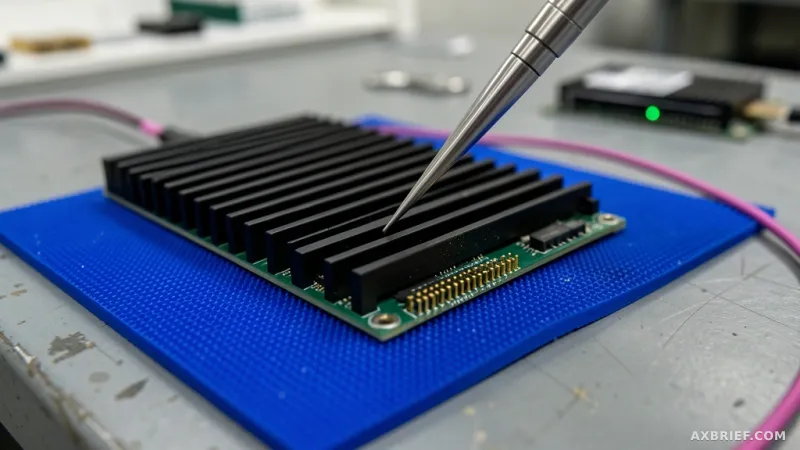
To solve the performance bottleneck, Google has positioned HEIR as a collaborative ecosystem rather than a closed tool. The project has partnered with specialized hardware accelerator firms including Belfort, Niobium, Cornami, and Optalysys. These companies are developing dedicated chips designed to handle the massive polynomial multiplications required by HE, aiming to bring the latency of encrypted inference closer to that of plaintext execution. Simultaneously, the project is being stress-tested and refined by a global academic network. Institutions such as Georgia Tech, Carnegie Mellon, UC Santa Barbara, the Illinois Institute of Technology, Purdue, the University of Edinburgh, and Tsinghua University are utilizing HEIR as a research platform to optimize encrypted computation efficiency.
This synergy between an open-source compiler, specialized silicon, and academic rigor transforms HEIR from a simple utility into a bridge. It allows the industry to move away from the risky trade-off between privacy and utility, enabling a future where the cloud can provide intelligence without ever needing to see the data it is analyzing.
The era of choosing between data security and AI functionality is ending as the barrier to encrypted inference collapses.