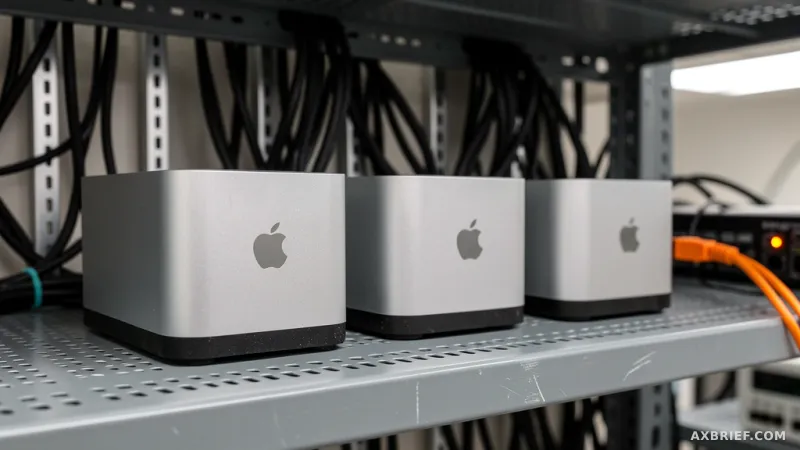
The modern developer's desk is undergoing a quiet but fundamental transformation. For years, the goal was a single, powerful workstation capable of handling every task from coding to rendering. However, a new trend has emerged among AI engineers and frontier research labs: the deployment of dedicated, always-on hardware specifically to host autonomous AI agents. These agents do not just respond to prompts; they execute long-running workflows, monitor systems, and perform iterative tasks that would render a primary workstation unusable. This shift has turned the compact Mac mini and Mac Studio from simple desktop computers into the preferred infrastructure for the agentic era.
The Rise of the Dedicated Agent Server
This surge in hardware adoption is not accidental. Doug Brooks, Senior Product Manager for Apple Silicon, noted in an interview leading up to WWDC 2026 that there is currently an incredible demand for these specific form factors. The reason lies in the unique operational requirements of AI agents, which differ significantly from standard LLM chat interfaces. An effective agent environment requires three non-negotiable pillars: absolute user control, environment isolation, and 24/7 stability. By offloading agents to a Mac mini, developers can maintain a separate execution environment that does not compete for resources with their primary IDE or browser, ensuring that an autonomous loop does not crash their main system or drain their battery.
Beyond the physical form factor, the ecosystem is tilting toward a Mac-first approach. Many of the most cutting-edge tools for agent development are being built specifically for macOS, reflecting the demographics of the frontier AI community. This has created a feedback loop where the hardware is optimized for the software, and the software is designed to leverage the specific unified memory architecture of Apple Silicon, cementing the Mac's position as the primary platform for local agent orchestration.
Beyond the GPU: The Whole-Chip Inference Strategy
While the industry often views AI performance through the narrow lens of GPU TFLOPS, Apple Silicon operates on a fundamentally different philosophy of resource distribution. The core insight for developers is that an AI agent is not just a large language model; it is a complex workflow involving tool calling, sensory input, and iterative reasoning. To handle this, Apple employs a hybrid inference structure that distributes workloads across the entire SoC rather than bottlenecking everything at the GPU.
In this architecture, the GPU handles the heavy lifting of LLM execution, but it is supported by a sophisticated network of accelerators. The Neural Engine is dedicated to power-efficient matrix operations, providing the backbone for the model's core computations without spiking power consumption. Simultaneously, specialized neural accelerators embedded within the CPU handle time-sensitive tasks, such as real-time voice recognition, where low latency is more critical than raw throughput. This multi-tiered approach extends across the entire product line, from the iPhone to the highest-end Mac silicon, ensuring a consistent execution path for AI workloads.
This hardware diversity enables a hybrid inference model that dynamically decides where a task should be processed. Instead of a binary choice between local and cloud, the system evaluates the nature of the request. Local processing is prioritized for tasks requiring high privacy, immediate response, or those that would incur prohibitive token costs in the cloud. Cloud offloading is reserved for massive compute tasks that exceed local memory limits. This strategy allows Apple to optimize the execution path for specific machines, ensuring that the agent remains responsive while keeping operational costs sustainable.
This shift necessitates a change in the developer's mental model. The industry must move away from GPU-centric thinking and toward whole-chip design. Optimizing an agent on Apple Silicon means understanding how to balance the workload between the CPU accelerators, the Neural Engine, and the GPU. When an agent calls a tool or processes a background workflow, the efficiency of that transition determines the overall perceived performance of the system.
This philosophy extends into what Apple calls Transparent AI. Rather than presenting AI as a separate, disruptive tool or a chat box, the goal is to integrate intelligence silently into the operating system and third-party applications. The AI becomes a background utility, an invisible layer of the OS that enhances functionality without demanding the user's constant attention. Real-world implementations of this are already visible in apps like Draw Things, which brings professional-grade local image generation to iPhone, iPad, and Mac, and SwingVision, which uses the iPhone camera to provide real-time AI analysis for tennis and pickleball matches.
For the practitioner, the challenge now lies in defining the optimal hybrid execution point. Success in deploying AI agents no longer depends solely on the size of the model, but on the strategic balance between cloud API costs, local inference latency, and the stringent requirements of user privacy.