Every developer and designer using generative AI for UI work has hit the same wall. You prompt the model for a sophisticated dashboard or a sleek landing page, and it delivers something that looks like a generic template from 2018. It is visually competent but devoid of soul, lacking the specific brand nuances that make a product feel intentional. In the industry, this flood of homogenized, identity-less AI output has earned a name: slop. The tension lies in the gap between a model's general knowledge of what a button looks like and a company's specific vision of how that button should behave and feel.
The Architecture of Brand Identity in Markdown
To bridge this gap, Atlassian has introduced an experiment called DESIGN.md. Rather than attempting to retrain a massive model on a proprietary design system—a process that is both costly and slow—Atlassian opted for a portable, text-based approach. DESIGN.md is a Markdown file that serves as a comprehensive manifest of a brand's visual identity, designed to be injected directly into an AI prompt. This allows the AI to understand the visual rules of a brand without having to guess or rely on generalized training data.
The file is structured into two distinct layers. The first layer consists of design tokens, which are the standardized values for the most basic elements of the UI, such as hex codes for colors, specific pixel values for spacing, and font family definitions. The second layer is where the real innovation happens: the design rationale. Instead of just telling the AI that a primary button is blue, DESIGN.md explains why that blue was chosen and how it should be used to create hierarchy and focus. By providing the reasoning behind the design, Atlassian enables the AI to apply these rules logically to new, unseen screens.
During the Team '26 keynote, Atlassian demonstrated this capability using Figma Make, a design generation tool within Figma. By applying the DESIGN.md file, the AI was able to generate a dashboard where the colors, spacing, shapes, and typography were perfectly aligned with the Atlassian design system in a single shot. This one-shot prototyping capability removes the need for iterative prompting or the setup of complex external tools, allowing a brand's identity to be transplanted into a generated UI almost instantaneously.
The Cost of Convenience and the Technical Debt Trap
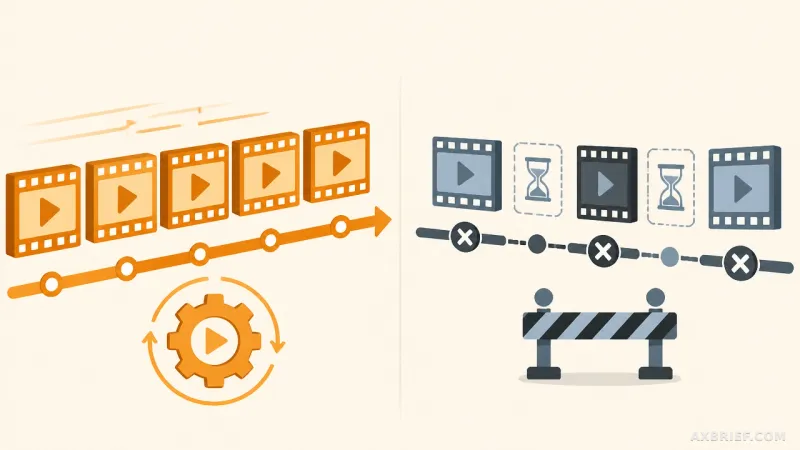
While the ability to instantly inject brand identity is powerful, the implementation reveals a significant friction point between rapid prototyping and production-grade engineering. The core issue is how the AI consumes the information. Because DESIGN.md is a static file that the AI must read in its entirety to maintain consistency, it creates a massive overhead in token consumption. Atlassian's data shows that using DESIGN.md as the sole guide for simple tasks results in approximately 92% additional token consumption compared to more optimized methods. Furthermore, the variance in token usage between different executions reached about 2.7 times, leading to increased generation times and higher operational costs.
This inefficiency stems from the contrast between a full-file read and a selective retrieval system like the Model Context Protocol (MCP). An MCP server allows an AI to fetch only the specific piece of information it needs at a given moment, whereas DESIGN.md forces the model to process the entire design philosophy for every single element it generates. For a small prototype, this is a negligible trade-off for speed. For a massive enterprise codebase, it is an unsustainable expense.
Beyond the cost, there is a deeper architectural risk: the creation of technical debt. DESIGN.md is designed to provide re-implementation specifications rather than strict code instructions. In practice, this means that instead of the AI agent identifying and using an existing, pre-approved component from the company's library, it often reads the styling specifications in the Markdown file and writes new, custom CSS or HTML from scratch. This results in a UI that looks correct but is built on a foundation of fragmented, non-standard code that is nearly impossible to maintain at scale. The AI essentially bypasses the established design system's code library to satisfy the visual requirements of the DESIGN.md file.
This creates a clear divide in utility. For the early stages of a project—where a designer needs to visualize an idea quickly or a company wants to create a custom-themed version of a product for a specific client—DESIGN.md is an exceptional tool. It allows for the rapid manifestation of brand identity without the friction of a full engineering pipeline. However, in a production environment where code standards are rigid and efficiency is paramount, the selective retrieval of MCP remains the superior choice.
Ultimately, DESIGN.md does not replace the professional design system; it acts as a translation layer that makes those systems legible to generative AI. The choice between using a portable Markdown manifest or a sophisticated MCP server depends entirely on whether the goal is the speed of a prototype or the stability of a product.