The modern AI race is no longer being won solely in the realm of mathematics or algorithmic breakthroughs. Instead, the battlefield has shifted to the dirt and concrete of the American Midwest. For months, the developer community has whispered about a growing disconnect: the gap between when a frontier model is declared finished in a lab and when its API actually becomes available for public use. This latency is not a failure of coding, but a failure of physics. The industry has hit a wall where the speed of software evolution has completely outpaced the speed of industrial construction.
The Rapid Deployment Blueprint
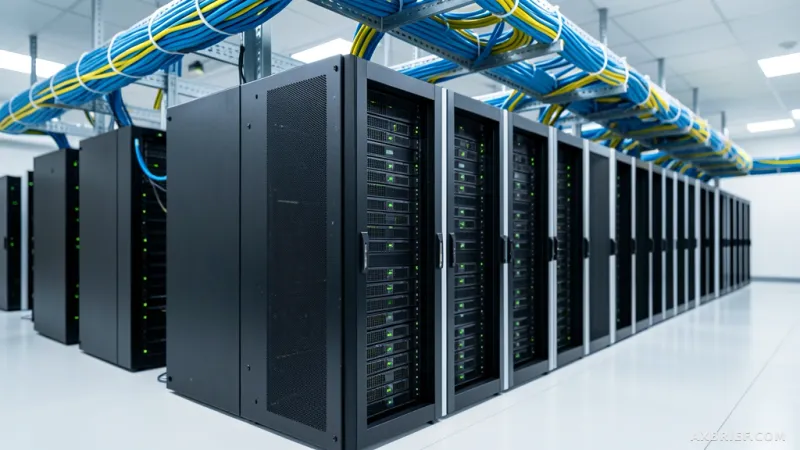
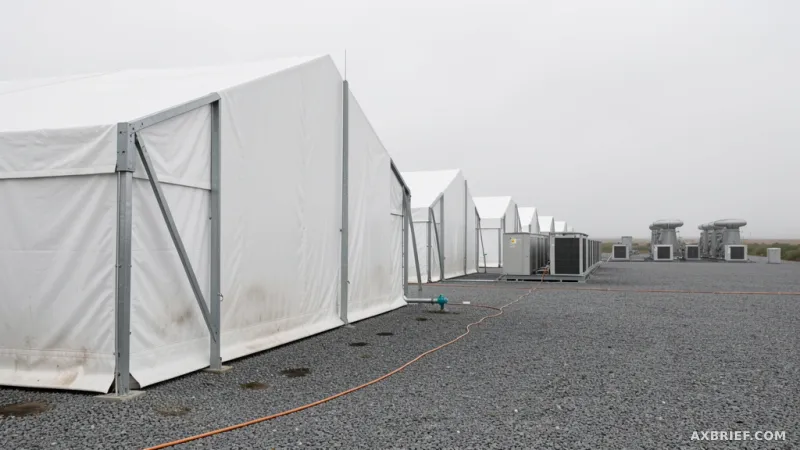
Meta is attempting to shatter this bottleneck by abandoning traditional construction timelines. In the outskirts of New Albany, Ohio, the company has implemented a strategy it calls rapid deployment structures. Rather than waiting years for the completion of permanent concrete shells, Meta has installed six massive, weather-resistant tents to house its compute clusters. These are not temporary shelters in the traditional sense, but industrial-grade environments designed to withstand extreme weather while slashing total completion time by half.
According to data from Michael Thomas of Cleanview, who tracked the project via city permits and satellite imagery, Meta has constructed five tents spanning 125,000 square feet each. To solve the most critical constraint of all—electricity—Meta has paired these structures with 200MW modular gas turbines. This allows the company to generate power independently of the local utility grid, bypassing the years of negotiation and infrastructure upgrades typically required to bring gigawatts of power to a single site. This tactical pivot mirrors the aggressive maneuvers of xAI and recalls the era when Tesla installed tents in the Fremont factory parking lot to accelerate Model 3 production.
This physical urgency is driven by a specific product pressure. Meta's latest model, Muse Spark, is reportedly already developed and ready for deployment. However, the company has faced repeated delays in releasing the APIs necessary for developers to integrate the LLM into their own applications. As reported by the Wall Street Journal, these delays have created significant friction for the ecosystem. Meta is now investing up to $145 billion in data centers and capital expenditures to ensure that the physical footprint of the company matches the ambition of its research teams. While this massive spending triggered a 5% dip in Meta's stock price, the company views the risk of infrastructure lag as a greater threat than short-term market volatility.
The Shift from Intelligence to Infrastructure
This pivot reveals a fundamental truth about the current state of generative AI: the bottleneck has moved from the GPU to the grid. When a company like Meta resorts to tent-based data centers, it is an admission that the traditional cycle of urban planning and utility scaling is too slow for the AI era. The industry is entering a phase where the ability to secure land and power is more valuable than the ability to optimize a transformer architecture. This tension is visible across the entire landscape, where every major player is fighting a war of efficiency to lower the cost of intelligence.
While Meta solves for space, Anthropic is solving for reliability and cost. The release of Claude Opus 4.8 marks a significant leap in autonomous capability, with a defect rate in code generation that is four times lower than previous versions. It has outperformed both Opus 4.7 and GPT 5.5 in key benchmarks. To make this power accessible, Anthropic introduced a fast mode that is 2.5 times faster and 3 times cheaper. The toolset has also become more granular, allowing users to control the model's cognitive depth via the `/effort` command, with levels ranging from Low and High to XI and Max. For those needing direct system interaction, the `/remote-control` command now enables the AI to execute computer tasks managed via a mobile app.
This drive toward efficiency is also fueling a brutal price war. Alibaba has entered the fray with Qwen 3.7 Max, a model that is approximately 6 times cheaper than Claude Opus. In a demonstration of its raw utility, Qwen 3.7 Max spent 35 hours performing over 1,000 tool calls in an unfamiliar AI chip environment to build an AI computing kernel that performed 10 times better than the manufacturer's official version. By integrating directly with Claude Code and Open Claw, Qwen is systematically lowering the financial barrier to high-performance coding agents.
Even the giants are rethinking the interface of AI. Google's Anti-Gravity research team recently demonstrated an AI network capable of building an entire operating system from a single prompt. This system utilized 93 specialized sub-agents, processing 2.6 billion tokens across 15,314 model calls to run the open-source game Freedom at a total cost of $916.92. This architecture represents a leap beyond Gemini 3.1 Pro, moving toward a world where AI does not just answer questions but manages complex, multi-step engineering projects. This is the precursor to Remy, Google's 24/7 personal AI agent currently in internal dogfooding. Remy is designed to live across Gmail, Docs, Calendar, and Drive, acting as a background operator that anticipates user needs rather than waiting for a prompt.
However, this acceleration is creating immense pressure on the hardware supply chain. While NVIDIA has managed to reduce per-chip memory usage by 10% to 20% to alleviate memory constraints, the financial margins for hardware providers are thinning. Broadcom has warned that while total megawatt and gigawatt demand is expanding, the spend per megawatt is stagnating, leading to margin compression. Micron felt this pressure acutely, with its stock dropping 6%—wiping out $60 billion in market value—following analysis that long-term margins could fall by 66%.
Amidst this volatility, the consolidation of power is accelerating. OpenAI, Anthropic, and xAI are absorbing the majority of the world's top AI talent. The movement of Andrej Karpathy to Anthropic signals a shift in R&D leadership, while xAI is leveraging the Colossus 2 supercomputer to train next-generation coding models from scratch. The acquisition of Cursor by SpaceX for $60 billion further illustrates the blurring lines between aerospace, compute, and software. Even the robotics sector is scaling; Figure's robots have sorted 250,000 packages over 200 hours of continuous streaming, and Atlas has achieved the raw strength required to lift refrigerators.
The current trajectory suggests that the winners of the AI era will not be those with the most elegant models, but those who can most aggressively integrate software, hardware, and energy. Whether it is through 200MW gas turbines in Ohio tents or the deployment of 93-agent networks for OS construction, the goal is the same: the total removal of friction between an idea and its execution.
The era of the virtual AI is ending, and the era of the physical AI infrastructure has begun.