Most professionals have a digital graveyard of half-finished Notion pages or Obsidian vaults that became too complex to maintain. The friction usually begins at the moment of capture, where the user must decide which folder a thought belongs to or which tag will make it discoverable six months from now. This cognitive overhead often leads to a paradox where the tools designed to increase productivity actually create a new chore: the maintenance of the system itself.
The Architecture of Zero-Friction Input
Monolog approaches this problem by treating the recording process as a continuous stream of consciousness rather than a filing exercise. The interface mimics the ubiquitous habit of messaging oneself, providing a simple chat window where users can dump information without prior categorization. When a user types a phrase like "Next Tuesday lunch with Young-su," the AI does not simply store the text; it recognizes the temporal markers and automatically classifies the entry as a scheduled event. Similarly, a prompt such as "Send quote by Friday" is instantly processed as a to-do item.
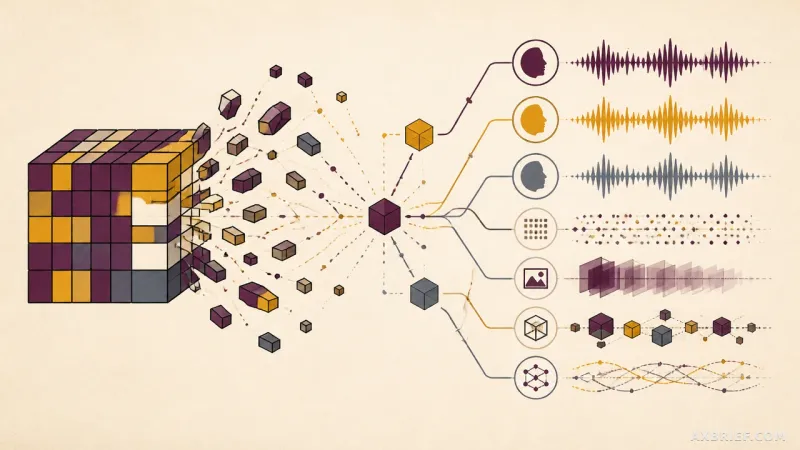
This automation extends to the metadata layer. The AI analyzes the content of every entry to generate relevant tags automatically, removing the need for the user to manually label their thoughts. The scope of capture is not limited to text. Monolog supports a multi-modal input system that includes images, drawings, links, maps, voice recordings, and videos. The system specifically employs optical character recognition and analysis to process business cards or receipts within images, ensuring that the data inside a photo is as searchable as a typed sentence.
To ensure these records are accessible across any workflow, the service is deployed across a wide ecosystem. It is available as a mobile app for iOS, iPadOS, and Android, while PC users can access their data via a web interface, a dedicated desktop application, and a Chrome extension that lives in the side panel for quick capture during browsing. The platform also introduces a feature called Smart Message, which resurfaces relevant past records in the form of a chat message, allowing users to jump directly back to the original context of a thought.
Shifting the Paradigm From Organization to Retrieval
The fundamental shift monolog introduces is the transition from an organization-centric model to a retrieval-centric model. Traditional productivity tools like Notion or Obsidian are essentially construction kits for productivity systems. They require the user to be an architect, designing hierarchies and linking databases to ensure information remains findable. Monolog rejects this architecture in favor of an unstructured data approach, where the burden of organization is shifted from the time of input to the time of output.
This is made possible through the implementation of semantic search. Unlike keyword-based search, which requires an exact match, semantic search understands the intent and relationship between concepts. If a user records that their next check-up at the ophthalmologist is in six months, a subsequent search for the word "hospital" will successfully retrieve that note. The AI understands that an ophthalmologist is a type of medical professional and a check-up happens at a hospital, bridging the gap between the user's original phrasing and their later query.
By defining the AI as a retrieval tool rather than a generative writing tool, monolog preserves the integrity of the user's original records. The value of a note is rarely found in the act of writing it, but rather in the moment it is rediscovered after being forgotten. By eliminating the management cost of maintaining a folder structure, the tool attempts to lower the barrier to data accumulation. The technical goal is to convert unstructured, non-linear human thought into structured, queryable data in real-time without the user ever feeling the process.
The success of this system depends entirely on the precision of the AI's recall and its ability to handle the nuances of natural language. If the semantic search fails to connect "hospital" with "ophthalmologist," the user will inevitably return to the safety of manual folders. The reliability of the auto-generated tags and the recall rate of the semantic engine are the primary metrics that will determine if an unstructured system can truly replace a structured one.
This experiment suggests a future where AI functions as a seamless external brain, managing the logistics of memory so the user can focus on the act of thinking. For those who prioritize speed of capture over the aesthetics of organization, this represents a significant departure from the current state of productivity software. The operational details and live environment of the tool can be explored via the official website at https://www.monolog.ing or the web application at https://app.monolog.ing.