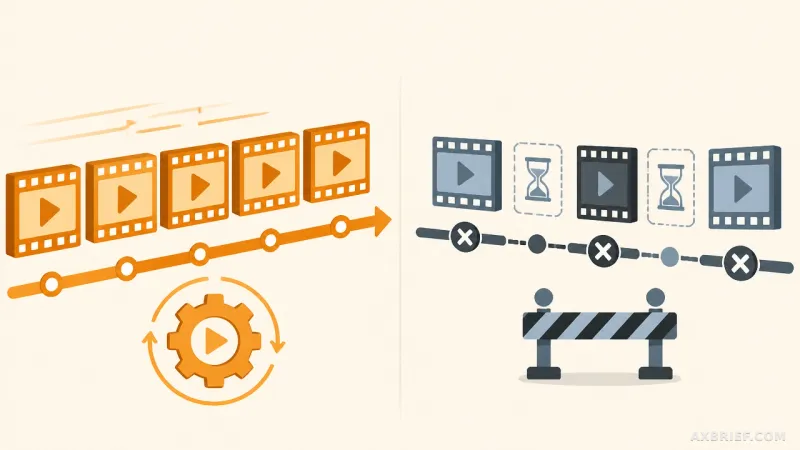
For most developers, the modern workflow has become a repetitive cycle of Alt-Tabbing between an IDE and a browser window. The habit is ingrained: prompt a request in ChatGPT or Claude, copy a generated code snippet, and paste it into a local file, hoping the context window captured enough of the project structure to make the code runnable. This paradigm treats AI as a sophisticated autocomplete tool rather than a collaborator. However, the industry is currently shifting toward agentic coding, where the AI does not just suggest lines of code but actively plans, executes, and iterates on software engineering tasks within a live environment.
The Architecture of the Ornith-1.0 Family
DeepReinforce-AI has entered this race with the release of Ornith-1.0, a suite of models specifically engineered for agentic workflows. Unlike general-purpose LLMs, Ornith-1.0 is designed to move beyond simple generation toward autonomous problem-solving. To ensure accessibility across different hardware constraints, the developers released the model in four distinct configurations. The lineup includes a 9B-Dense model for lightweight deployments, a 31B-Dense model for balanced performance, and two Mixture of Experts (MoE) variants—a 35B-MoE and a massive 397B-MoE—designed to maximize computational efficiency by activating only a fraction of parameters per token.
These models are not built from scratch but are the result of intensive additional training on top of Google's Gemma 4 and Qwen 3.5. By leveraging these strong foundations and applying a specialized training regime, DeepReinforce-AI has optimized the models for tool use and strategic planning. To foster global adoption and transparency, the entire suite is released under the MIT license, removing regional restrictions and allowing developers to integrate the models into proprietary pipelines for free.
The performance metrics suggest a significant leap in efficiency for smaller models. In the Terminal-Bench 2.1 evaluation, which measures a model's ability to operate within a terminal environment, the Ornith-1.0-9B model achieved a score of 43.1. This is a stark contrast to its direct competitors in the same weight class; Qwen3.5-9B scored 21.3, and Gemma4-12B scored 21. Essentially, the 9B variant of Ornith-1.0 delivers nearly double the performance of other models of similar size. This trend continues in the SWE-bench Verified benchmark, where Ornith-1.0-9B recorded a score of 69.4, placing it on par with, or even ahead of, models in the 35B parameter range.
From Answer Generation to Path Optimization
The disparity in performance between Ornith-1.0 and other small-scale models stems from a fundamental shift in how the AI is trained to think. Most coding models are trained to predict the next token of a correct code block, effectively learning what the final answer looks like. Ornith-1.0 instead utilizes Reinforcement Learning (RL) to optimize what the developers call the scaffold. The scaffold is the logical framework or the reasoning path that leads to the correct solution. Rather than simply rewarding the model for producing the correct code, the RL process rewards the model for discovering the most efficient and logical path to that code.
This approach transforms the model from a pattern matcher into a strategic agent. By focusing on the process of derivation rather than the result, the model learns how to plan its steps, identify potential errors in its own logic, and select the correct tools for the job. This is complemented by a transparent Chain-of-Thought (CoT) structure. When Ornith-1.0 processes a request, it performs its internal reasoning within specific `<think>` blocks before delivering the final output. This allows developers to audit the AI's logic in real-time, making it significantly easier to debug complex architectural decisions or trace the origin of a logical error in a bug fix.
This shift in focus from parameter count to path precision changes the hardware conversation. The primary bottleneck for deploying high-end coding agents has traditionally been the massive VRAM requirements of 30B+ models. However, because Ornith-1.0-9B achieves 35B-level results, the barrier to entry drops precipitously. In a standard environment with a single 80GB GPU, the 9B model requires only 19GB of memory to serve a high-performance coding agent. The efficiency gain is not just a matter of speed, but of viability, allowing sophisticated agentic workflows to run on consumer-grade or mid-tier enterprise hardware without sacrificing the reasoning capabilities typically reserved for giant models.
The era of the copy-paste workflow is ending as the precision of the reasoning path becomes more valuable than the raw size of the neural network.