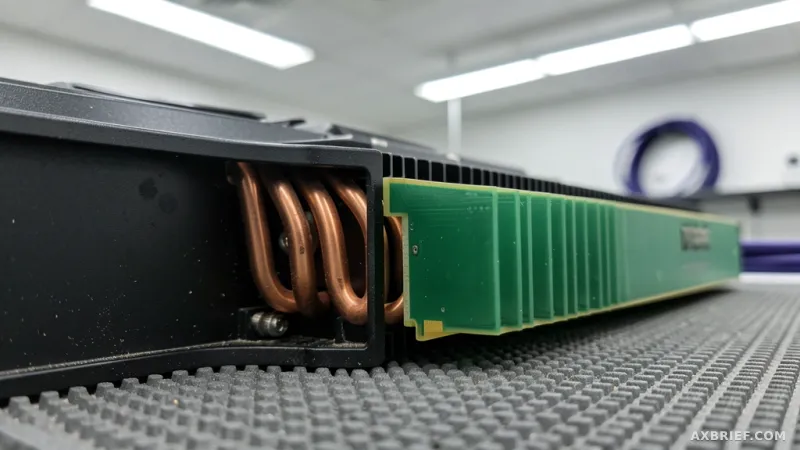
The current era of generative AI is defined by a paradoxical struggle. Engineers are deploying the most powerful silicon in history, such as the NVIDIA B200, yet they frequently find these chips idling. In the high-stakes environment of Vision-Language Model (VLM) deployment, the bottleneck has shifted. It is no longer just about the raw TFLOPS of the GPU, but about the agonizing milliseconds spent waiting for the CPU to tell the GPU what to do next. This gap between hardware potential and actual execution is where the most critical optimizations are now happening.
The Architecture of the GPU Bubble
Moondream has introduced Photon, a specialized inference engine designed to push VLM performance toward true real-time capabilities. When tested on NVIDIA B200 hardware, Photon achieved an inference speed of approximately 33ms, representing a decode throughput increase of up to 35% compared to traditional inference methods. To understand this leap, one must first understand the GPU Bubble, the primary antagonist in high-performance inference.
Most AI models rely on autoregressive text generation, meaning the model must determine the current token before it can begin calculating the next one. While the GPU handles the heavy lifting of matrix multiplication, the CPU is tasked with housekeeping. This includes selecting the next request, configuring metadata, and recording the output tokens. The problem is a matter of scale. The GPU's computation time for a single token is incredibly short, but the CPU's housekeeping tasks carry a fixed time cost. This creates a synchronization gap where the GPU sits idle, waiting for the CPU to finish its administrative duties. This idle period is the bubble, and in high-throughput environments, these bubbles aggregate into massive efficiency losses.
Photon solves this by implementing pipelined decoding. Rather than following a linear sequence of CPU-then-GPU, Photon overlaps these operations. While the CPU is processing the token from the current step, the GPU is already beginning the computation for the next token. By nesting these tasks, Photon ensures the GPU remains in a state of continuous operation, effectively hiding the CPU's latency behind the GPU's computation.
Engineering the Pipeline and the Zombie Tax
Achieving this overlap requires more than just a scheduling change; it requires a fundamental redesign of how memory and execution are handled. Photon implements this through three specific technical mechanisms. The first is the use of ping-pong slots. For a GPU to execute a decode step, it requires a set of buffers for input staging, logit output, sampled token storage, and KV cache management. Photon bundles these into a structure called `DecodeSlot`. To avoid the synchronization delays associated with runtime memory allocation, Photon utilizes pinned host buffers with fixed addresses to perform Direct Memory Access (DMA) transfers. By employing two slots in a ping-pong configuration, the CPU can read the results from one slot while the GPU simultaneously writes the next operation into the other, preventing data collisions.
The second mechanism addresses the critical path of constrained decoding. Moondream's spatial awareness capabilities often require structured outputs, such as coordinates or bounding boxes, which necessitate constrained decoding to limit the tokens the model can generate. Normally, the allowed token mask for step $t+1$ depends on the token sampled at step $t$, creating a hard dependency. Photon breaks this by separating the forward pass from the sampling process. It executes the GPU forward pass before the mask is finalized and performs the sampling immediately after the CPU commit is complete. This removes the CPU's sampling wait time from the critical path of execution.
The third mechanism is the handling of what the developers call zombies. In a pipelined architecture, the GPU may have already launched the computation for step $t+1$ by the time the CPU realizes that step $t$ produced an end-of-sequence (EOS) token. Rather than implementing a complex and costly cancellation logic that would break the pipeline, Photon uses a reference counting field called `inflight_refs`. When a sequence ends, it is marked as finalized. The system continues to output the result but maintains the KV pages and LoRA slots until `inflight_refs` reaches zero. This allows for safe resource recovery without interrupting the flow of the pipeline.
Furthermore, Photon does not treat the prefill stage—where the prompt and image are first processed—as a separate entity. It integrates prefill into the same two-slot pipeline by launching it with `kind="prefill"`. This ensures that even for workloads generating very short responses, the overlap between CPU housekeeping and GPU computation remains seamless.
From an operational standpoint, this architecture introduces a slight overhead known as the zombie tax. The theoretical gain of pipelined decoding is expressed as the ratio of the blocking loop time to the pipelined time ($ rac{T_{block}}{T_{pipe}}$). As hardware becomes faster and computation time shrinks, the relative cost of CPU housekeeping grows, making the gains from Photon more significant. The zombie tax manifests as a small amount of wasted computation; if a sequence has a length of $L$, there is roughly a $1/L$ probability of performing one unnecessary forward pass. For a sequence of 110 tokens, this is a negligible 1% overhead. In batch-processing environments, this cost vanishes almost entirely because the weights are already streamed, and the zombie sequence simply occupies one row in a larger matrix.
Photon is not the result of a single breakthrough but a convergence of image tiling, kernel optimization, scheduler reordering, and the elimination of synchronization points. As the industry moves toward increasingly powerful accelerators, the CPU bottleneck will only become more pronounced, making this brand of pipeline optimization the new standard for VLM efficiency.