The financial world has long treated SpaceX not as a traditional aerospace company, but as a speculative engine of the future. For years, the narrative has been driven by the sheer audacity of Elon Musk's vision, creating a valuation bubble that often defies standard discounted cash flow models. As the company edges closer to a potential initial public offering, the gap between the perceived market value and the cold, hard math of fundamental analysis is beginning to widen. The industry is currently witnessing a clash between the visionary premium and the reality of capital expenditures required to turn the vacuum of space into a viable server farm.
The Math Behind the $63 Fair Value
Morningstar recently stripped away the hype to provide a rigorous valuation of SpaceX, arriving at a fair value of $63 per share. This figure stands in stark contrast to the anticipated IPO offering price of $135, representing a 53% discount. This is not a simple expression of skepticism, but a probability-weighted calculation based on three distinct financial trajectories. To understand how Morningstar reached $63, one must look at the company as a collection of separate assets and speculative options.
The foundation of the valuation rests on the core space and connectivity business, which Morningstar values at approximately $40 per share. This represents the steady-state revenue from Falcon 9 launches and the existing Starlink constellation. To this base, the analysts added $6.50 per share derived from the projected $85.7 billion in capital to be raised through the IPO, assuming the issuance of 6.39 billion shares. They further added $1.80 per share for existing cash and investment assets, while subtracting $2.30 per share to account for outstanding debt. The final piece of the puzzle is a $16.50 per share value assigned as a call option for the commercialization of orbital AI infrastructure.
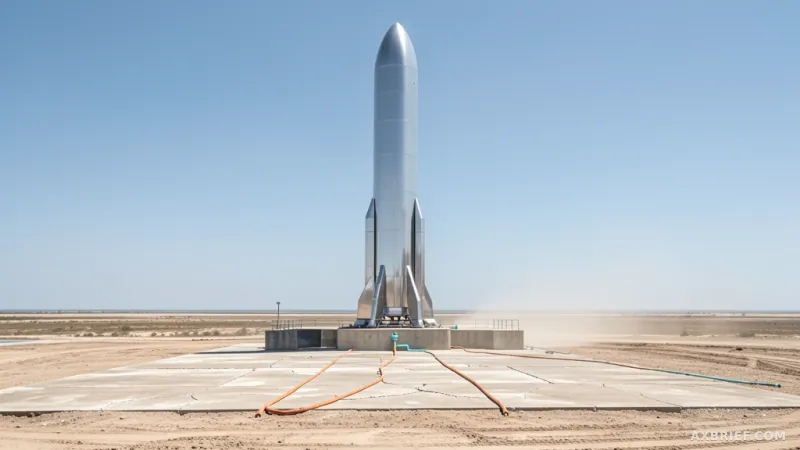
However, this entire financial house is built on the successful deployment of Starship. Morningstar's model assumes that SpaceX will achieve full reusability of its next-generation heavy-lift vehicle. Specifically, the projection requires SpaceX to execute 340 Starship missions by 2035, which equates to a launch cadence of nearly one flight per day. The critical metric here is a rocket reuse rate of 85%, extending cost and time savings not just to the booster but to the upper stage of the spacecraft. Morningstar notes that these engineering hurdles are significant, and it is unlikely that these technical challenges will be fully resolved before 2028.
The Orbital AI Gamble and the Option Premium
The central tension in SpaceX's valuation is whether the company will be viewed as a transportation utility or an orbital AI infrastructure giant. The $16.50 call option mentioned earlier is tied to the possibility of deploying AI data centers in orbit, a move that would fundamentally shift the company's revenue profile. Morningstar analyzes this potential through three scenarios, each with vastly different implications for the stock price.
The most aggressive path is the Moonshot scenario. In this version of the future, orbital AI platforms achieve an operational cost advantage over ground-based computing. By 2040, SpaceX would deploy 20% of the world's AI infrastructure computing capacity, excluding Russia and China. Using SpaceX's own estimates—where a single satellite provides 100kW of AI processing power and a single Starship fairing can carry over 100 satellites—the company would build a cluster of 59,000 satellites by 2035. This would result in 11.6GW of computing capacity and annual revenues of $225 billion, driving the share price up to $154. Yet, Morningstar assigns this outcome a mere 7% probability.
The more likely path is the Minimum Viable Product (MVP) scenario, which carries a 50% probability. Here, orbital data centers are realized but face capacity constraints, serving niches where data transmission latency is acceptable. This model envisions 48,000 satellites with 50kW of processing power each, totaling 2.4GW of capacity and $47 billion in annual revenue. Then there is the No Go scenario, with a 43% probability, where orbital data centers either fail to function or offer no tangible advantage over terrestrial sites. In this case, SpaceX would continue commercializing its ground-based Colossus data center but would fail to capture a meaningful share of global computing capacity.
For the investor, this creates a massive option premium. Buying shares at the $135 IPO price means paying $72 over the fair value of $63. This $72 is not a payment for current earnings, but a premium paid for the right to participate in high-risk, high-reward projects like orbital AI, lunar chip manufacturing, and the construction of Martian cities. To justify the $135 price tag, an investor would have to believe that the Moonshot scenario has a 77% probability and the MVP scenario a 23% probability, completely eliminating the possibility of failure.
While the vision is compelling, the practical risks remain immense. These ambitious interplanetary projects consume vast amounts of capital, which inevitably leads to the dilution of shareholder value. The critical question for the market is whether orbital AI infrastructure can truly overcome the physical limitations of ground-based data centers and if SpaceX's capital structure can withstand the delay of these breakthroughs beyond 2028.