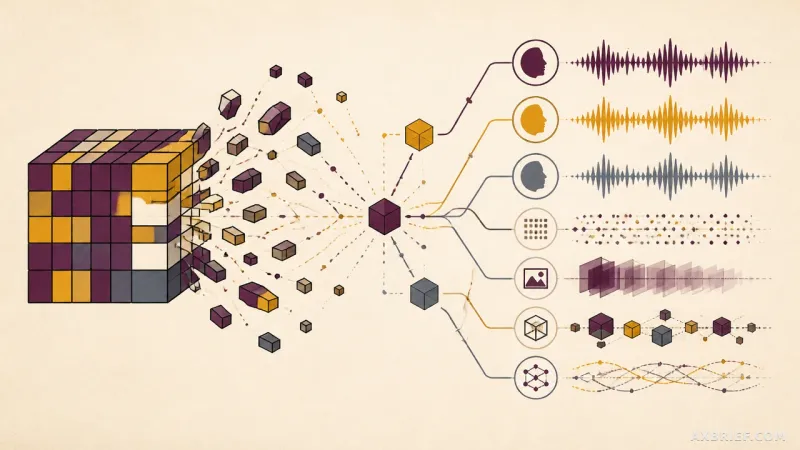
Audio engineers and developers looking for a private, localized solution to track isolation can now deploy StemDeck, an open-source desktop application designed to split music files and YouTube URLs into up to six distinct stems including vocals, drums, bass, guitar, piano, and other instruments.
Local Execution Architecture and Installation Requirements
StemDeck is built around Meta AI's six-track neural network Demucs (htdemucs_6s), utilizing PyTorch to automatically detect and leverage available hardware acceleration. The application identifies NVIDIA GPUs via CUDA, Apple Silicon via MPS, and falls back to CPU processing on other systems. The backend is constructed with FastAPI using REST and Server-Sent Events (SSE), while the frontend uses vanilla JavaScript with the Web Audio API to render waveforms onto an HTML5 Canvas. For the desktop shell, the application adopts Tauri v2, building with Rust and WKWebView on macOS and Rust and WebView2 on Windows.
Users can run the application across multiple operating systems with tailored packaging. On macOS, users download a DMG file and move it to the application folder, triggering an automatic download of a Python runtime, FFmpeg, and the Demucs model weights during the initial setup. On Windows, users extract the archive and launch StemDeck.exe, storing dependencies in a local data folder rather than AppData. For source builds, developers need Python 3.12, Rust, Node.js, and the uv package manager. Container environments can access pre-built GHCR images and Unraid community applications, using the `--runtime=nvidia` flag for GPU acceleration.
DAW-Style Mixer and Audio Analysis Features
The interface provides a multitrack mixer equipped with track-specific volume faders, mute, solo, and monitoring controls that synchronize across preview mixers and sidebar states. Live VU meters powered by Web Audio analyzers use post-gain RMS calculations with peak hold and slow falloff. Users can click track chips to select specific stem combinations, where clicking a single stem isolates that track. Selecting a subset of stems automatically generates a seventh backing track lane named Original, which combines all unselected elements for direct A/B comparisons. Users can also merge chosen stem combinations into a single mix.wav file using ffmpeg amix.
The audio analysis pipeline integrates a librosa-based beat tracker to measure BPM, key, scale, and confidence scores, alongside a pyloudnorm integration adhering to the ITU-R BS.1770 standard for integrated LUFS and dBFS sample peak measurements. Task management allows users to cancel active pipelines at any time, terminating child processes, purging temporary directories, and returning the application to an idle state. The library panel supports folder-based management, drag-and-drop operations, search filters, and trash management, defaulting to `~/Documents/StemDeck` for file storage.
Practical Deployment Constraints and Considerations
Teams adopting StemDeck must evaluate its positioning against commercial cloud services like Moises or LALAL.AI. StemDeck is engineered as a local tool for personal study and research, meaning it lacks mobile applications and advanced commercial musician suites. The YouTube URL input is provided as a convenience feature for authorized content, and users must manage copyright responsibilities independently since automated downloading may interact with platform terms of service. Operators must account for initial model download delays, potential performance bottlenecks during CPU-only execution, and startup log checks to verify that PyTorch properly detects CUDA or MPS acceleration.