The current trajectory of artificial intelligence is defined by an insatiable hunger for compute. While the industry chases trillion-parameter giants housed in massive data centers, a quiet counter-movement is emerging among embedded engineers. The goal is no longer just about scaling up, but about scaling down to the absolute limit of the silicon. This week, the conversation shifted from high-end GPUs to a microcontroller that costs less than a fast-food meal, proving that the boundary between a simple chip and a generative agent is thinner than previously thought.
The Architecture of Extreme Edge AI
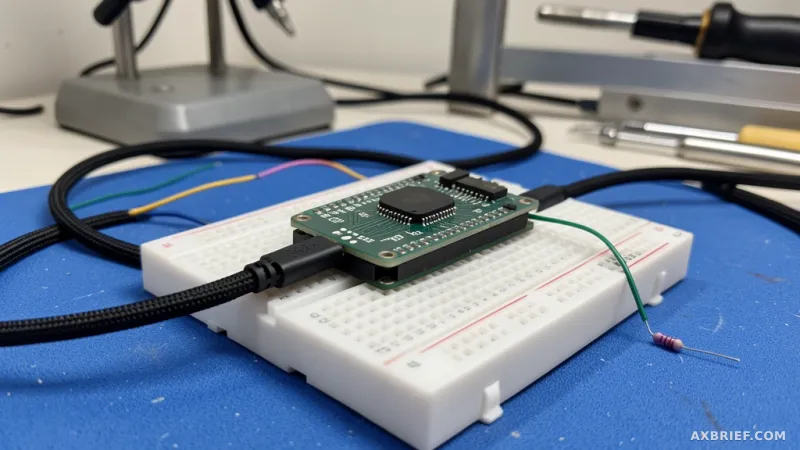
At the center of this experiment is the ESP32-S3, a low-cost microcontroller typically priced around $8. In a setup that requires zero server connectivity, this chip successfully drives a language model boasting 28.9 million parameters. The system is entirely self-contained, processing all computations on-chip and outputting text directly to a small physically connected screen. In terms of raw performance, the device generates text at a rate of approximately 9 tokens per second, maintaining a fully local environment where no data ever leaves the hardware.
To make this possible, the model was trained on the TinyStories dataset, a specialized collection designed to teach models how to construct short, simple narratives with linguistic consistency. Because the model is optimized for this specific niche, it excels at weaving basic tales but lacks the cognitive breadth for general-purpose utility. It cannot answer complex questions, follow intricate instructions, or write functional programming code. These limitations are not a failure of software, but a direct result of the physical constraints of the inference engine's size.
Breaking the SRAM Bottleneck with Gemma Techniques
To understand why a 28.9 million parameter model on an ESP32-S3 is significant, one must look at the previous state of the art for similar hardware. Prior attempts to run LLMs on these chips typically topped out at around 260,000 parameters. This new implementation represents a nearly 100-fold increase in model scale, moving the needle from primitive token prediction to actual narrative generation. The primary obstacle to this growth is the ESP32-S3's SRAM, which is capped at a meager 512KB. In traditional LLM deployments, the model weights must reside in fast-access memory to avoid crippling latency, which effectively limits the model size to the size of the SRAM.
The breakthrough comes from adopting the Per-Layer Embeddings technique utilized in Google's Gemma models. Instead of attempting to load the entire model into the limited SRAM, the developers implemented a strategy that leverages the chip's larger but slower flash memory. By placing the bulk of the model parameters in flash memory and keeping only the active computational fragments in the fast SRAM, the system bypasses the traditional memory ceiling. This approach treats the flash memory as a massive lookup table consisting of 25 million rows.
When the model processes a token, it does not scan the entire weight matrix. Instead, it selectively retrieves only the specific rows required for that token, reading approximately 450 bytes of data per operation. This surgical approach to memory access minimizes the bottleneck caused by the speed difference between flash and SRAM, allowing a model that is physically too large for the chip's memory to function in real-time. This optimization proves that the perceived limit of on-device AI is often a software architecture problem rather than a hardware impossibility.
The conceptual foundation for this project draws heavily from Andrej Karpathy's llama2.c, which demonstrated that pure C implementations of language models could be highly efficient. By stripping away the overhead of heavy frameworks and focusing on raw memory layout, this implementation moves the theory of tiny LLMs into a practical, deployable reality. Detailed implementation paths, including firmware configurations, wiring diagrams, and flashing instructions, are documented in `firmware/esp32_llm/README.md`, while the specific on-chip performance metrics are recorded in `RESULTS.md`.
While the memory tricks allow the model to grow in size, the fundamental nature of the hardware still dictates the ceiling of intelligence. Because the high-level reasoning capabilities of an LLM are tied to the complexity of the weights residing in the active inference area, the ESP32-S3 remains a storyteller rather than a strategist. The result is a device that cannot solve a math problem or debug a script, but can maintain a coherent thread of a story entirely offline.
This shift toward extreme quantization and creative memory mapping suggests a future where basic generative capabilities are embedded in every household appliance and industrial sensor, independent of the cloud.