
The modern corporate landscape has been defined by a singular, chilling narrative: the Great Replacement. For the past two years, Big Tech has treated mass layoffs not merely as a fiscal correction, but as a strategic pivot toward an automated future. In boardrooms from Mountain View to Menlo Park, the prevailing belief was that generative AI would soon evolve into autonomous agents capable of absorbing the roles of thousands of mid-level engineers and managers. This belief provided a convenient moral and economic justification for slashing headcounts, leaving a trail of anxious professionals wondering if their specific skill set had become a legacy system overnight.
The Gap Between Optimism and Execution
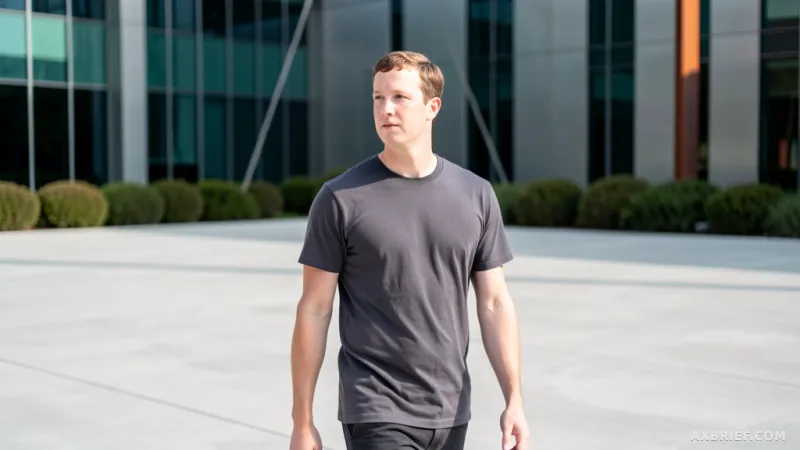
This narrative recently hit a wall of reality at Meta. During a recent internal town hall, Mark Zuckerberg admitted that the development trajectory of agentic AI—systems designed to execute complex tasks independently on behalf of a user—has not accelerated in the way the company anticipated. Specifically, Zuckerberg noted that the pace of development over the last four months has fallen short of internal expectations. This admission is significant because it reveals a disconnect between Meta's organizational bets and the actual technical output of its AI labs.
The tension within Meta reached a breaking point between January and February, during a period of intense restructuring. Internal reports suggest a deep divide existed between the company's top-tier technical talent and its executive leadership. While the engineers expressed urgent concerns that Meta was falling behind the rapid curve of AI evolution, the management team responded with a surge of optimism. This optimism was fueled largely by the perceived capabilities of external tools, most notably Anthropic's Claude Code. Management viewed the success of such coding assistants as a signal that human programmers were becoming redundant, leading to a push for aggressive workforce efficiency.
This clash of perspectives resulted in a strategic gamble: Meta preemptively reduced its human workforce under the assumption that AI agents would fill the void almost immediately. The company bet that the transition from AI as a chatbot to AI as an autonomous worker would be a seamless leap. However, the reality of the last few months has proven that the gap between a helpful coding assistant and a fully autonomous agent is wider and more complex than the executive suite had calculated.
The Cost of Wrong Premises
Technical gaps in the AI industry can shift the power dynamics of a trillion-dollar company in a matter of weeks. The source of Meta's current crisis can be traced back to December 2025, following the success of Claude Code. Zuckerberg concluded that Meta had lost the race to develop a coding agent capable of writing and modifying its own codebase. In a sudden move to course-correct, he restructured the organization, granting Alexandr Wang, the head of Meta AI, sweeping authority across the company. This shift demonstrates how the success of a competitor's product can instantly dismantle an internal hierarchy and force a total strategic pivot.
This pattern of relying on flawed premises is not new for Meta. In 2023, the company was slow to react to the initial generative AI boom because it was still deeply entrenched in its metaverse strategy. Zuckerberg had operated on the assumption that the pandemic would permanently shift human interaction toward virtual reality, leading him to ignore the nascent shifts in Large Language Models. By the time Meta realized the metaverse was not the immediate future of social interaction, it had already lost critical ground to OpenAI and Google. The current struggle with AI agents is a mirror image of the metaverse failure: a strategic blindness caused by an over-reliance on a specific, incorrect hypothesis about human behavior and technology.
In an attempt to force the acceleration of AI agents, Meta's leadership turned to a more invasive strategy. After laying off thousands of employees to cut costs, the company shifted its remaining resources toward hiring a concentrated group of AI engineers. To bridge the productivity gap, Meta implemented AI-driven content moderation and, more controversially, required remaining staff to install computer usage tracking tools. The goal was to capture the granular, second-by-second data of how skilled humans actually perform their jobs. Meta intended to use this telemetry as training data for the very agents meant to replace those humans, essentially attempting to digitize professional intuition through surveillance.
However, this attempt to automate expertise through data collection failed to produce the expected acceleration. The experience revealed a fundamental technical truth: recording a human's workflow is not the same as teaching an AI to reason through a complex problem. The failure was not a matter of processing power or data volume, but a failure of strategy. By overestimating the immediate substitutability of human labor, Meta engaged in a strategic miscalculation that differed from the delays of 2023. This was not a case of being too slow, but of being too aggressive based on a false premise.
True competitive advantage in the AI era will not be found in the scale of layoffs or the volume of surveillance data, but in the precise definition of which tasks can actually be automated without collapsing the system's reliability.



