The current race for AI alignment has largely been a technical skirmish fought with reward models and reinforcement learning from human feedback. Developers and researchers have spent the last few years obsessing over how to stop a model from hallucinating or leaking passwords, treating the problem as a series of edge cases to be patched. But while Silicon Valley focuses on the plumbing of safety, a much older institution is attempting to define the architecture of the house. This week, the conversation shifted from technical guardrails to moral foundations as the Vatican stepped directly into the governance of generative AI.
The Architecture of Magnifica Humanitas
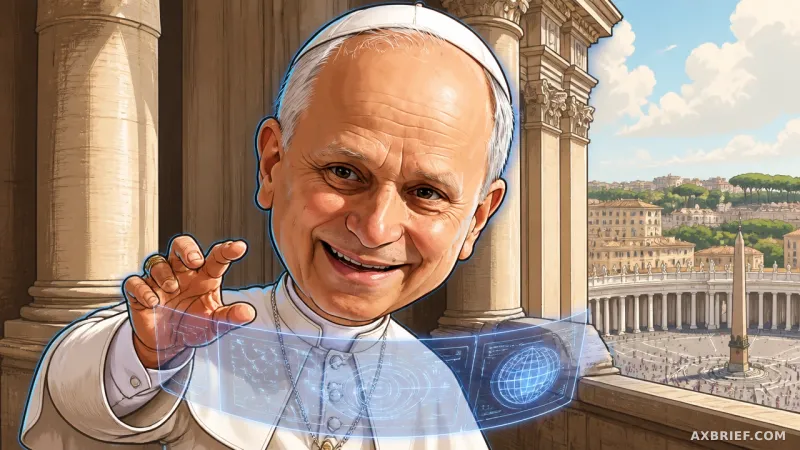
Pope Leo XIV has unveiled Magnifica Humanitas, a comprehensive encyclical that pivots the AI conversation away from the capabilities of the technology and toward the purpose assigned to it by its creators. The document does not shy away from the immediate anxieties of the digital age, explicitly naming job displacement, the proliferation of misinformation, the rise of autonomous weapons, and algorithmic discrimination as critical risks. However, the Vatican introduces a philosophical reversal that challenges the standard industry approach to optimization. Rather than viewing human flaws and limitations as errors to be corrected by a more efficient machine, the encyclical frames these imperfections as the very conditions necessary for human prosperity. The central demand is a rigorous audit of whether AI promotes genuine intimacy, justice, and peace in human relationships, or merely simulates them.
To ensure this was not merely a theological exercise, the Vatican built a sophisticated advisory apparatus. The effort was spearheaded by the Pontifical Academy of Sciences (PAS), which consists of 80 members from 36 different countries, alongside the Pontifical Academy of Social Sciences (PASS), which focuses on ethics and social justice. Just before the public release in May, the Vatican further institutionalized this approach by launching an Inter-departmental AI Committee. This body brings together representatives from seven different Vatican agencies, including those overseeing doctrine, education, and human development, ensuring that the resulting guidelines are grounded in both scientific reality and ecclesiastical tradition.
From Moral Declarations to Model Weights
What distinguishes Magnifica Humanitas from previous religious statements on technology is its direct line into the weights and biases of leading models. This is most evident in the relationship between the Vatican and Anthropic. The AI safety firm invited 15 Christian leaders to share the inner workings of their model development and operation. This collaboration led to the integration of Catholic thought into the draft of the Claude Constitution, the set of principles that governs how the model Claude evaluates its own responses. Internally, this process is linked to a document known as the soul doc, a moral blueprint designed to ensure the machine does not simply mirror the existing good and evil of the internet, but actively aspires toward a defined moral good.
This transition from theory to practice is backed by significant capital and political leverage. The Vatican has a historical track record of turning encyclicals into systemic shifts. The Rerum Novarum of the industrial era provided the moral scaffolding for labor unions and living wage laws, eventually influencing New Deal legislation in the United States. Similarly, the 2015 Laudato Si' encyclical on climate change led more than 300 Catholic institutions to divest from fossil fuels. We are seeing that same pattern emerge now with AI. The Lilly Endowment, the largest shareholder of Eli Lilly & Co., has committed $50.8 million to the University of Notre Dame for 2025 to develop a faith-based AI ethics framework. This investment transforms religious ethics into an academic and practical guideline that corporations and developers can actually implement.
Beyond the money, the Vatican operates through a powerful human network. In the 119th United States Congress, 28% of members are Catholic, and six of the nine Supreme Court justices come from Catholic backgrounds. When the Pope establishes a moral vocabulary, it often becomes the invisible infrastructure for legal and policy decisions. This influence is already manifesting in the courts. When Anthropic was recently flagged for supply chain risks, 14 Catholic theologians filed an amicus brief in support of the company, demonstrating that the Church is willing to use its institutional weight to protect AI firms that align with its ethical vision.
For AI practitioners, this signals that the scope of governance is expanding. Alignment is no longer just about technical safety or universal human rights; it is becoming a choice between competing value systems. Global companies must now recognize that the ethical standards of a massive religious bloc can translate directly into divestment movements or legislative pressure. The critical signal to watch moving forward will be the specific checklists produced by the University of Notre Dame. The moment these faith-based guidelines are adopted into corporate AI policies or cited in government standards, the Vatican's moral vocabulary will have officially become a piece of global technical infrastructure.