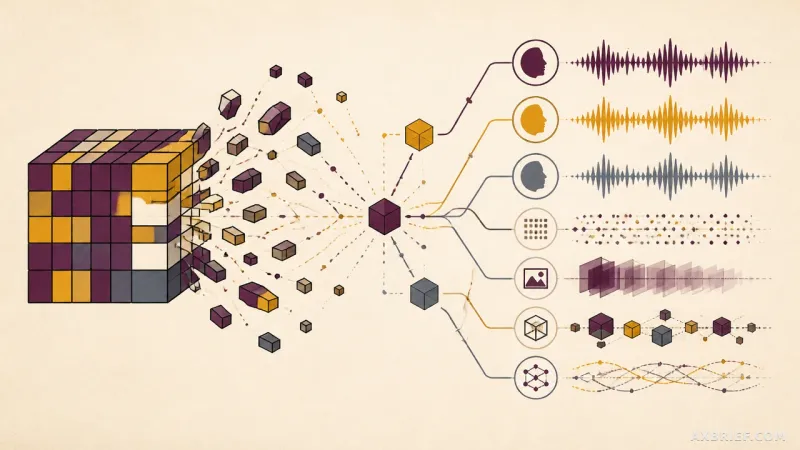
Imagine a developer in the middle of a critical deployment, relying on a suite of LLMs to debug code and generate documentation. Suddenly, the API response from ChatGPT returns a 404. The developer quickly switches to Claude, only to find the interface unresponsive. In a final attempt, they pivot to Grok, but the model fails to process the request. For a few hours between September 3 and September 4, this scenario became a reality for thousands of users as the world's leading AI services appeared to collapse in a synchronized wave of instability.
The Anatomy of a Triple Outage
The disruptions began on the night of September 3 and stretched into the early hours of September 4. While the timing suggested a systemic failure of the internet's backbone, the technical post-mortems revealed a fragmented reality. There was no single point of failure in the shared infrastructure; Cloudflare, AWS, and Microsoft Azure reported no widespread outages that could account for the simultaneous downtime.
SpaceX reported that Grok's instability was rooted in a localized failure at the Memphis compute center, the massive server facility responsible for processing the model's data. The outage began at 10:30 PM on September 3, affecting Grok across the web, iOS, Android, and the X platform. Recovery happened in stages, with Android services returning at 2:04 AM and web services following at 2:07 AM on September 4. SpaceX issued apologies to the affected compute partners following the restoration.
OpenAI faced a different struggle. Between 11:43 PM on September 3 and 1:55 AM on September 4, a significant number of users encountered 404 Not Found errors when attempting to access ChatGPT and Codex. OpenAI attributed this to a routing error. In networking, routing acts as the digital signage that directs data packets to the correct destination server. When these signs are misconfigured, users are sent to non-existent paths, effectively severing the connection to the service. OpenAI applied a mitigation strategy around 12:17 AM on September 4 before declaring a full recovery.
Anthropic's Claude experienced the earliest onset of trouble, with error rates spiking at 10:26 PM on September 3. Unlike the other outages, Claude's failure was widespread across multiple model versions, including Mythos/Fable 5.1, Opus 5, Opus 4.8, and Opus 4.6. The service remained unstable until 1:16 AM on September 4. While Anthropic confirmed that the issue was identified and resolved, the company remained vague about the specific technical cause, providing no detailed explanation for why multiple model versions failed simultaneously.
The Thundering Herd and the Failover Trap
If the outages were caused by three unrelated technical failures—a compute center crash, a routing error, and an undisclosed Anthropic bug—the question remains: why did they happen at the exact same time? The answer likely lies not in the hardware, but in human and algorithmic behavior. This phenomenon is known in distributed systems as the thundering herd effect.
In a thundering herd scenario, a failure in one system triggers a massive, simultaneous migration of users to a secondary system. When ChatGPT went dark, a tidal wave of users immediately pivoted to Claude. This sudden, unplanned surge in traffic can overwhelm even the most robust infrastructure, pushing a stable system over the edge into a state of instability. As Claude began to falter under the redirected load, users shifted again, this time toward Grok, propagating the overload across the AI ecosystem like a falling row of dominoes.
This risk is amplified by the rise of multi-model strategies. Many enterprise AI applications now implement automated failover mechanisms. These are scripts designed to automatically switch the API endpoint from one provider to another if the primary service returns an error. While this is intended to ensure high availability, it creates a dangerous feedback loop. An automated failover doesn't just move a few users; it moves millions of requests in milliseconds. This transforms a localized outage into a systemic contagion, where the very tools designed to provide redundancy actually accelerate the collapse of competing services.
The Fragility of the AI Stack
The simultaneous failure of these giants reveals a critical vulnerability in how the industry approaches AI reliability. Relying on a simple failover to a competitor is no longer a safe bet when the user base is large enough to crash the alternative.
True resilience will require more sophisticated traffic shaping and circuit-breaker patterns that prevent a thundering herd from migrating in a single, destructive burst.