The design industry is currently obsessed with the shortest path between a prompt and a product. From the rapid prototyping of Midjourney to the structural drafting of ChatGPT, the prevailing logic is one of compression. Agencies and freelancers are racing to strip away the friction of production, treating the creative process as a series of bottlenecks to be optimized. In this climate, efficiency is the only currency that matters, and the tools that can reduce a week of labor into a few seconds of GPU compute are hailed as the new standard.
Yet, amidst this rush toward automation, one font foundry has taken a radical stand. They have issued a total rejection of generative AI across their entire design and production pipeline. While their competitors lean into the convenience of algorithmic generation, this studio views the AI-driven path not as a shortcut to excellence, but as a scenic route leading directly into a desert. For them, the convenience offered by these tools is fundamentally decoupled from the actual goal of typography, which is the expression of human identity through form.
The Shadow of the Data Set
To understand why a professional studio would intentionally handicap its speed in an era of instant generation, one must look at the nature of the training data. The foundry posits that generative AI does not perceive reality; it perceives a finite, frozen snapshot of it. Most current models rely on datasets that effectively end around 2021, creating a temporal ceiling on what the AI can "know" or "imagine."
This limitation is described through the lens of Plato's Cave. In the allegory, prisoners mistake the shadows cast on a wall for the actual objects in the physical world. The foundry argues that AI is the ultimate shadow-player. It is incredibly adept at recombining existing fragments of data to create a sophisticated puppet show, but it possesses no capacity to step outside the cave and observe the living, breathing world. It cannot witness a new architectural trend in a remote city or feel the texture of a handmade paper; it can only rearrange the pixels of things that have already been digitized.
This reliance on historical data creates a dangerous feedback loop. When AI generates a font based on the statistical average of existing typefaces, it doesn't create something new—it creates a refined average. This process actively erodes creative diversity. The most alarming consequence is the potential erasure of minority cultural visual languages. If a culture's typographic tradition is not well-represented in the massive datasets used by companies like OpenAI or Midjourney, that language becomes invisible to the machine. The AI does not seek to expand the visual vocabulary of the world; it seeks to collapse it into the most probable outcome based on the most available data.
The Friction of the Human Wrist
The core of the foundry's resistance lies in the belief that beauty is a byproduct of physical struggle. A digital output that is perfectly smooth, devoid of the microscopic tremors of a human hand or the resistance of a physical tool, is viewed not as a triumph of precision, but as a failure of soul. Typography is not a collection of abstract geometric shapes; it is a biological record of human evolution and physical constraint.
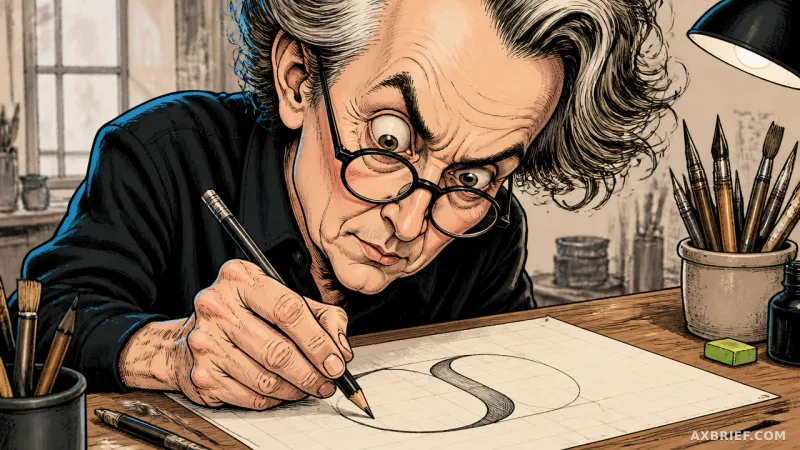
Consider the letter A. Its form did not emerge from a vacuum of aesthetic preference but evolved from a primitive drawing of an ox head. Even the serif—the small decorative stroke at the end of a letter's main stem—is a fossil of a physical action. In ancient Rome, scribes using flat brushes in their right hands would make a short, horizontal flick at the start and end of a stroke to ensure a clean line. The serif is not a "design choice" in the modern sense; it is the physical signature of a human wrist interacting with a tool and a surface.
This is where the fundamental divide between human and machine emerges. When Midjourney is prompted to draw an ox, it does not evoke the emotional concept of a homeland or the smell of earth; it calculates the statistical probability of pixel placement. ChatGPT cannot invent a new calligraphy technique because it has no wrist to ache and no physical limitation to overcome.
Historically, artistic breakthroughs happen when a creator feels a physical discomfort or a technical limitation and attempts to solve it. The evolution of a style often begins with a mistake, a slip of the hand, or a struggle against the medium. Because AI feels no pain, no frustration, and no physical resistance, it is incapable of the creative leap that comes from overcoming a hurdle. It generates forms based on probability, whereas humans generate forms based on experience.
This gap creates a critical bottleneck for non-mainstream languages. Generative AI works efficiently only for languages with massive amounts of training data. For the countless languages and dialects of the world that lack digital dominance, the AI offers no help. In fact, it threatens to close the door permanently. As the market shifts toward AI-generated content, the economic viability of local designers—those who understand the specific cultural nuances and physical histories of their own scripts—diminishes. If the ecosystem that supports these specialists collapses, the visual languages of marginalized cultures will either be absorbed into a homogenized global average or vanish entirely.
In a world where the distance between thought and image has been reduced to zero, the only remaining point of differentiation is the presence of human motivation. The Roman scribe's brush angle created the serif, and the human hand's imperfection created the art. The true value of a typeface now lies not in its visual perfection, but in whether it is a fragment of a statistical probability or a record of a living, breathing human experience.