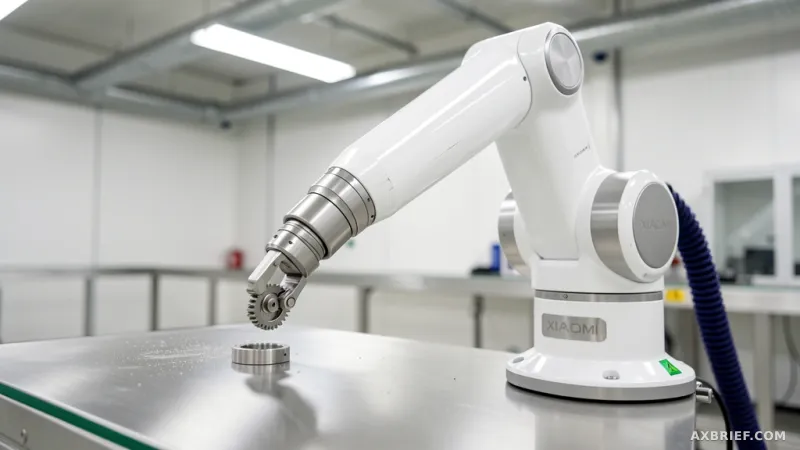
The robotics community has long been haunted by the data bottleneck. While large language models feast on the nearly infinite expanse of the internet, robots are trapped in the physical world, where every single hour of high-quality training data requires expensive hardware, human supervision, and tedious manual labeling. For years, the industry has struggled to move beyond narrow, task-specific policies that break the moment a coffee mug is moved two inches to the left. The prevailing tension has been a choice between the precision of narrow training and the fragility of general-purpose models.
The Architecture of Xiaomi-Robotics-1
Xiaomi is attempting to break this deadlock with the release of Xiaomi-Robotics-1, abbreviated as XR-1. This robot foundation model is built on a massive scale of pre-training, utilizing 100,000 hours of robot-agnostic UMI (Universal Manipulation Interface) trajectories. The model employs a two-stage learning structure designed to first master general behavioral generation before refining those skills through real-world robot data. The pre-training phase is expansive, covering more than 1,700 distinct scenarios across residential homes, commercial facilities, industrial sites, and outdoor environments.
To move from general knowledge to specific utility, Xiaomi implemented a subsequent learning stage. This phase integrated over 7,200 hours of proprietary real-world home robot data, focusing on domestic chores such as organizing sofas, sorting shoe racks, and storing kitchenware. This was supplemented by filtered open-source datasets and high-quality UMI data annotated by humans. The resulting performance gains are stark when compared to the baseline model, Ï0.5. In tasks requiring fewer than 10 hours of demonstration, XR-1 achieved a comprehensive success rate of 75%, while Ï0.5 managed only 40%. When the demonstration time increased to under 40 hours, XR-1's success rate climbed to 85%, compared to 53% for the baseline.
Specific task performance under the 10-hour demonstration threshold further illustrates this capability. XR-1 reached success rates of 70% for phone packing and printer refilling, and 80% for both laundry insertion and box packing. The model also dominated four major simulation benchmarks. In RoboCasa, it scored 74.5%, a 2.6%p lead over the runner-up. In RoboCasa365, it hit 57.4%, outperforming the second-place model by 23.2%p. VLABench saw a score of 59.1%, an 11.1%p improvement, while RoboDojo recorded a score of 13.93%, which is 58.3%p higher than the next best performer.
Decoupling Intent from Execution
The technical breakthrough of XR-1 lies in how it handles the sheer volume of data. Manually annotating 100,000 hours of video is a logistical impossibility. To solve this, Xiaomi developed an automated annotation pipeline powered by a Vision-Language Model (VLM). The system first segments long videos into fixed-length clips. The VLM then analyzes these clips to describe the state changes of the gripper and the interacting objects in natural language. By learning to generate actions that match these linguistic state-transition descriptions, the model acquires a generalized representation of behavior that is entirely independent of any specific robot's physical form.
This creates a critical separation between behavioral intent and physical execution. In the second stage of learning, Xiaomi performs two distinct alignment processes. The first is robot morphological alignment, where the abstract behavioral capabilities learned during pre-training are mapped to the specific joint controls and actuation methods of a physical robot. The second is command alignment. This transforms the model from one that responds to state-transition descriptions into one that understands and executes direct natural language commands from a user. Unlike the automated pre-training, this alignment phase uses UMI data where humans have manually annotated time intervals and command prompts to ensure high precision.
This architecture reveals a fundamental shift in robot training: the ability to scale. Xiaomi's research indicates that as the volume of pre-training data and the number of model parameters increase, the verification behavior error consistently decreases. More importantly, improvements in the pre-trained model translate directly into higher success rates for real-world robots. To date, the team has observed no signs of performance saturation, suggesting that the ceiling for this approach is significantly higher than previously thought.
For developers and robotics engineers, the primary impact is the drastic reduction in the cost of adapting to new tasks. The traditional requirement for massive amounts of task-specific, high-quality data has been a primary barrier to deployment. XR-1 mitigates this by allowing a robot to achieve an 80% success rate in a task like laundry insertion with less than 10 hours of demonstration, reaching 100% success with under 40 hours. This demonstrates that a foundation model's generalization capabilities can replace the need for exhaustive data collection in every new environment.
By providing a predictable performance curve even when encountering unseen environments and object instances, XR-1 increases operational reliability. The strategy for deployment shifts from training a model from scratch for every single task to utilizing a massive UMI pre-trained base and adding a minimal layer of real-world demonstrations for rapid adaptation.
This shift toward robot-agnostic foundation models suggests a future where physical hardware is merely a peripheral to a centralized behavioral intelligence.