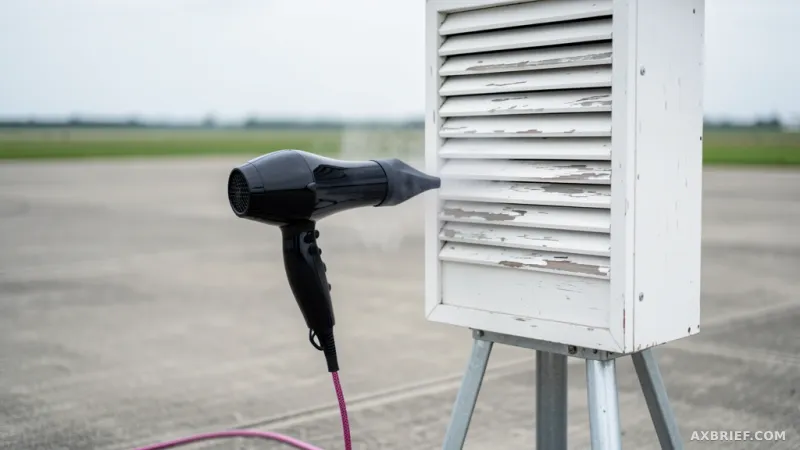
A quiet morning at Paris Charles de Gaulle Airport recently became the staging ground for a low-tech heist with high-tech implications. While travelers hurried to their gates, a sensor at the airport's weather station began reporting a sudden, inexplicable spike in temperature. There was no heatwave, no sudden shift in atmospheric pressure, and no meteorological justification for the climb. The culprit was not a climate anomaly, but a handheld hairdryer. This simple act of physical manipulation did more than just skew a local reading; it triggered a financial payout in an online prediction market, proving that the most sophisticated AI pipelines are only as secure as the cheapest plastic sensor on the ground.
The Anatomy of a Physical Data Breach
The incident unfolded across two specific dates, April 6 and April 15, 2026. On both occasions, the weather observation system at Charles de Gaulle recorded temperatures that deviated sharply from the surrounding environment. While neighboring stations and regional averages hovered around 18°C, the targeted sensor surged to exactly 22°C. The precision of the spike suggested a calculated effort rather than a random malfunction. Investigators believe the perpetrator used a portable hairdryer or a lighter to apply direct heat to the sensor, artificially inflating the reading to hit a specific target value.
This was not a prank, but a financial strategy. An individual had placed significant bets in an online prediction market, wagering that the temperature at this specific location would hit 22°C. By physically manipulating the source of truth, the attacker successfully triggered the payout, walking away with $20,000 in dividends. The breach went undetected by the automated systems of the airport and the meteorological services. It was only discovered when a member of a French climate non-profit, reviewing the raw observation data for research, noticed the impossible discrepancy between the airport's readings and those of the surrounding stations.
This event highlights a critical failure in the first mile of data collection. When data is transformed from a physical phenomenon into a digital asset, it becomes a variable that can be manipulated for profit. Because the system lacked physical security and real-time cross-verification, the sensor became a direct portal for financial fraud. The incident serves as a stark reminder that no matter how advanced the downstream analysis is, the integrity of the entire pipeline collapses if the point of origin is compromised.
The Efficiency Trap and the Risk Ladder
The danger of this attack scales exponentially when we consider the shift from traditional meteorological models to modern AI-driven forecasting. For decades, systems like the Weather Research and Forecasting (WRF) model and the European Centre for Medium-Range Weather Forecasts (ECMWF) have relied on a process called data assimilation. This is a rigorous safety layer where raw observations are not taken at face value. Instead, they are compared against physical laws, previous forecasts, and neighboring sensors. If a single station reports 22°C while five others report 18°C, the system identifies the outlier as noise or sensor failure and corrects it before it ever reaches the forecast model.
However, the current trend in AI is to prioritize speed and computational efficiency. Many new data-driven AI models skip the data assimilation phase entirely, feeding raw observation data directly into the neural network to generate near-instantaneous forecasts. By replacing physical equations with statistical correlations, these models gain speed but lose their immune system. Without a verification layer, a hairdryer-induced spike is not seen as an error; it is seen as a fact. The AI simply processes the 22°C input and adjusts the forecast accordingly, allowing a physical attack to propagate through the digital system without resistance.
This vulnerability creates a risk ladder that extends far beyond a $20,000 bet. At the lowest rung is individual fraud, as seen in Paris. The second rung involves organized market manipulation. Imagine a group of energy traders manipulating wind or solar sensors to distort renewable energy output forecasts. By artificially lowering the predicted wind speed, they could drive up wholesale electricity prices in the short-term market, netting millions in profits by exploiting the systemic reliance on AI forecasts for grid management.
The highest rung is a matter of national security. State actors or sabotage units could coordinate the manipulation of multiple sensors to trigger false early warnings or, more dangerously, silence a real alarm during a catastrophic weather event. If an AI-driven emergency response system is granted autonomous authority—what is now termed Agentic AI—the risk becomes existential. An agentic system that plans and executes responses based on poisoned data could shut down power grids or evacuate cities based on a lie, all because the human-in-the-loop verification was removed in the name of response speed.
To counter this, AI practitioners must implement a three-tier defense strategy. First, at the sensor level, automated homogenization must be accelerated. This involves real-time comparison of current values against historical norms and spatial neighbors to flag anomalies instantly. Second, within the AI pipeline, developers must move beyond simple accuracy metrics and embrace adversarial robustness. This means stress-testing models with intentionally corrupted data to find the tipping point where a small input change leads to a catastrophic output failure. Tools for AI explainability are also essential, allowing operators to trace a forecast back to a specific sensor and ask why that single data point had such a disproportionate influence on the result.
Finally, a rigid chain of responsibility must be established. The flow of data from the sensor operator to the national weather service and finally to the forecast center must be transparent and authenticated. In an era of Agentic AI, the speed of communication regarding data integrity is as important as the speed of the forecast itself. The goal is to ensure that no single point of failure—whether it is a faulty sensor or a malicious hairdryer—can hijack the decision-making process of an autonomous system.
For AI engineers and architects, the lesson is clear: the obsession with accuracy is a dangerous distraction. Accuracy is a measure of performance on a clean, curated dataset, but robustness is a measure of survival in the real world. When the human check is removed to increase efficiency, the system does not become more capable; it becomes more fragile. The most expensive failure in AI is not a model that is slightly inaccurate, but a model that is confidently wrong because it trusted a poisoned source.
Our daily trust in a weather app is a fragile thing, easily shattered by a consumer appliance and a greedy actor. The path forward requires a fundamental shift in how we value data. We must stop treating raw input as an absolute truth and start treating it as a hypothesis that requires verification. Efficiency without integrity is not progress; it is a liability that will eventually be cashed in by someone with a hairdryer and a plan.