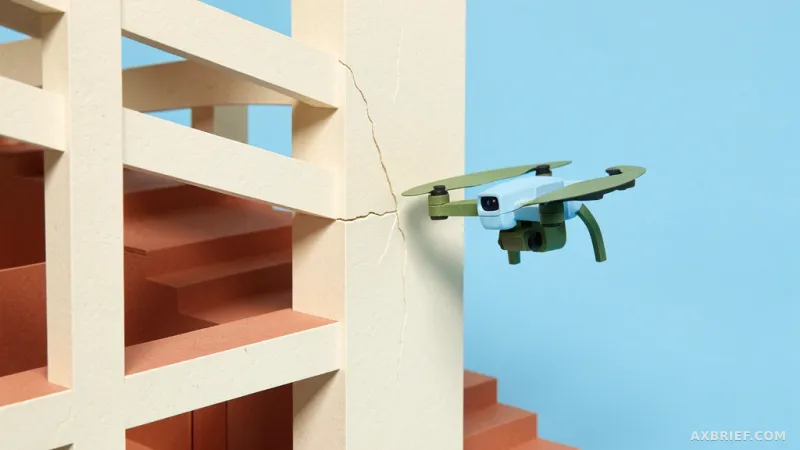
The standard facility inspection workflow hasn't changed much in decades: a worker hangs from a rope, climbs scaffolding, or rides a boom lift to eyeball concrete and steel for cracks. Every year, someone risks a fall to check the same high-rise wall, the same roof truss, the same light tower. This week, that script flipped at a baseball stadium in South Korea.
SierraBase, an AI and robotics company based in Seoul, deployed its autonomous drone Sirius Wing at Changwon NC Park — home of the NC Dinos — to inspect the stadium's exterior walls, roof structures, light towers, and upper seating sections. The work was part of a broader initiative by the Changwon Facility Corporation, which claims this is the first time a local public institution in South Korea has built a dedicated autonomous drone inspection system. The project was conducted in collaboration with the Changwon Unmanned Aviation Training Center.
What Sirius Wing Inspected and Why It Matters
The inspection targets were all high-risk zones where human access is either dangerous or impractical: the upper exterior walls, the roof structure, the light towers, and the upper seating areas. These are the spots where traditional rope-access teams or aerial lifts struggle to maintain consistent coverage, and where visual inspection quality depends heavily on the inspector's physical condition and experience on any given day.
Sirius Wing flew a pre-programmed autonomous route through these zones, capturing data at consistent distances and angles. The result is a dataset that eliminates the subjective variability of human inspection — no missed spots because a worker was tired, no inconsistent angles because the lift couldn't reach. The Changwon Facility Corporation is now reviewing a shift from the current annual inspection cycle to a monthly capture-based system, with quarterly close-up imaging to track crack propagation, corrosion spread, and bolt loosening over time.
This isn't a one-off demo. The inspection was designed around operational efficiency and field safety from the start. By partnering with the Changwon Unmanned Aviation Training Center for flight safety protocols and aligning with the facility management's specific requirements, SierraBase validated that a single autonomous system can cover the full range of structural types — different heights, different materials, different risk profiles — without putting a single person in a harness.
360-Degree LiDAR SLAM and 0.1mm AI Crack Detection
Most autonomous drones rely on GPS for positioning. But GPS signals don't reach the underside of a light tower, the shadow side of a roof structure, or the narrow gap between a wall and a catwalk. In those environments, standard drone navigation degrades rapidly.
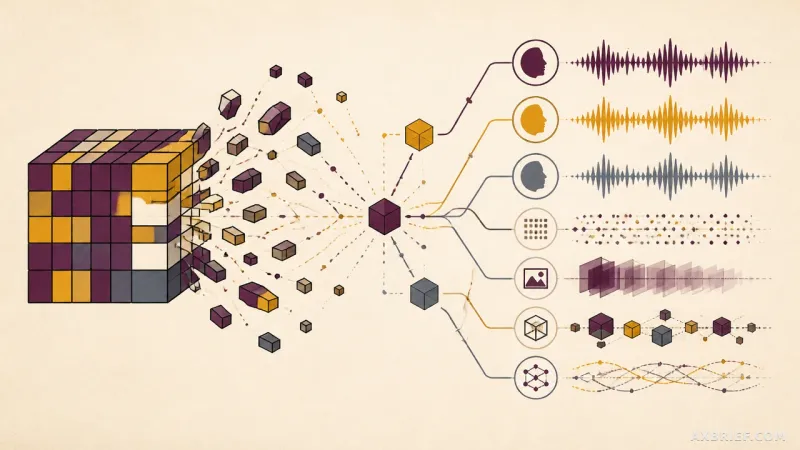
Sirius Wing solves this with a 360-degree rotating LiDAR-based SLAM system — Simultaneous Localization and Mapping. The drone builds a real-time 3D map of its surroundings while simultaneously tracking its own position within that map, all without satellite signals. The 360-degree rotating sensor minimizes blind spots and captures the geometric shape of structures quickly. The output is a precise 3D digital twin of the facility, generated in real time during flight.
Once the data is collected, the AI engine takes over. SierraBase trained its detection model on over 400,000 images of infrastructure defects — cracks, corrosion, loose fasteners. The system can identify cracks smaller than 0.1mm, which are virtually invisible to the human eye under field conditions. Instead of relying on an inspector's judgment about whether a hairline crack is 0.08mm or 0.15mm, the AI outputs pixel-level measurements of crack width and length, standardized across every inspection.
All detected defects are then fed into Sirius Editor, SierraBase's data analysis and report generation tool. The system automatically produces the visual inspection network diagrams and damage quantity tables that previously required manual cross-referencing of photos and handwritten notes. The 3D mapping data and AI detection results are combined on a coordinate basis, so the exact location and extent of each defect is pinned to the digital twin — and therefore to the physical structure. Repair crews know exactly where to go and what to fix.
From Annual Checkups to Monthly Data-Driven Monitoring
The old model of facility safety management is an annual full inspection. One visit per year. One snapshot in time. Between those snapshots, cracks grow, corrosion spreads, and bolts loosen — all invisible until the next inspector climbs up.
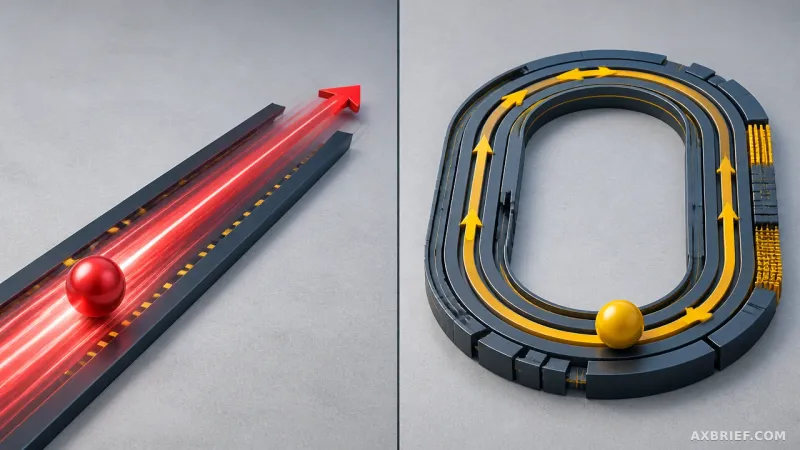
Changwon Facility Corporation is now evaluating a system that captures high-resolution data once per month. That's a 12x increase in inspection frequency. But the real shift isn't just the cadence — it's the ability to compare data over time. Quarterly close-up imaging lets engineers track the progression of a 0.1mm crack: Is it widening? Is it branching? How fast is the corrosion spreading across that steel bracket? These are questions that a single annual inspection cannot answer, because there's no baseline to compare against.
The new system also changes the response model. Instead of waiting for the annual report to identify problems, the monitoring platform can flag suspicious areas immediately after each capture. A specific coordinate on the digital twin shows an anomaly — the system alerts the facility manager, and a targeted inspection or repair can be scheduled before the defect becomes a hazard. This is a shift from reactive maintenance (fix it after it breaks) to preventive management (fix it before it becomes a problem).
The data itself becomes the inspection record, replacing the subjective notes of a human inspector with objective measurements and time-stamped imagery. The facility manager doesn't need to wonder whether the crack was there last year — the system has the pixel-level data to show exactly when it appeared and how it changed.
CES 2025 Best Innovation Award and the Global Infrastructure Play
SierraBase won the CES 2025 Best Innovation Award in the Smart City category, along with a Japan Good Design Award. Domestically, the company secured the Ministry of Land, Infrastructure and Transport's New Construction Technology certification and was selected as a Ministry of Science and ICT Global ICT Future Unicorn. These aren't just trophies — they're regulatory and market entry credentials. The construction technology certification, in particular, is a formal validation of technical feasibility within South Korea's conservative construction industry, which directly lowers barriers for public procurement and project expansion.
But the company's real competitive edge comes from over 200 field demonstrations conducted across bridges, tunnels, swimming pools, and other infrastructure in South Korea. Each demo exposed the AI model to different lighting conditions, different surface materials, and different structural geometries. For a machine learning system, this kind of edge-case exposure is more valuable than any benchmark score — it reduces false positives and improves detection precision in the unpredictable conditions of real-world facilities.
The global infrastructure inspection market currently lacks a unified technical standard. Different countries and companies apply different diagnostic criteria, which means the first player to establish a de facto standard gains significant market leverage. SierraBase is positioning its combination of global certifications and field data as the foundation for that standard — not just selling hardware, but proposing a standardized inspection process. In a market without rules, the company that defines the rules controls the ecosystem.
What This Means for Public Facility Management
Changwon NC Park's high exterior walls, roof structures, light towers, and upper seating sections are exactly the kind of high-risk zones that make facility managers nervous. Traditional inspection methods require putting people in those zones. The autonomous drone system removes that risk entirely. For the first time in South Korea's local public sector, a facility inspection was completed without a single person climbing a ladder or hanging from a rope.
The practical implication is straightforward: any facility with hard-to-reach structural elements — stadiums, bridges, dams, power plants, high-rise buildings — can now be inspected more frequently, more precisely, and more safely using the same approach. The technology exists, the certification exists, and the field data exists. The question is no longer whether autonomous inspection works, but how quickly public and private infrastructure managers will adopt it.