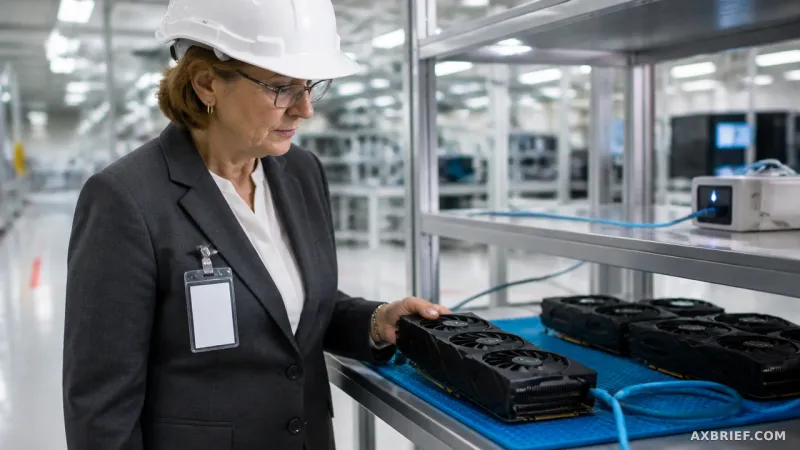
The monthly infrastructure bill for training and serving large AI models has become a line item that reshapes entire balance sheets. For the hyperscalers, the scramble for Nvidia’s H100 and Blackwell GPUs now dictates project timelines, hiring plans, and even product roadmaps. It is against this backdrop that Meta is making its most concrete move yet to reclaim control over its own compute destiny.
According to an internal memo seen by Reuters, Meta will begin mass production of its latest in-house AI accelerator chips in September 2025. At least one of the chips under development moved from design to a successful test phase in roughly six weeks, clearing the path for volume manufacturing. The company expects its 2025 capital expenditure to land between $125 billion and $145 billion, the vast majority of which is earmarked for AI infrastructure. A growing slice of that spend is now flowing toward custom silicon rather than off-the-shelf GPUs.
The MTIA Roadmap and a Chiplet Architecture
Meta publicly detailed four new chips in March under its Meta Training and Inference Accelerator program, laying out a phased deployment schedule that stretches into 2026. Some of these chips are already shipping in limited quantities; others will roll out across Meta’s data centers over the next twelve months. The program represents the company’s most aggressive push to decouple its AI workloads from any single hardware vendor.
The design philosophy departs sharply from the monolithic GPU approach. Meta has adopted a modular chiplet architecture that lets engineers mix and match individual components to tailor a single package for specific workloads. The supply chain reflects this modularity. Broadcom collaborates on the chip design. TSMC handles fabrication at its advanced nodes in Taiwan. Samsung supplies the RAM, Sandisk provides storage, and Sumitomo Electric contributes fiber-optic interconnect equipment. The result is a bespoke system-on-package tuned for Meta’s own software stack rather than a general-purpose accelerator that must serve every possible customer.
Meta is not alone in this pivot. OpenAI disclosed last month that it is working with Broadcom to develop a dedicated inference processor. Anthropic is reportedly exploring custom chip designs with Samsung. Amazon already operates its Trainium and Inferentia lines at scale, and Google’s TPU fleet has powered internal workloads for years. The direction of travel is unmistakable: the industry is moving from a GPU monoculture toward a landscape of workload-optimized silicon, and the speed of that transition is accelerating.
What the MTIA Actually Runs — and What It Doesn’t Replace
The MTIA chips are not designed to train a next-generation GPT-class foundation model from scratch. Meta is targeting a narrower, higher-volume set of workloads: the ranking and recommendation algorithms that sit inside Facebook, Instagram, and its family of apps, along with a broad range of inference tasks across its AI services. These workloads run continuously at planetary scale, and even a modest improvement in cost-per-inference translates into hundreds of millions of dollars saved annually.
This focus on inference and recommendation is the strategic linchpin. Training a single large language model is a bursty, capital-intensive event. Serving recommendations to billions of users every day is a steady-state operational cost. By optimizing silicon for the latter, Meta attacks the part of its AI bill that compounds month after month.
Crucially, the MTIA ramp does not mean Meta is walking away from Nvidia or AMD. The internal memo and public statements make clear that GPU procurement will remain substantial for the foreseeable future. Custom chips handle the predictable, high-volume inference pipeline. GPUs remain the workhorse for training runs, research experimentation, and workloads that demand the flexibility of CUDA. The infrastructure strategy is additive, not a wholesale replacement — at least for now.
The shift in thinking matters more than any single chip tape-out. For the past decade, the default answer to “we need more AI compute” was “order more GPUs.” That assumption is now broken. Engineering teams at Meta and its peers are evaluating hardware not as a commodity but as a configurable layer of the stack, where the cost-performance ratio of a custom inference chip versus a general-purpose GPU becomes a first-order design decision. Infrastructure architects who treat all silicon as interchangeable will find themselves on the wrong side of the cost curve within six months.
Meta’s September production start is a signal that the custom-silicon era has moved from experiment to execution. The question is no longer whether hyperscalers can design their own AI chips, but how quickly they can integrate them into every rack that serves a production model.