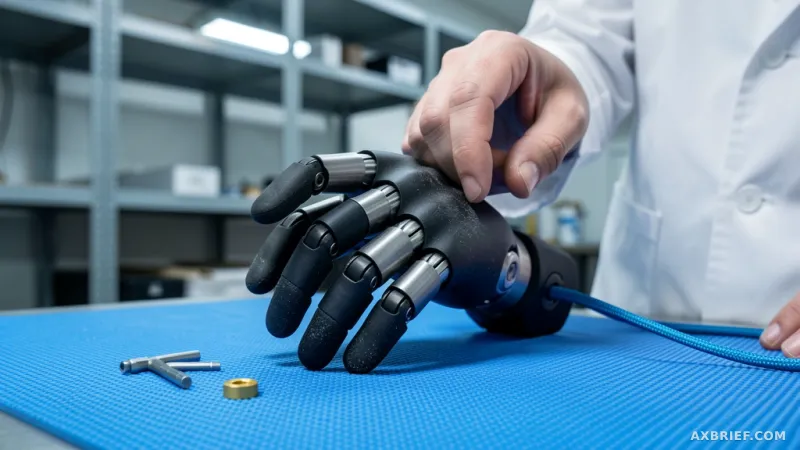
Engineers have long chased the ghost of human dexterity, yet the reality in the lab remains frustratingly clumsy. It is a common scene in robotics development: a multi-jointed hand that looks capable on a spec sheet fails the moment it encounters a real-world object, either slipping due to poor friction or crushing a delicate component because it lacks tactile nuance. For too long, the industry has relied on manufacturer-provided data that describes what a robot hand can do in a vacuum, rather than how it performs under the chaotic pressures of actual operation.
The Data-Driven Approach to Dexterity
To bridge this gap between theoretical specs and operational reality, Realworld has introduced All Hands Up, a comprehensive data platform that analyzes the design limits and inherent trade-offs of more than 10 different multi-jointed robot hands. Rather than offering a simple catalog, the platform establishes a rigorous set of benchmarks to quantify performance. Central to this evaluation is the Kapandji Scale, which measures the functional range of motion of the thumb, and the assessment of whether the Distal Interphalangeal joints—the fingertips—can be driven independently.
Beyond joint mobility, the platform tracks the minimum graspable diameter, defining the smallest object a hand can securely hold, alongside the specific friction characteristics of the external materials. To move beyond static measurements, Realworld implemented a proprietary benchmark called DexBench. This framework subjects the hardware to 18 distinct real-world manipulation tasks, providing a empirical score of how these hands handle diverse objects. With data updates scheduled quarterly, the platform transforms hardware selection from a guessing game into a precise engineering decision.
The Engineering Paradox: Strength vs Compliance
While a human hand seamlessly transitions from lifting a heavy suitcase to threading a needle, robot hands are trapped by a fundamental architectural conflict. The core of the issue lies in the relationship between motor size, gear ratios, and back-drivability. To keep a robot hand compact, engineers must use smaller motors, which naturally reduces grip strength. To compensate for this loss of power, they often increase the gear ratio. While a higher gear ratio successfully boosts the gripping force, it destroys back-drivability—the ability of the joint to move freely when an external force is applied.
This creates a critical tension: a hand that is strong enough to hold a heavy tool becomes too rigid to react safely to an unexpected collision or to perform the delicate, compliant movements required for AI-driven learning. Because no single hardware configuration can currently maximize both strength and flexibility, Realworld proposes a bifurcated hardware strategy. They categorize hardware into two distinct types. Type 1 is designed for field deployment, prioritizing lightweight construction and high durability for industrial environments. Type 2 is dedicated to data collection and AI training, prioritizing high back-drivability and extreme precision to capture the nuanced movements necessary for reinforcement learning.
This strategic split allows developers to use Type 2 hardware to refine the AI's manipulation policies in a controlled environment before deploying those policies onto the more rugged Type 1 hardware. To facilitate this transition, All Hands Up provides interactive visualization based on the Universal Robot Description Format (URDF). Users can manipulate joints via a web browser to test whether a specific grasp is physically possible before committing to a hardware purchase. By providing the raw URDF data, the platform ensures that these insights can be ported directly into simulation environments and development pipelines.
This shift toward transparent, comparative hardware data marks the end of the era where robot hands were treated as black boxes, moving the industry toward a future of purpose-built dexterity.