
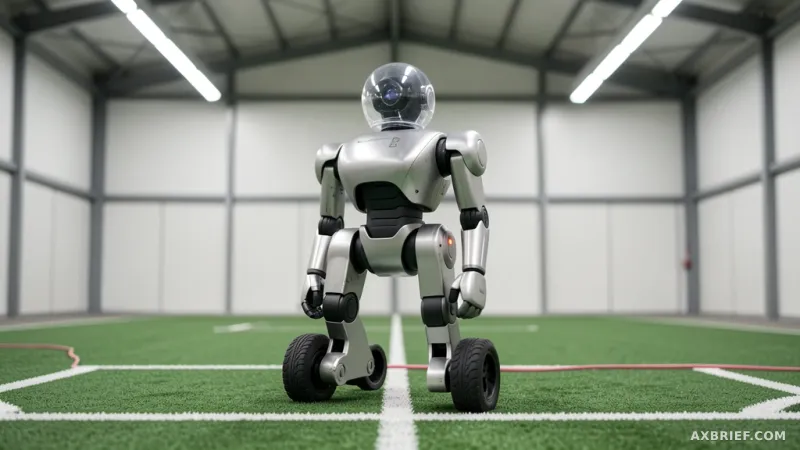
The robotics industry has spent the last few years obsessed with the brain, pouring billions into large language models that can reason through complex logic but cannot pick up a coffee cup. While the digital intelligence of AI has scaled exponentially, the physical manifestation of that intelligence has lagged, creating a gap between what a robot can plan and what it can actually execute in a messy, unpredictable living room. This week in Songdo, Incheon, that gap closed significantly as the global robotics community gathered to witness the current ceiling of physical AI.
The Architecture of a Record-Breaking Performance
At the RoboCup 2026 Home Service competition, the Tidyboy team from Pusan National University deployed their humanoid robot, Anubis, to a result that redefined the competition's history. The event represented the largest gathering in the competition's history, drawing 2,879 participants from 364 teams across 45 different countries. In a category designed to test the absolute limits of a robot's ability to understand human speech, interpret gestures, navigate indoor environments autonomously, and manipulate physical objects, Anubis did more than just win. The team secured first place globally for the second consecutive year, but the margin of victory was historic. Anubis successfully completed all six assigned missions with perfect precision, establishing the highest total score ever recorded in the history of the Home Service division.
To achieve this, the Tidyboy team integrated a sophisticated suite of capabilities into a single hardware platform. Anubis operates using a synchronized system of 3D object recognition and autonomous navigation, allowing it to map an environment and identify targets in real-time. Unlike simpler robots that rely on pre-programmed paths, Anubis utilizes dual-arm manipulation to grasp and move objects with human-like dexterity. This technical stack was put to the test against elite competition, including Germany's NimbRo, Japan's Hibikino Musashi from Kyushu Institute of Technology, and China's Tinker from Tsinghua University. The result was a comprehensive victory that earned Anubis two specialized accolades: the Best Manipulation Award for its precision in handling objects and the Best Human-Robot Interaction Award for its ability to parse and respond to human intent.
The Shift from Automation to Physical AI
Winning a robotics competition is often a matter of optimizing for a specific set of constraints, but the significance of the Anubis victory lies in the convergence of disparate skill sets. In the past, humanoid robots were typically specialized; a robot might be exceptional at manipulation but struggle with navigation, or it might be a master of human interaction while remaining physically clumsy. The tension in home service robotics has always been the trade-off between perception and action. If a robot perceives the world perfectly but cannot execute a grip, it fails. If it can move perfectly but misinterprets a human command, it is useless.
Anubis represents a shift toward true Physical AI, where the loop between sensing and acting is tightened to near-zero latency. By winning both the Best Manipulation and Best Human-Robot Interaction awards simultaneously, Pusan National University proved that these two domains are no longer mutually exclusive. The robot does not simply execute a sequence of commands; it judges the environment and adapts its physical response based on the 3D data it perceives. This ability to reduce the error margin between perception and control is the primary differentiator between a machine that follows a script and an agent that possesses physical intelligence. The record-breaking score is not just a numerical achievement, but a validation that the integration of high-level cognitive understanding and low-level motor control has reached a professional tipping point.
The benchmark for home robotics has shifted from simple task completion to the seamless integration of perception and physical agency.



