The modern AI data center is currently fighting a war against physics. Inside these massive halls, thousands of GPUs are packed into racks, attempting to function as a single, monolithic brain. But as the scale of these clusters grows, the physical medium connecting them is failing. Engineers are hitting a wall where copper wiring, the industry standard for decades, can no longer carry signals across a room without massive power loss or the need for energy-hungry signal boosters. The industry is realizing that the bottleneck for the next generation of AI is not the speed of the chip itself, but the speed and efficiency of the light that connects them.
The Industrial Scale of Light
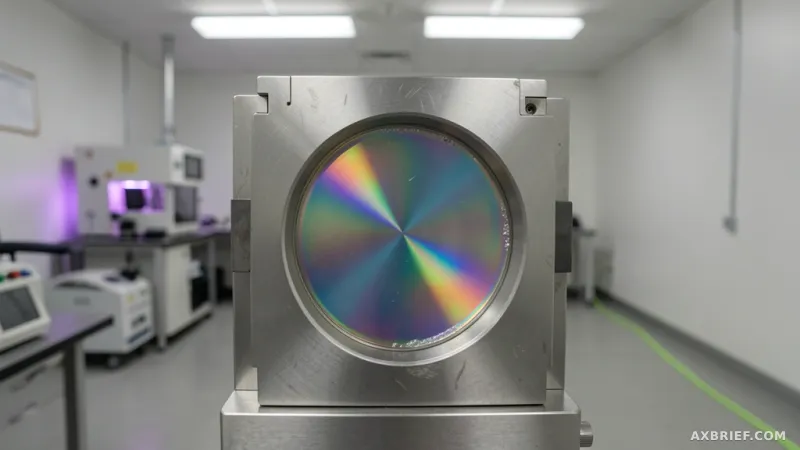
To break this bottleneck, Coherent has begun a massive expansion of its manufacturing capabilities in Sherman, Texas. The facility is designed to be the epicenter of a critical shift in AI hardware: the transition to mass-produced compound semiconductors. At the heart of this operation is the world's first 6-inch Indium Phosphide (InP) fab. This is not a marginal upgrade; it is a fundamental shift in production scale. For years, InP production was trapped in the 3-to-4-inch wafer range, which resulted in low yields and high per-chip costs that made wide-scale adoption difficult. By moving to 6-inch wafers, Coherent has effectively quadrupled the usable surface area per wafer, drastically lowering the cost per chip and enabling the volume required for global AI infrastructure.
This industrial pivot is backed by a combination of government strategy and private capital. Coherent has secured 50 million dollars in grants from the U.S. government via the CHIPS and Science Act, supplemented by approximately 17 million dollars from the Texas CHIPS program and the Sherman Economic Development Corporation. These funds are intended to repatriate the supply chain for optical components, reducing reliance on overseas fabrication for the very parts that make high-speed networking possible. However, the private sector's urgency is even more apparent. NVIDIA has invested 2 billion dollars into Coherent's research and development and U.S. manufacturing capacity. This investment is a strategic piece of NVIDIA's broader 500 billion dollar plan to build out AI infrastructure within the United States, ensuring that the physical connectivity of their chips can keep pace with the logic of their architectures.
The manufacturing process at the Sherman plant mirrors the complexity of traditional silicon fabs, utilizing lithography, photoresist, deposition, and etching. However, instead of pure silicon, Coherent grows specialized compound semiconductor layers on the InP substrate. By precisely tuning these layers, they create lasers that can emit and modulate light with extreme precision. These lasers are then integrated into pluggable optical modules the size of a USB stick or used as external laser sources for more advanced packaging. This facility is expected to create over 550 direct jobs, transforming Sherman into a hub for the physical layer of AI.
Breaking the Copper Bottleneck
To understand why a 6-inch InP wafer matters, one must look at the failure of copper. As signal frequencies increase to meet the demands of LLMs, the distance a signal can travel over copper before degrading becomes vanishingly short. In a typical setup, connecting just eight racks with copper requires a series of retimers—signal amplifiers that consume significant power and add latency. This creates a paradox where a significant portion of a data center's power budget is spent simply moving data from one GPU to another, rather than performing the actual computations.
Silicon photonics solves this by converting electrical signals into light. While the initial conversion requires energy, light travels across the data center with almost zero power loss regardless of distance. This is where Coherent's InP technology becomes the critical enabler. By providing the high-efficiency lasers needed for these conversions, Coherent allows data center operators to redirect power from signal amplification back into the GPUs themselves.
This transition is mandatory for the upcoming NVIDIA Vera Rubin Ultra NVL576. This system is a behemoth, consisting of eight racks, each housing 72 Rubin Ultra GPUs, for a total of 576 GPUs operating within a single domain. At this scale, copper is no longer a viable option. The distances between the first and last GPU in a 576-chip cluster are too great for electrical signals to survive without prohibitive power costs. Coherent provides the pluggable optical modules and transceivers that allow these 576 GPUs to communicate as if they were on the same piece of silicon.
Beyond simple modules, Coherent is pushing into Co-packaged Optics (CPO). In traditional setups, the optical engine is separate from the switch chip. CPO integrates the optical engine and the switch chip into the same package, minimizing the distance the electrical signal must travel before becoming light. Coherent provides the external laser modules for NVIDIA Spectrum-X Photonics and Quantum-X Photonics switches. These lasers are mounted on the front plate of the switch, pushing high-speed data into regions of the data center where copper cannot reach. This architecture determines the ultimate scalability of the entire AI cluster; without these laser modules, the NVL576 would be a collection of powerful chips that cannot talk to each other fast enough to be useful.
The shift in capital is telling. For the last few years, the AI gold rush focused almost exclusively on the logic chip—the GPU. But the industry is now realizing that a GPU is only as powerful as the network it belongs to. The focus is moving from raw TFLOPS to total network bandwidth. The ability to secure a stable, domestic supply of compound semiconductors is now a strategic imperative. If the supply of InP lasers fails, the deployment of the next generation of GPU clusters halts, regardless of how many chips NVIDIA can print.
AI scalability is no longer a software problem or a logic-gate problem; it is a materials science problem. The transition from 3-inch to 6-inch InP wafers is the industrial answer to the physical limits of electricity. By replacing the copper wire with a scalable pipeline of light, the industry is removing the final physical barrier to the growth of massive AI models.
The efficiency of the next-generation data center will not be measured by the speed of a single chip, but by the volume of optical modules available to connect them. The era of compute-centric scaling is ending, and the era of connectivity-centric scaling has begun.