Every developer who has run a large language model on a local workstation knows the specific frustration of the stutter. You hit enter, and the model begins to respond, but the text crawls across the screen one character at a time, mimicking a slow typist. This latency is not a failure of the GPU's raw power, but a fundamental limitation of how most AI models think. The industry has long relied on autoregressive generation, a process where the model predicts a single token, appends it to the sequence, and then starts the entire process over again for the next token. In a local environment, this creates a massive hardware bottleneck where a powerful processor spends most of its time idling, waiting for the next single keystroke to be calculated before it can move forward.
The Architecture of Parallel Generation
Google is attempting to break this sequential bottleneck with the release of DiffusionGemma, an experimental open model designed to shift the paradigm of text generation. Distributed under the Apache 2.0 license, DiffusionGemma is not merely a refinement of existing architectures but a fundamental pivot toward text diffusion. By integrating the intelligence-per-parameter efficiency of the Gemma 4 family with recent research into Gemini diffusion, Google has created a model capable of increasing inference speeds by up to 4x on dedicated GPU hardware.
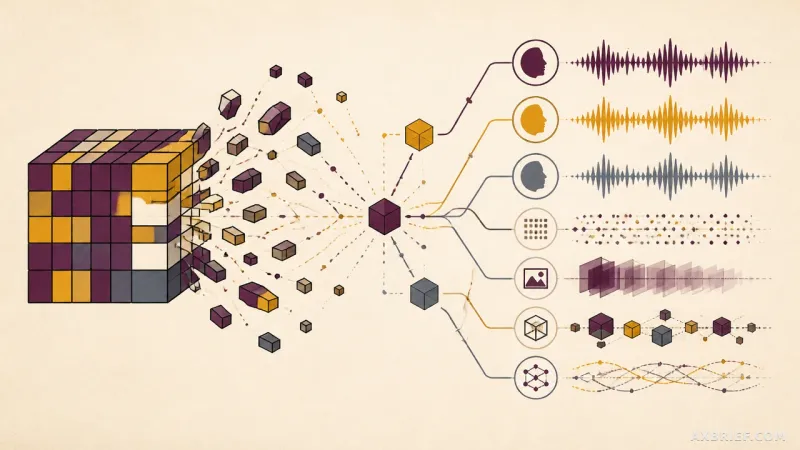
The technical core of this speedup lies in the combination of a 26B MoE (Mixture of Experts) structure and a specialized diffusion head. Unlike standard LLMs that function like a typewriter, DiffusionGemma operates more like a high-speed printing press. Instead of predicting the next word in a sequence, the model utilizes a parallel generation mechanism that drafts an entire block of 256 tokens simultaneously. This approach allows the model to saturate the processing capabilities of a dedicated accelerator by feeding it large chunks of work rather than a stream of tiny, repetitive tasks. By processing these blocks in parallel, the model eliminates the idle time inherent in autoregressive loops, allowing the hardware to operate at its theoretical peak efficiency.
The Shift to Non-Linear Intelligence
The transition from sequential to parallel generation introduces a capability that autoregressive models fundamentally lack: bi-directional attention. Because DiffusionGemma processes a block of text as a whole, it can look both forward and backward across the 256-token window. This enables non-linear text generation, where the model can refine the beginning of a sentence based on how it decides to end it, rather than being locked into a path decided by the first few tokens.
This architectural shift has immediate practical implications for complex logic tasks. The AI optimization team at Unsloth has already demonstrated this by fine-tuning the model for Sudoku puzzles. In a Sudoku grid, the value of a single cell is dependent on the values of cells that come after it in a linear scan. A standard LLM often struggles here because it cannot change a previous token once it has been generated. DiffusionGemma, however, can iterate on the entire block, adjusting multiple tokens simultaneously until the logic of the puzzle is satisfied. This same capability extends to structural tasks, such as ensuring complex Markdown formatting is perfectly closed or rendering code snippets in near real-time without the characteristic lag of token-by-token streaming.
The visual manifestation of this process is best seen in the text-to-3D SVG demos available on Hugging Face. In these demonstrations, the output does not appear from left to right. Instead, it begins as a cloud of visual noise that gradually crystallizes into a sharp, clear SVG image through a series of iterative refinement steps. This is the essence of text diffusion: starting with a chaotic state and narrowing it down to a precise answer through parallel optimization.
However, this performance gain comes with a significant architectural trade-off that separates local use from enterprise scaling. The throughput advantages of DiffusionGemma are most pronounced in local or low-concurrency environments where a single user owns the entire GPU. In these scenarios, the priority is reducing latency for the individual. But in high-QPS (queries per second) cloud environments, the math changes. Parallel decoding requires significantly higher memory occupancy per request because the model must maintain the state for the entire 256-token block simultaneously.
For a cloud provider serving thousands of concurrent users, the memory overhead of parallel generation increases the cost per request. Cloud servers already mitigate the autoregressive bottleneck through massive batching, where requests from hundreds of different users are bundled together to keep the GPU busy. In that specific context, the traditional autoregressive model remains more economically viable. For the developer, the choice therefore becomes a matter of deployment: if the goal is a real-time, interactive local editor or a non-linear generative app, DiffusionGemma is a massive leap forward. If the goal is a high-scale API with millions of users, the memory costs of diffusion may outweigh the speed benefits.
This divergence marks a new era where model architecture is chosen not just for intelligence, but for the specific physics of the hardware on which it will run.