The current era of artificial intelligence is defined by a frustrating paradox. While Large Language Models have effectively solved the problem of knowledge acquisition by scraping the entirety of the human-written internet, Physical AI remains trapped in a data drought. Developers attempting to teach robots how to navigate a warehouse or plug in a server cable cannot simply download a dataset of a billion physical interactions. There is no internet for the sense of touch, and there is no global repository of the precise muscle tensions required to stack a poker chip. The industry has realized that for robotics to reach a GPT-3 moment, the strategy must shift from gathering existing data to intentionally manufacturing it.
The Infrastructure of Sensation
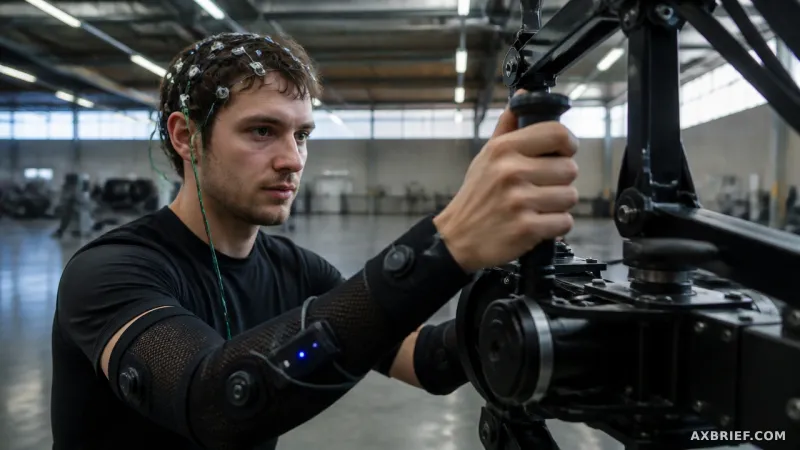
Encord is pivoting from its roots in data annotation and model evaluation to build a full-scale manufacturing pipeline for real-world physical data. The goal is to capture the invisible signals that accompany human movement, moving beyond simple video frames to a multi-modal stream of biological intent. To achieve this, Encord has integrated specialized hardware, including EEG headsets developed by Zander Labs to monitor brain activity and electromyography (EMG) sensors attached to the operator's forearms to capture the electrical impulses of muscle contractions.
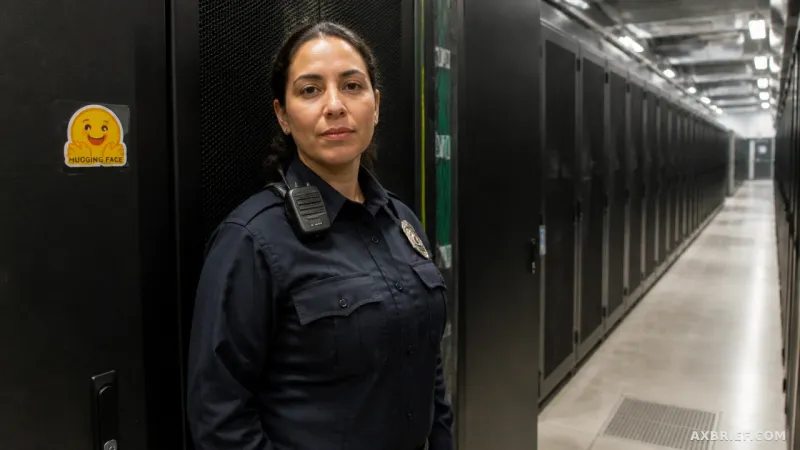
This biological data is captured within a leader-follower robotic framework. In this setup, a human operator controls a leader robot arm, and a follower arm mimics those movements in real-time. This allows Encord to generate high-precision manipulation data for tasks that require extreme dexterity, such as pouring coffee or stacking poker chips. The company is currently focusing these efforts on data center automation, specifically the high-precision task of connecting and disconnecting Ethernet cables from the rear of servers, a process that has historically been a significant bottleneck for autonomous infrastructure management.
The Economics of High-Fidelity Intent
The integration of EEG and EMG sensors is not merely about adding more data points; it is about solving the fundamental failures of computer vision. In traditional robotics training, developers rely on ego data—first-person video feeds. However, video suffers from the occlusion problem, where the robot's own hand or the object being manipulated blocks the camera's view of the fingers. By using EMG sensors, Encord can bypass the visual field entirely, using muscle signals to describe the 3D position and movement of the hand with mathematical precision. When this is paired with dense annotations—such as a textual description stating the right hand is tightening a bolt—the resulting dataset allows LLM-based models to understand the context of the action rather than just the pixels of the movement.
Furthermore, the EEG data provides a window into the operator's psychological state. Neuroscientists at Zander Labs note that brain activity can reveal moments of error, hesitation, or surprise. This creates a critical feedback loop for model builders, providing a clear signal of when a task is cognitively demanding. By identifying these high-load moments, developers can determine exactly where to deploy highest-effort models to handle the most complex edge cases.
This approach introduces a stark economic trade-off in data procurement. Encord's analysis indicates that high-density annotated data is approximately 100 times more valuable for model training than standard ego data. However, the cost to produce this high-fidelity data is 20 times higher than that of simple video collection. Despite this cost increase, the performance gains in model reasoning and manipulation precision justify the investment, shifting the focus from quantity to quality.
The Scale Gap and Hardware Bottlenecks
Despite these advancements, the scale of the challenge remains immense. The scarcity of physical data is the primary constraint preventing Physical AI from achieving general-purpose utility. While LLMs scaled by consuming the web, physical manipulation requires a volume of data that does not exist in nature. Encord estimates that to break through the current performance threshold for physical manipulation, the industry needs a dataset approximately five times the size of the entire YouTube video corpus. This realization transforms data acquisition from a research project into a capital-intensive manufacturing business.
Even with perfect data, the industry faces a hard ceiling in hardware. The current state of robotic pincers cannot fully replicate the degrees of freedom or the tactile sensitivity of human fingers. This creates a physical bottleneck where the model may understand the intent and the path perfectly, but the hardware cannot execute the output. This suggests that the future of Physical AI will not be won by the most elegant model architecture, but by the team that can most efficiently manufacture high-fidelity data to squeeze every possible bit of performance out of existing hardware.
For practitioners in the field, the takeaway is clear: the strategy for Physical AI must be redesigned. The era of simple data collection is over. Success now depends on the ability to manufacture multi-modal, high-density datasets that combine visual, muscular, and neural signals to bridge the gap between digital intelligence and physical mastery.