For years, the quest for a truly human-like robotic hand has been stalled by a fundamental architectural flaw. Most humanoid hands operate like puppets, with heavy motors housed in the wrist or forearm, pulling a complex web of tendons and wires to move the fingers. This remote actuation creates a massive bottleneck in agility and increases the bulk of the limb, making the hand feel disconnected from its own power source. The industry has long sought a way to move the muscle directly into the finger, but the physics of miniaturization—balancing torque, heat, and control—has remained a stubborn barrier.
The Engineering of the D-Drive Module
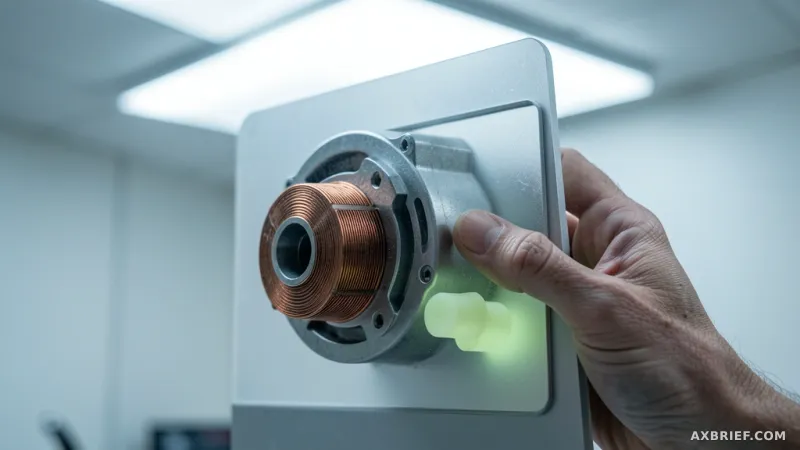
Double Giken has addressed this bottleneck with the release of the D-Drive Module, or DDM, a series of ultra-compact actuators designed specifically for a motor-in-finger architecture. The DDM is not a single product but a specialized line of modules tailored for the tight tolerances of humanoid digits. The lineup consists of two primary models: the DDM-1017-R28-U, which features a diameter of 10mm and a length of 17mm, and the DDM-1117-R28-U, which slightly increases the diameter to 11mm while maintaining the 17mm length. Despite the difference in diameter, both models maintain a remarkably low weight of approximately 15g.
Technically, the DDM is a powerhouse of integration. It utilizes a 28:1 reduction ratio to translate high-speed motor rotation into the usable torque required for gripping and manipulation. To handle the electrical demands of such a small form factor, the modules support a maximum current of 1.5A. Communication is handled via UART (Universal Asynchronous Receiver-Transmitter), allowing for a streamlined data flow between the actuator and the central controller. This level of miniaturization is a direct response to the needs of humanoid hands, which require the simultaneous coordination of dozens of joints without adding prohibitive weight to the extremity.
From Remote Tendons to Integrated Intelligence
The shift from remote actuation to the DDM's motor-in-finger approach represents more than just a change in placement; it is a total simplification of the robotic nervous system. In traditional designs, the distance between the motor and the joint introduces friction, elasticity, and mechanical loss, all of which must be compensated for by complex software. By integrating a BLDC motor, a planetary gear reducer, and a closed-loop control driver into a single module, Double Giken has eliminated the need for the cumbersome wiring and pulleys that typically plague humanoid hand designs.
What makes the DDM truly disruptive is its internal feedback loop. Each module contains built-in sensors for position, speed, temperature, and current. This means the actuator does not just move; it senses. By providing real-time feedback directly from the joint, the system achieves a level of precision that remote motors cannot match. The impact of this architecture is most evident in the D-Hand 5MT, a multi-fingered robotic hand where Double Giken applied this technology. By moving the actuators into the fingers, the company reduced the overall weight of the hand by approximately 400g while bringing its size closer to that of a human hand. This weight reduction is not merely a metric of efficiency but a catalyst for dexterity, allowing for independent control of each finger and movements that mirror human kinematics.
Beyond the current DDM lineup, the company is pushing further into Quasi-Direct Drive (QDD) technology and the development of low-backlash reducers. These advancements aim to reduce the mechanical play in the joints, further increasing the fidelity of the robot's touch. This trajectory suggests a move toward a broader ecosystem of Physical AI hardware, where the DDM serves as the foundational building block for not only humanoid robots but also advanced prosthetics, wearable exoskeleton suits, and high-fidelity R&D platforms.
As the intelligence of AI models continues to scale, the hardware they inhabit must evolve to match their cognitive capabilities. The DDM establishes a new baseline for how small and light a functional robotic joint can be while remaining independently controllable. The competition for the most capable humanoid hand is no longer about who can build the strongest grip, but who can achieve the highest level of miniaturization without sacrificing precision.