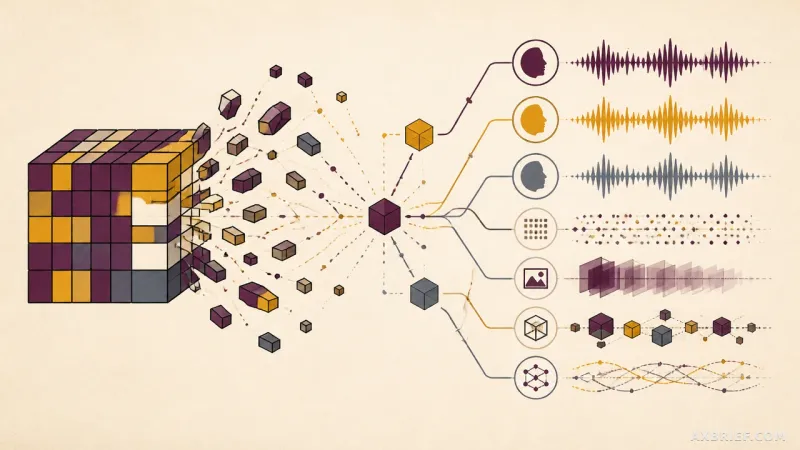
The modern voice interface is plagued by a persistent, awkward gap. It is the silence that lingers between the moment a user finishes a sentence and the moment the AI acknowledges it with text on a screen. For developers building real-time agents, this latency is the primary enemy of natural conversation. Until now, the industry standard has relied on a two-step pipeline: first, a Speech-to-Text (STT) model converts audio to a raw transcript, and then a second LLM pass cleans up the disfluencies, removes the filler words, and formats the output. This sequential process creates a bottleneck that makes truly fluid, human-like interaction nearly impossible.
The Architecture of Refined Audio Processing
Google is attempting to collapse this pipeline with the release of Gemini 3.5 Transcribe. Unlike traditional STT models that focus solely on literal transcription, Gemini 3.5 Transcribe is designed to move directly from raw audio to refined, formatted text. This model is now available to developers through the Gemini API in Google AI Studio and the Gemini Enterprise Agent Platform, targeting a wide array of use cases from real-time voice agents and live captioning tools to sophisticated post-call analysis pipelines.
To ensure immediate utility, Google has already integrated the model into its own ecosystem. The Rambler feature on Android and the Gemini app for macOS utilize this technology to handle the messy reality of human speech. It is also embedded within Gboard, Chrome, and Google Antigravity. The model does not just listen; it understands context, capturing inline corrections made by the speaker in real-time and allowing users to trigger complex tasks like file analysis, image generation, and deep searches using only their voice.
From a technical standpoint, the model provides a rich set of metadata that goes beyond simple text. It delivers word-level timestamps, recording the exact start and end time of every single word spoken. This allows for millisecond-precision synchronization between audio and text. Furthermore, it includes multi-speaker attribution, which identifies and separates different voices within a single conversation. For the enterprise developer, these features enable the creation of automated dialogue classification pipelines or interfaces where a user can click a specific word to jump to that exact moment in an audio recording.
Google has also addressed the problem of specialized language. The model supports custom vocabulary, allowing organizations to define internal jargon, technical terminology, or specific proper nouns to increase recognition accuracy. This adaptability ensures that the model captures the speaker's intent even when the conversation shifts into highly niche professional domains.
The Shift from Transcription to Intelligence
The true disruption of Gemini 3.5 Transcribe lies in its departure from the traditional transcription philosophy. By integrating the transcription and refinement processes into a single step, Google has significantly reduced the number of API calls required to reach a usable output. This architectural shift is where the performance gains become evident. According to data from Artificial Analysis, Gemini 3.5 Transcribe reduces the time to final transcription by 70% compared to its predecessor, Chirp 3.
This speed increase is not just a marginal improvement; it is a fundamental change in how voice interfaces feel. When the gap between speech and text vanishes, the interaction shifts from a command-and-response pattern to a genuine conversation. This efficiency is backed by rigorous benchmarking. On the FLEURS benchmark, which measures multilingual speech recognition, Gemini 3.5 Transcribe consistently outperformed Chirp 3 across various languages and regional accents.
Accuracy has also seen a measurable leap. The model has pushed the Word Error Rate (WER) down to the 5% range. In non-streaming mode, where the model processes a complete audio file to maximize context, it achieves a WER of 5.04%. In streaming mode, where audio is processed in real-time, the WER is 5.50%. Historically, streaming modes suffer from significantly higher error rates because the model must guess the end of a sentence before it is spoken. The narrow gap between 5.04% and 5.50% suggests that Gemini 3.5 Transcribe maintains high precision even under the pressure of real-time delivery.
Perhaps the most innovative edge is the use of screen context. When operating within Gboard, Chrome, or Google Antigravity, the model references the text and data currently visible on the user's screen. If a user is looking at a technical whitepaper and mentions a complex term found on that page, the model uses that visual context to ensure the term is transcribed correctly. This transforms the model from a passive listener into an active observer of the user's digital environment.
Scaling the Voice Ecosystem
To prevent the deployment of these capabilities from becoming an infrastructure nightmare, Google has paired the model with the Gemini Live API. Building a real-time media streaming stack is notoriously difficult, requiring precise control over packet loss, jitter, and server-side latency. By abstracting this layer, Google allows developers to bypass the heavy lifting of backend infrastructure.
This abstraction is already being utilized by a broad coalition of platforms, including Agora, Fishjam, LangChain, LiveKit, Pipecat, Vercel, and Vision Agents. These partners integrate the Gemini Live API to provide a managed environment where developers can focus on UX design rather than server maintenance. Early adopters like Vivo, Intellitek Health, and Lingopal have reported significant reductions in time-to-market, citing the API's low latency and extensive language support as key drivers for their product velocity.
For developers choosing a deployment path, the model offers a clear trade-off between speed and precision. The streaming mode, with its 5.50% WER, is the optimal choice for interactive AI agents where immediate response is the priority. The non-streaming mode, with its 5.04% WER, is better suited for archival purposes, legal transcription, or deep analytical pipelines where data integrity is more important than real-time feedback. Additionally, the model's ability to handle live language switches allows it to seamlessly transition between languages, such as Korean and English, without requiring the user to manually toggle settings.
By removing the infrastructure tax and collapsing the transcription pipeline, Google is moving toward a world where the voice interface is no longer a clumsy approximation of typing, but a primary, high-fidelity input method.