For decades, the professional video editor's life has been defined by the timeline. It is a world of frame-by-frame precision, where a simple change in lighting or the removal of an object requires hours of masking, tracking, and rendering. The creative process is often bottlenecked by the mechanical labor of the software. But a shift is occurring. The industry is moving away from the manual manipulation of pixels and toward a reality where the editor describes the desired outcome in plain English, and the software reconfigures the visual reality in real time. This is the promise of the new era of multimodal intelligence.
The Architecture of Omni and Flash
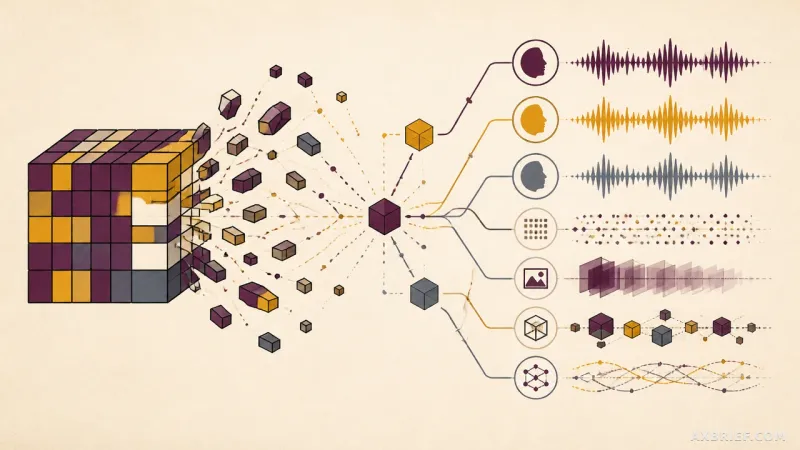
At Google I/O 2026, the company unveiled Gemini Omni and the Gemini 3.5 model series, marking a pivot toward models that do not just reason about data but actively manipulate it. Gemini Omni is designed as a fully integrated multimodal engine capable of processing images, audio, video, and text simultaneously. Unlike previous iterations that might pass data between separate specialized models, Omni handles generation and reasoning within a single structure. This allows for an unprecedented level of consistency in video editing. A user can issue a command to turn a statue into bubbles or lower the lighting in a specific room, and the model executes the change while maintaining the scene's physical laws and contextual coherence across multiple conversational turns.
While Omni handles the creative and multimodal heavy lifting, Gemini 3.5 Flash is engineered for speed and the execution of long-horizon tasks. In practical tests within AI Studio, Gemini 3.5 Flash can generate a variety of UX approaches for a checkout flow in just 60 seconds. Its efficiency extends to complex mathematical and visual tasks, such as the rapid visualization of the mathematical constant Pi or the creation of 64 distinct fractal variations. The goal here is to maintain frontier-level reasoning while slashing the latency that typically plagues complex agentic workflows.
Google is integrating these models deeply into its existing ecosystem. Gemini 3.5 Flash now serves as the default engine for the Gemini app and the AI-powered modes within Google Search. Gemini Omni Flash is being rolled out to subscribers of Google AI Plus, Pro, and Ultra, though it is being provided for free to users of YouTube Shorts and the YouTube Create app. For those in the United States with an Ultra subscription, the experience culminates in Gemini Spark, a personal AI agent integrated into Workspace that operates 24 hours a day to manage professional and personal logistics.
Antigravity and the Rise of the Execution Engine
The true technical leap, however, is not found in the models themselves but in how they are orchestrated. Google introduced the Antigravity framework, a large-scale agent execution harness that transforms Gemini 3.5 Flash from a chatbot into a manager. Antigravity allows the primary model to deploy multiple sub-agents, each specialized for a specific part of a complex task. Instead of a single model attempting to solve a problem sequentially, Antigravity enables parallel processing. This means that for high-volume tasks—such as renaming thousands of unstructured assets or classifying data based on dynamic, shifting criteria—the system can generate a massive volume of results simultaneously.
This architecture solves the primary tension in current AI development: the trade-off between intelligence and speed. By breaking a long-horizon task into parallel sub-tasks, Google has created a system that can handle the iterative nature of coding and graphic production without the user having to prompt every single step. The AI moves from being a tool that provides an answer to a system that manages a workflow. This is most evident in the new Generative UI capabilities. By combining Gemini 3.5 Flash with Antigravity, Google Search is evolving. Instead of returning a list of links, the system can now build a custom dashboard, a tracker, or a mini-app in real time to answer a specific user query. This functionality will be available for free to all users starting this summer.
This shift toward proactive execution is further realized in the Information Agents. These agents operate in the background, inferring what a user needs before they even perform a search. Rather than waiting for a query, these agents provide tailored updates and relevant web links autonomously. For Ultra and Pro subscribers, this means the AI is no longer a passive recipient of instructions but an active participant in the user's information stream. Within the Workspace environment, Gemini Spark takes this a step further by performing actual labor. It can coordinate across Gmail, Docs, and Slides to execute real-world actions, such as compiling a specific grocery list based on dietary constraints and automatically adding those items to an Instacart shopping cart.
For the developer community, this infrastructure is being opened via the Gemini Enterprise Agent Platform, the Gemini API, and Android Studio. This allows enterprises to build their own custom agents optimized for specific business processes, moving beyond generic AI assistance toward specialized automation. With API deployment scheduled for the coming weeks, companies can now integrate these multi-step agentic workflows into their internal systems to eliminate repetitive operational bottlenecks.
Google's new engine represents a fundamental change in the identity of artificial intelligence. The technology has moved past the stage of simply finding information or generating text; it has entered the stage of autonomous execution. By collapsing the gap between reasoning and action through the Antigravity framework and the Omni multimodal core, Google is redefining productivity not as the ability to find an answer faster, but as the ability to complete a complex project with minimal manual intervention.
The AI is no longer just a librarian; it has become the operator.