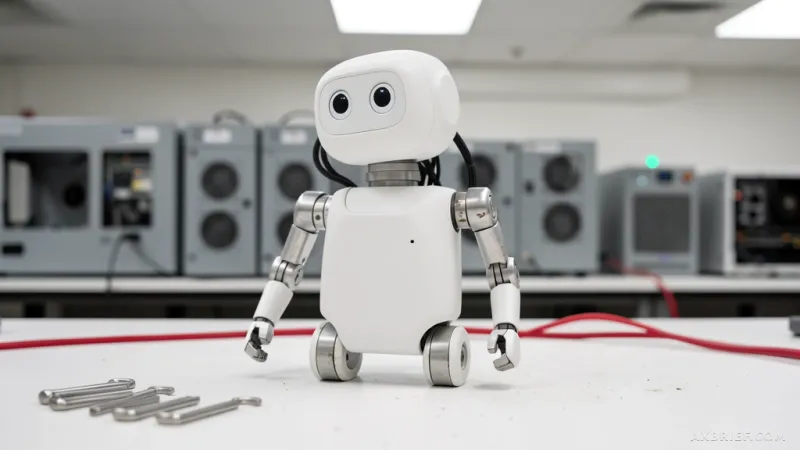
Anyone who has spent time interacting with a modern AI voice assistant knows the specific, jarring quality of the artificial pause. You ask a question, and for a fraction of a second—or sometimes several seconds—there is a void. This silence is not a natural beat in a conversation; it is the sound of a server processing a request, a token being generated, and a packet traveling across a network. In a digital interface, this delay is a minor annoyance. But when that AI is housed inside a physical body, that same silence transforms into a failure of presence. It reminds the user that they are not interacting with a sentient entity, but with a machine that is lagging. This week, the focus in the developer community has shifted from how large a model can be to how consistently fast it can respond, as the industry moves toward the era of Physical AI.
The Architecture of Immediate Response
To bridge the gap between machine processing and human conversation, a new real-time speech-to-speech loop has been implemented using a high-performance stack centered on Google DeepMind's Gemma 4 31B. The system is designed to eliminate the perceived lag by optimizing every stage of the interaction pipeline. At the core of the operation, Gemma 4 31B serves as the cognitive engine, handling the complex reasoning and text generation required for natural dialogue. To ensure that the model's output is generated at speeds that mimic human thought, the team integrated the Cerebras inference engine. This infrastructure provides the raw computational throughput necessary to push tokens out of the model almost instantaneously, removing the primary bottleneck found in traditional cloud-based LLM deployments.
Once Gemma 4 generates the text response, the system passes the data to Qwen's Text-to-Speech (TTS) engine, which converts the digital text back into audible speech. The result is a seamless flow: voice input is converted to text, processed by Gemma 4 via Cerebras, and spoken back to the user. This is not a theoretical exercise or a carefully edited demo video. This specific technical stack has been deployed at scale across more than 9,000 Reachy Mini robots. The deployment of this pipeline across thousands of physical units proves that the combination of open-source models and specialized inference hardware can meet the rigorous stability and performance requirements of real-world environments.
For developers looking to replicate or build upon this architecture, the project has been made transparent. A live demonstration of the real-time responsiveness is available via the Hugging Face Space at https://huggingface.co/spaces. Furthermore, the complete implementation details and the underlying logic for the voice-to-voice pipeline have been released through the `huggingface/speech-to-speech` repository. By providing the actual code and the configuration for the model connections, the project allows the broader community to examine how inference optimization and model chaining can be used to create a low-latency experience without relying on proprietary, closed-box APIs.
The P95 Problem and the Illusion of Life
While average response times are the standard metric for most software, they are a deceptive measure of quality in the context of human-robot interaction. Most commercial AI systems maintain a respectable median latency, meaning half of the responses are fast. However, the true enemy of natural conversation is the P95 latency—the slowest 5% of responses. These long-tail delays are where the system stutters, where a tool call to an external API hangs, or where a complex multimodal prompt causes the model to hesitate. When a user experiences a P95 event, the conversation breaks. The rhythm is lost, and the psychological connection to the robot is severed.
This is where the integration of Cerebras and Gemma 4 creates a fundamental shift. By stabilizing the inference process and aggressively reducing the long-tail latency, the system ensures that the worst-case scenario is still fast enough to feel natural. In the world of Embodied AI, consistency is more valuable than peak speed. A robot that always responds in 200 milliseconds is perceived as more "alive" than a robot that usually responds in 100 milliseconds but occasionally freezes for two seconds. The unpredictability of the latter creates a sense of instability and distrust in the user, whereas the former establishes a reliable social cadence.
This reliability is further enhanced by the modular design of the speech-to-speech pipeline. The system is built as a series of independent, swappable components. If a developer finds that a specific TTS engine is introducing too much lag or that a different version of an LLM provides better reasoning for a specific task, they can replace that single module without redesigning the entire system. This modularity allows for precise tuning of the P95 latency. Developers can isolate the exact point of failure—whether it is the speech-to-text conversion, the LLM inference, or the text-to-speech synthesis—and optimize that specific segment. This approach transforms the AI pipeline from a rigid monolith into a flexible toolkit, enabling the creation of robots that can not only speak but can do so with the timing and nuance of a human being.
In a web browser, a one-second delay is a loading spinner; in a physical robot, a one-second delay is a sign of malfunction. By prioritizing the elimination of the long-tail latency over simple average benchmarks, the Gemma 4 and Cerebras implementation sets a new standard for how we deploy intelligence into the physical world. The shift from maximizing parameter counts to minimizing latency variance is the key to moving AI out of the chat box and into the physical environment.
The transition to Physical AI demands a move away from the erratic performance of general-purpose cloud APIs toward predictable, low-latency open-source stacks. The success of the 9,000-robot deployment proves that when inference stability meets modular design, the gap between machine response and human interaction finally disappears.