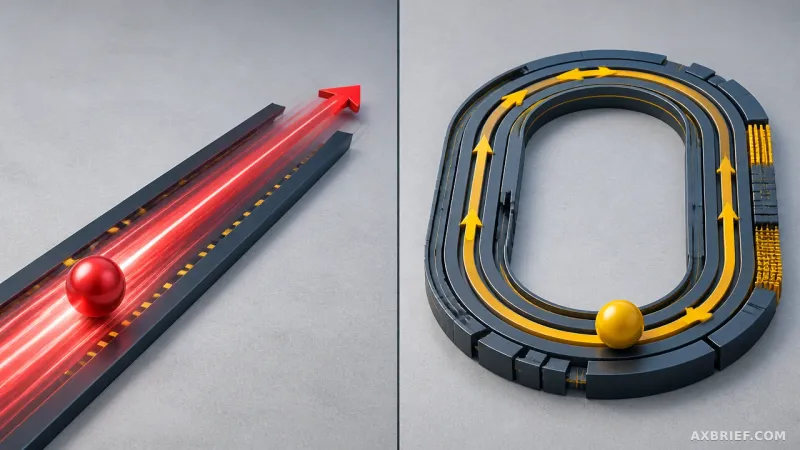
Every robotics engineer knows the crushing weight of the physical testing bottleneck. You spend weeks refining a neural network, only to realize that validating a single model checkpoint requires a human operator to stand beside a physical robot for hundreds of hours. It is a slow, expensive, and fragile process where a single mechanical glitch or a stray cable can wipe out a day of data. This friction has long been the primary barrier preventing robot AI from iterating at the same breakneck speed as Large Language Models. The industry has tried to solve this with simulations, but the sim-to-real gap—the discrepancy between virtual physics and reality—usually means that a model that excels in a simulator fails miserably the moment it touches a real-world floor.
The Architecture of High-Fidelity Virtual Worlds
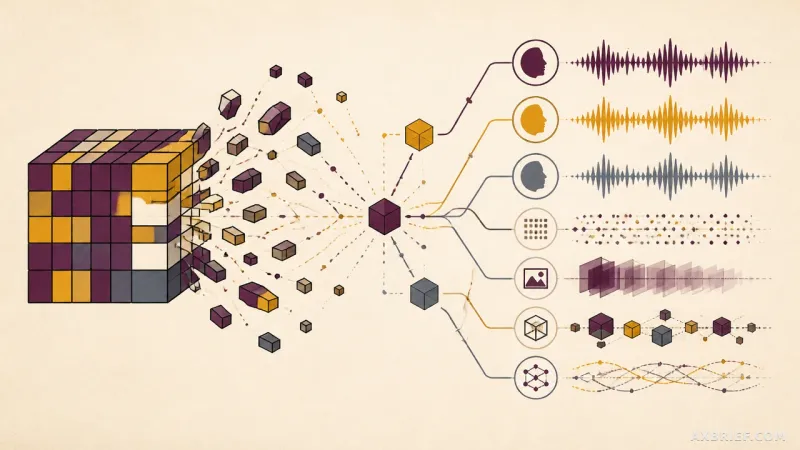
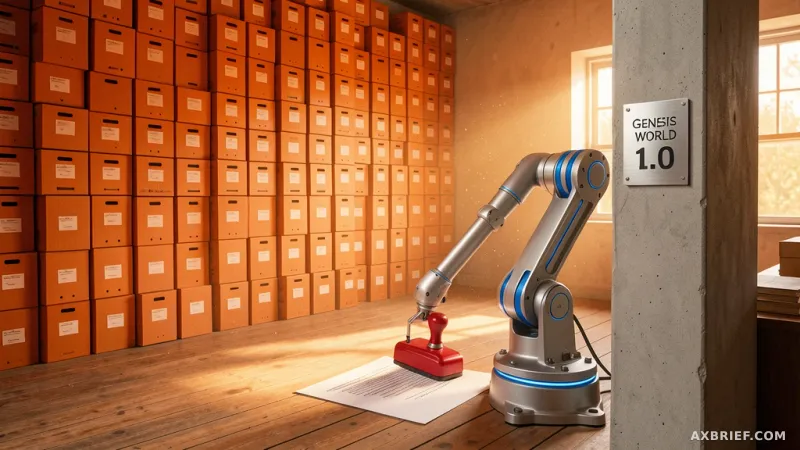
Genesis AI is attempting to break this cycle with the release of Genesis World 1.0, a simulation ecosystem designed to reduce the sim-to-real gap by 45 percent. The system is not a single tool but a vertically integrated stack comprising four core components: a physics engine, a renderer, a compiler, and a simulation interface.
At the foundation is the Genesis World physics engine, released as open-source software under the Apache 2.0 license. Unlike many simulators that specialize in one type of matter, this engine supports rigid bodies via MJCF, URDF, and USD, as well as elastic bodies through FEM, particles via MPM, and fluids using SPH and PBD. This allows developers to simulate complex interactions—such as a robotic arm manipulating a liquid-filled container—within a single unified pipeline. To handle the mathematical complexity of these interactions, the engine provides three distinct couplers: a general-purpose coupler, a semi-analytic primal coupler in the style of Drake, and an Incremental Potential Contact (IPC) coupler that guarantees no-crossing contacts. Developers can switch between these computational methods with a single line of code.
Visual fidelity is handled by Nyx, a real-time path-tracing renderer provided as the `gs-nyx-plugin` Python package. Requiring NVIDIA GPUs and a CUDA environment, Nyx calculates the actual paths of light rays as they bounce off surfaces, producing photorealistic shadows and reflections. It achieves a rendering speed of 4ms for 1080p frames without requiring pre-computation. By integrating HDRI pipelines and 3D Gaussian Splats, Nyx ensures that the visual data the AI perceives in simulation is nearly identical to what a real-world camera would capture. To avoid the latency of loading individual scenes, Nyx employs a batch physics-driven approach, bundling thousands of different scenarios into a single rendering pipeline.
Underpinning the speed of these operations is the Quadrants compiler. Forked from Taichi in June 2025 and released under Apache 2.0, Quadrants translates Python code into GPU-specific languages including NVIDIA CUDA, AMD ROCm, Apple Metal, and Vulkan. Rather than executing physics steps as isolated calls, Quadrants records the entire computational sequence into a single kernel graph, effectively eliminating execution latency. It optimizes complex matrix operations using 16x16 tile block paths and utilizes the DLPack standard to implement a zero-copy memory sharing system with PyTorch. This means data is processed instantly without the overhead of copying memory between the simulation and the AI model. In practical benchmarks for robot manipulation and locomotion, this architecture is up to 4.6 times faster than Taichi. For instance, the initial boot time for `single_franka_envs.py` was slashed from 7.2 seconds to just 0.3 seconds.
Finally, the simulation interface ties these tools together. It utilizes a photogrammetry pipeline to create precise digital twins of real-world environments. The interface automates everything from scene layout and asset selection to the definition of task specifications and success metrics. This allows developers to deploy robots into cross-embodiment environments—where multiple different robot configurations coexist—using a consistent interface without manual reconfiguration.
Shifting the Paradigm from Training to Evaluation
While the raw speed of Genesis World 1.0 is impressive, the real breakthrough lies in how it changes the development workflow. Traditionally, teams used simulations to train their models, but this often led to overfitting, where the AI learned to exploit the specific quirks and errors of the simulator's physics rather than learning the actual task. Genesis AI solves this through a zero-shot real-to-sim strategy. In this workflow, the robot is trained exclusively on data collected from the real world. The simulation is used solely for evaluation.
By separating training from evaluation, the team ensures that any performance gain seen in the simulator is a reflection of the model's actual intelligence, not its ability to game a virtual environment. To prove the reliability of this approach, Genesis AI tested three model variants across 14 different tasks with 200 episodes each. The results showed a Pearson correlation coefficient of 0.8996 between simulation and hardware results. Furthermore, the Mean Maximum Rank Violation (MMRV) via SimplerEnv was recorded at 0.0166, meaning that if Model A outperformed Model B in the simulator, it almost always outperformed it in the real world as well.
This reliability allows for a massive acceleration in the iteration cycle. A standard evaluation cycle that would normally require one robot and one operator for over 200 hours is now compressed into less than 30 minutes of GPU computation. This represents a 400x increase in evaluation speed. To further harden these models, the system employs 10-dimensional perturbation axes. By systematically varying parameters like object weight or surface friction across thousands of tests, developers can pinpoint the exact failure threshold of a model before it ever touches a physical prototype.
When discrepancies do occur, the team uses a side-by-side rig. By running the simulator and the physical robot simultaneously and swapping their input data—such as feeding real camera footage into the simulated controller or vice versa—engineers can isolate whether an error is caused by a physics calculation mistake, a rendering glitch, or a control signal delay. This level of diagnostic precision was previously impossible in traditional robotics pipelines.
For practitioners, this shift removes the immense overhead of maintaining robot stations and paying for the man-hours required to monitor them. Because the simulation results are bit-accurate and reproducible, developers can now test dozens of hyperparameter candidates every hour. The system's support for industry standards like URDF and MuJoCo actuators ensures that existing robot designs can be imported immediately without needing proprietary software or expensive new hardware.
The transition from 200 hours of physical labor to 30 minutes of digital computation marks a fundamental shift in robotics. The era of learning through thousands of physical falls is being replaced by the era of massive parallel verification. As the cost of failure drops to near zero, the speed of robotic evolution is no longer limited by the durability of the hardware, but by the fidelity of the simulation.