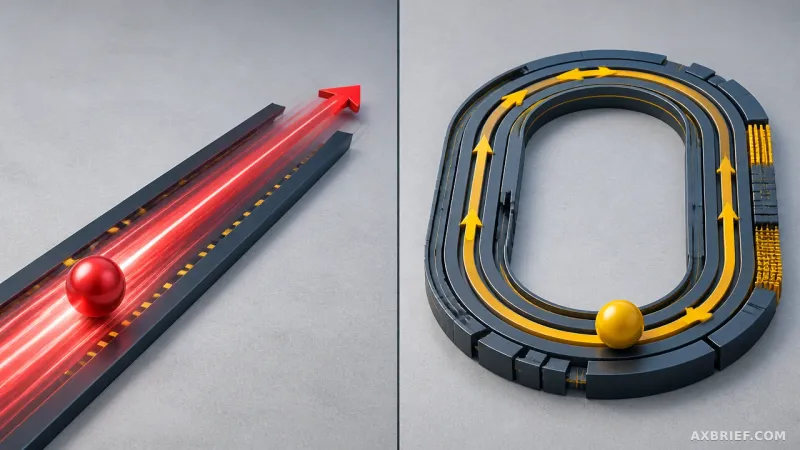
For years, the gap between a working AI prototype and a deployable product has been a tedious stretch of boilerplate code. An engineer spends a week perfecting a complex chain of model calls, only to spend another week writing FastAPI wrappers, defining Pydantic schemas, and wrestling with a frontend framework just to make that logic accessible to others. The friction is not in the AI logic itself, but in the translation of that logic into a usable interface and a stable API. This repetitive cycle of building the engine and then building the dashboard has long been the primary bottleneck in AI prototyping.
The Architecture of Visual Pipelines
Gradio is attempting to erase this friction with the release of `gr.Workflow`, a node-based graph interface that allows developers to design AI pipelines through a drag-and-drop canvas. In this environment, the pipeline is no longer a hidden sequence of Python calls but a visible map consisting of three primary node types: Reference, Operator, and Subject. Reference nodes serve as the entry points, capturing user input. Subject nodes act as the terminal points, delivering the final output. Between them lie Operator nodes, where the actual computation happens.
These Operator nodes are highly flexible. A developer can assign a custom Python function, a model from Hugging Face Inference Providers, an existing Gradio Space, or even a specific row from a Hub dataset as an operator. To connect these nodes, developers drag type-based ports, ensuring that only compatible data types can be linked. Once the graph is constructed and the Run button is pressed, the system executes the operations in the defined sequence. The entire workflow is then deployable to Hugging Face Spaces with a single command, transforming a visual diagram into a live web service without requiring manual server configuration.
From Visual Graphs to Parallel Infrastructure
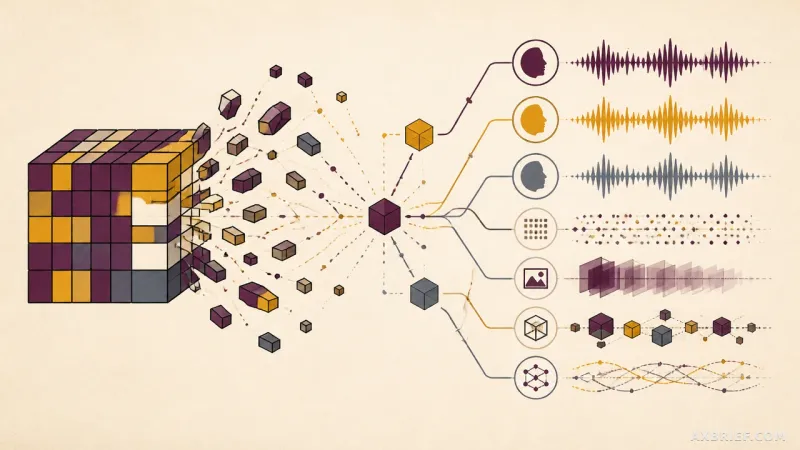
The real shift occurs when moving beyond linear sequences into the fan-out pattern. Unlike traditional sequential scripts, `gr.Workflow` allows a single input to trigger multiple operators simultaneously. This parallel execution significantly reduces total response time and allows for complex, multi-modal outputs from a single prompt. In the Generative Art Lab example, a single text prompt is distributed to three separate paths: two different FLUX model nodes generating watercolor and cyberpunk interpretations, and one LLM node drafting a gallery title. All three processes run in parallel, delivering a comprehensive creative package instantly.
Similarly, the Data Detective implementation demonstrates this efficiency by routing a dataset ID through four independent analysis nodes. One node generates a summary card, another provides a row preview, a third calculates column statistics, and a fourth creates distribution charts. Because these nodes operate independently, the user receives a full diagnostic suite without waiting for each analysis to finish sequentially.
To handle the heavy lifting of these parallel tasks, Gradio integrates Hugging Face Inference Providers and ZeroGPU. By using Inference Providers, developers can offload computation to external servers, calling models like Qwen-Image-Edit without consuming their own local GPU resources. For logic that requires internal execution, the `fn` node allows for the integration of standard Python functions, enabling a hybrid approach where an external provider generates an image and a local LLM function generates a caption.
Resource management is further optimized through the `@spaces.GPU` decorator. This enables ZeroGPU dynamic allocation, meaning a GPU is only occupied the moment a node executes and is released immediately upon completion. This is critical for memory-intensive tasks, such as the LTX-Video animator demo using the Diffusers library, where resources are allocated on a per-request basis to maximize throughput.
Perhaps the most disruptive feature is that the visual graph is not just a UI builder—it is an API generator. Every Subject node in the workflow is automatically converted into a REST API endpoint based on its label. In the AI Media Studio workflow, naming output nodes as sticker, voiceover, and episode_title automatically creates `/sticker`, `/voiceover`, and `/episode_title` endpoints. This removes the need to write any backend routing code.
Developers can interact with these endpoints using the `GradioClient` library in Python:
from gradio_client import GradioClientclient = GradioClient('space_name')
result = client.predict(
api_name='/sticker',
api_input=[...]
)
For environments requiring standard HTTP communication, the endpoints are accessible via `curl` using POST requests with JSON payloads:
curl -X POST https://space_url/sticker -d '{"data": "value"}'This architecture transforms the role of the AI engineer. Instead of modifying UI code or rewriting API routes, developers now perform rewiring—simply changing the connection lines on the canvas to alter the data flow. Because the entire workflow is defined by a JSON schema, these designs can be saved, versioned, and replicated across projects. Detailed implementation patterns and operator types are available in the gr.Workflow guide.
By collapsing the distinction between the pipeline design, the user interface, and the API server, `gr.Workflow` allows engineers to move from an idea to a functional, API-enabled prototype in a fraction of the usual time. The focus shifts from the plumbing of software engineering to the core logic of AI orchestration.