
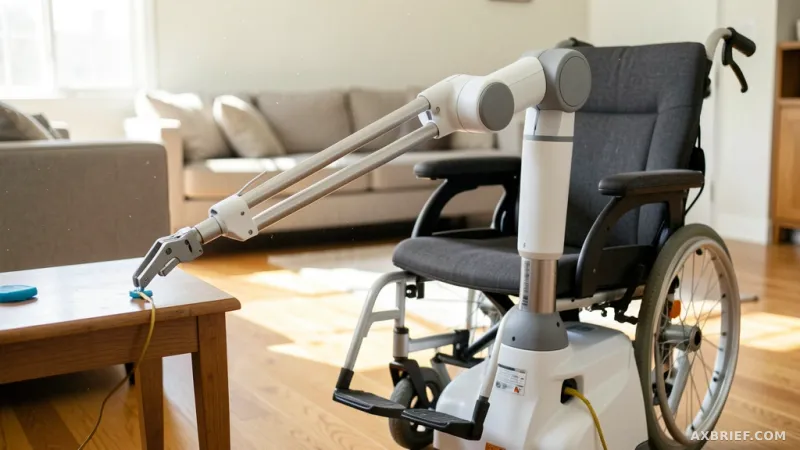
The robotics industry is currently captivated by the humanoid aesthetic. Social media feeds are filled with bipedal machines dancing, walking, or folding laundry, designed primarily to mimic the human form. Yet, for a person living with severe motor impairments, a robot that looks like a human is far less valuable than a robot that can reliably move a glass of water across a table. This gap between viral performance and actual utility is where Hello Robot has positioned its strategy.
The Pedigree of Practical Robotics
Hello Robot has been officially recognized as a 2026 Technology Pioneer by the World Economic Forum (WEF). This designation is granted annually to 100 early-stage companies that demonstrate the potential to fundamentally transform business and society through technological innovation. The company was founded in 2017 by Aaron Edsinger and Charlie Kemp, who brought together more than 50 years of combined robotics experience from institutions including MIT, Google, and Georgia Tech. Operating out of Martinez, California, the firm has dedicated its resources to developing robots that are safe, accessible, and fundamentally practical for home and professional use.
Their primary offering is Stretch, a mobile manipulator platform designed to navigate human environments and interact with physical objects. The previous iteration, Stretch 3, already garnered significant industry attention, winning the RBR50 robotics innovation award in the category of robots for societal benefit. Building on that foundation, the company recently released Stretch 4. This new model is not a minor update but a comprehensive redesign based on extensive customer feedback, specifically engineered to enhance the versatility and robustness of the developer platform.
Utility Over Aesthetics: The Anti-Humanoid Approach
While the broader AI and robotics trend pushes toward two-legged locomotion, Hello Robot has deliberately avoided the humanoid form. Bipedalism is visually impressive but often introduces instability and unnecessary complexity for simple domestic tasks. Instead, Stretch utilizes an omnidirectional wheeled base paired with a lightweight, extendable arm. This architectural choice prioritizes the efficiency of the task over the appearance of the machine. The focus is shifted toward the actual execution of chores, such as opening doors or retrieving items, rather than the spectacle of walking.
By offering this system as an open-source platform, Hello Robot has moved the technology out of the vacuum of the laboratory. The platform is currently deployed across hundreds of research labs, academic institutions, and corporate sites, allowing the robot's behavior to be validated in unpredictable, real-world environments. The most critical application of this approach is seen in pilot programs for individuals with severe motor impairments, including those with quadriplegia. Using a dedicated mobile app, these users can control the robot to perform essential daily tasks, such as fetching water, adjusting window blinds, or assisting with eating. This transition from a controlled demo to a functional tool allows users to expand their range of independent activity without relying on human caregivers.
By focusing on the number of tasks a user can perform autonomously rather than the visual fidelity of the robot, Hello Robot is redefining the metric of success for service robotics.
The success of Stretch 4 suggests a future where the value of physical AI is measured by the autonomy it restores to the user rather than the spectacle it provides the observer.



