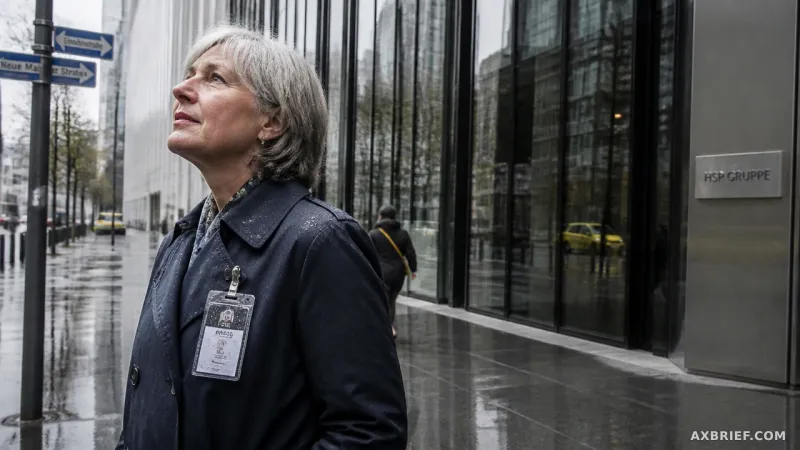
For decades, the professional services industry has operated on a fundamental tension between billable hours and actual value. In tax advisory, auditing, and legal work, the 'grind'—the hours spent synthesizing documents, cross-referencing regulations, and preparing initial drafts—is often seen as an unavoidable cost of precision. A partner evaluating a complex real estate investment typically spends nearly a full workday just on the preliminary analysis. But for Magdalene Posnak, a partner at HSP GRUPPE, that window has collapsed. What once took nine hours now takes approximately two. This shift is not the result of a few clever prompts or a fragmented use of AI tools, but rather a systemic overhaul of how a professional services network functions.
The Architecture of an AI-Driven Tax Network
HSP GRUPPE, a comprehensive network of tax advisors, auditors, and legal professionals, did not approach generative AI as a software upgrade, but as an operational pivot. While many firms treat AI as a way to write emails faster, HSP GRUPPE integrated ChatGPT Enterprise across 81 distinct organizational groups in collaboration with Kanzleipakt. The scale of this deployment is matched by a rigorous governance framework designed to prevent the common pitfalls of LLM adoption in highly regulated fields. The technical foundation relies on shared workspaces within ChatGPT Enterprise, but the actual application is governed by strict internal data protection and confidentiality protocols.
To ensure that AI does not compromise professional standards, the firm adheres to a strict human-in-the-loop mandate. Every AI-generated output must be reviewed and signed off by a qualified tax, legal, or accounting expert who assumes full professional responsibility for the result. In this model, the AI is explicitly positioned as a preparation engine—reducing the time required to gather and structure information—while the final professional judgment remains an exclusively human domain. This structural guardrail allows the firm to scale efficiency without sacrificing the fiduciary duty owed to their clients.
To prevent the fragmentation of knowledge, HSP GRUPPE established a monthly AI Forum. This is not a training seminar, but a peer-to-peer exchange where employees share specific, high-impact use cases discovered in the field. By institutionalizing the sharing of prompts and workflows, the firm ensures that a breakthrough in one office becomes a standard capability across all 81 groups, effectively raising the baseline competency of the entire organization.
From Productivity Tools to Agentic Workflows
The true distinction in the HSP GRUPPE model is the transition from using AI as a chatbot to deploying it as a series of specialized agents. The firm has standardized successful use cases into Custom Agents that act as digital specialists. For instance, the AI Client Communication agent does more than draft text; it ensures a consistent, client-oriented tone and structures complex technical advice into clear, actionable communication. Similarly, the Booking Assistant SKR03 & SKR04 agent automates the tedious classification and preparation of voucher entry queries, removing the repetitive manual labor that typically bogs down junior accountants.
This standardization allows senior leadership to use AI as a high-level cognitive partner. Managing Partner Frank Heibel utilizes ChatGPT as a technical sparring partner to refine complex tax queries and polish client communications. Managing Director Marco Sell employs AI-driven dashboards to explore financial scenarios in real-time during client meetings, transforming a static consultation into a dynamic strategic session. For Jan-Henrik Leifelt, a lawyer and tax advisor, the AI does not replace his judgment but augments it, allowing him to spend less time on information retrieval and more time on high-value legal strategy.
However, the most significant shift is currently unfolding in a pilot program for ChatGPT Work. HSP GRUPPE is moving beyond reactive AI—where a user asks a question and receives an answer—toward Agentic AI, where the system can autonomously coordinate multi-step processes. The primary target for this evolution is the year-end closing process. Traditionally, this is a reactive cycle: accountants begin closing the books, discover missing documents months after the fact, and then scramble to request them from the client.
By leveraging agentic workflows, HSP GRUPPE is building a system that continuously monitors ledgers throughout the year. The AI identifies missing information in real-time and proactively requests the necessary documentation from the client before the accountant even opens the file. This transforms the year-end closing from a stressful recovery operation into a streamlined verification process. Through a partnership with Kanzleipakt, the firm is now developing a DATEV-centric AI process team to document these experiments into scalable, referenceable workflows.
Professional services are moving toward a future where the expert no longer performs the preparation, but instead audits an autonomously prepared result.