The era of AI confined to a chat window is ending. For the past few years, the global tech community has been captivated by the generative capabilities of large language models that can write poetry or generate photorealistic images from a prompt. However, a quiet but profound shift is occurring in the developer and engineering circles. The focus is moving from the digital screen to the physical world, transitioning from generative AI to embodied AI. This movement is not about making a chatbot smarter, but about giving that intelligence a body—a robotic arm, a delivery drone, or an autonomous factory floor—that can perceive, decide, and act within the messy, unpredictable constraints of reality.
The Blueprint for Physical AI Integration
On July 8, 2026, Incheon National University (INU) formalized a strategic pivot toward this frontier by signing a comprehensive memorandum of understanding with the Korea Physical AI Association (KPAA). The partnership is designed to build a robust industry-academic cooperation system specifically tailored for Physical AI, a domain where artificial intelligence integrates with robotics, mobility, manufacturing equipment, and logistics systems. Unlike traditional AI, which operates in a vacuum of data, Physical AI requires the intelligence to interact directly with physical environments to perform real-world tasks.
The scope of this agreement is expansive, focusing on the cultivation of specialized talent and the creation of a pipeline between the university and KPAA member companies. The two organizations intend to launch joint research and development projects and identify empirical business opportunities to verify how these technologies perform in the field. This is not merely an academic exercise; the framework includes professional training for current employees, technical exchange programs, and direct links to employment and recruitment. Furthermore, the partnership will jointly plan national R&D projects and government-led initiatives to ensure that the educational curriculum is directly informed by the actual demands of regional industries.
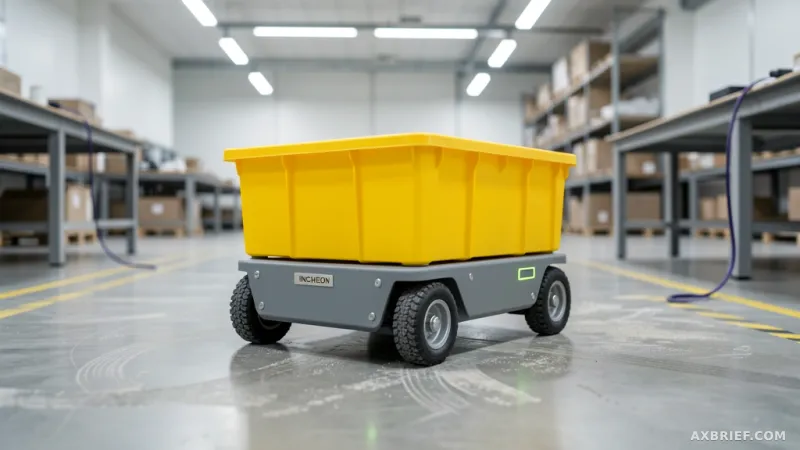
Central to this ambition is Incheon National University's recent global achievement. In its first appearance in the Smart Manufacturing League (SML) of the RoboCup 2026 Incheon Industrial category, the university secured first place in the world. This victory was not a fluke of software optimization but a demonstration of full-stack engineering. The INU team successfully executed every critical challenge of a modern industrial site, including robot design, autonomous navigation, precision manipulation, and the complex processes of assembly and loading. By winning on the global stage, the university proved it possesses the necessary control capabilities to manage hardware in a physical environment.
Beyond the Model: The Precision Gap
To understand why this partnership matters, one must recognize the fundamental tension between digital AI and Physical AI. In the world of LLMs, success is often a matter of scaling—more parameters, more data, and more compute. However, in the physical world, the size of the software model is secondary to the precision of hardware control and the ability to adapt to environmental variables. A model can theoretically understand how to pick up a fragile object, but if the actuator has a millimeter of play or the sensor fails to account for a change in lighting, the operation fails. This is the precision gap that separates a simulation from a solution.
This is where the synergy between INU's technical prowess and Incheon's geography becomes a strategic advantage. Incheon is not just a city; it is a living laboratory for AI transformation, or AX. With its massive infrastructure—including a global airport, a major seaport, sprawling logistics hubs, and dense manufacturing complexes—the city provides the ideal environment to test and scale Physical AI. While other institutions might struggle to find real-world testing grounds, INU is positioned in the heart of the very industries that require AI transformation the most.
The Korea Physical AI Association acts as the bridge in this ecosystem. By converting the technical needs of its member companies into joint university projects and research tasks, the association ensures that the academic output is not theoretical but applied. When a company identifies a specific bottleneck in a logistics warehouse, that problem becomes a classroom project or a research goal at INU. This creates a feedback loop where industrial demand shapes the curriculum, and the curriculum produces talent capable of solving immediate industrial problems.
By combining the world-class design and manipulation skills proven at RoboCup 2026 with the logistical infrastructure of Incheon, the university is moving beyond the goal of simply teaching AI. It is building a pipeline for deployable intelligence. The focus has shifted from asking what AI can say to asking what AI can do on a factory floor.
This integration of global competitive excellence and regional industrial infrastructure marks the beginning of a new standard for how AI talent is developed for the physical economy.