The typical workflow for training a robotic arm is a grueling exercise in patience and manual labor. A researcher spends hours meticulously positioning a table, adjusting the lighting to avoid glare, and performing hundreds of manual demonstrations to teach a robot how to push a simple object. One accidental bump to the table or a slight shift in the light source can invalidate an entire dataset, forcing the team to start from scratch. This physical bottleneck, often called the data tax, has long been the primary barrier to scaling physical AI, as the time required to collect high-quality real-world data grows exponentially with the complexity of the task.
The Architecture of a Pixel-Based World Model
To break this cycle, researchers have developed the Interactive World Simulator, a model that allows imitation learning policies to be trained using 100% simulation data with zero reliance on real-world demonstrations. Unlike traditional simulators that rely on complex physics engines to calculate forces and collisions, this system is an action-conditioned video prediction model. It operates entirely in pixel space, predicting the next frame of a video based on the current image and the robot's intended action. By treating physics as a visual prediction problem rather than a mathematical one, the model bypasses the need to manually define the geometric structures, contact dynamics, or friction coefficients of every object in the scene.
Performance is optimized for accessibility, achieving a runtime of 15 FPS on a single consumer-grade RTX 4090 GPU. This allows for real-time interaction where a user can control a virtual robot via a remote device and see the model generate the resulting visual sequence instantaneously. Crucially, the simulator maintains physical plausibility over long horizons, with the ability to perform predictions lasting over 10 minutes without the video quality collapsing or the physics breaking down.
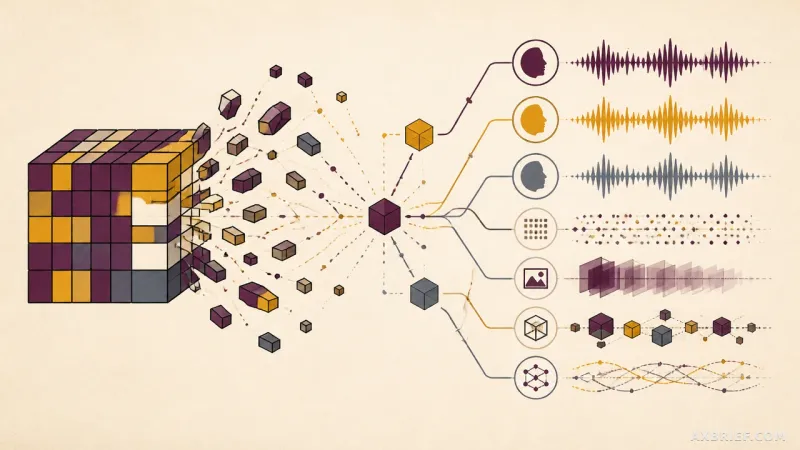
To handle the immense computational load of predicting high-resolution pixels, the system employs a two-stage learning structure. In the first stage, an autoencoder is trained to compress RGB images into a low-dimensional 2D latent representation. This process strips away redundant visual information, allowing the model to reason within a compact vector space rather than processing millions of individual pixels. Once the autoencoder is trained, its weights are frozen to provide a stable coordinate system for the second stage: the action-conditioned dynamics model. This dynamics model takes the previous latent state and the robot's action sequence as input to predict the next latent state, which is then passed through the decoder to reconstruct the final pixel image.
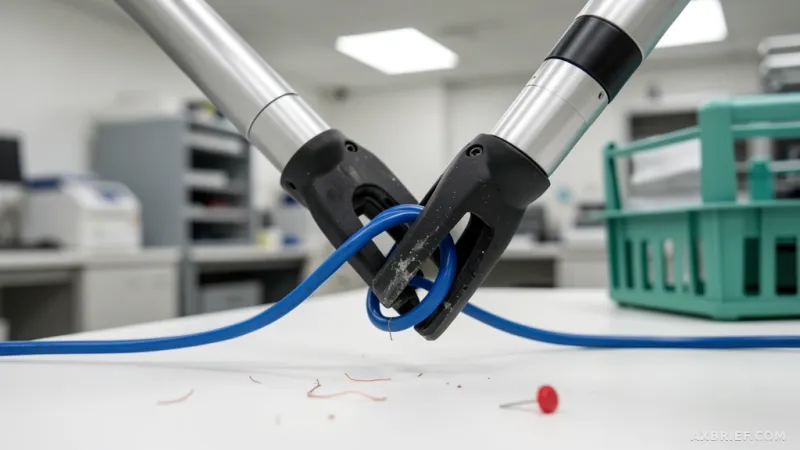
To solve the problem of error accumulation—where small mistakes in early frames lead to a blurred, unrecognizable image over time—the researchers integrated consistency models. These models reduce the number of sampling steps required for generation, increasing response speed while ensuring that the visual output remains stable and physically consistent even during extended simulations. The versatility of this approach was tested across four distinct manipulation tasks: T-pushing for rigid body contact, rope routing for deformable object interaction, mug grasping for precision gripper dynamics, and dummy sweeping for multi-object manipulation. In the rope routing task, the model successfully distinguished between a rope being inserted into a clip versus sliding past it, while in the mug grasping task, it captured the subtle dynamics of a cup slipping or a handle rotating.
Bridging the Sim-to-Real Gap Through Data
The shift from mathematical physics to data-driven video prediction addresses the most persistent failure point in robotics: the Sim-to-Real gap. Traditional simulators require developers to manually input friction coefficients and surface stiffness. Because it is impossible to mathematically model every variable of the real world, policies trained in these environments often fail when deployed on physical hardware. The Interactive World Simulator eliminates this manual tuning by learning the laws of physics directly from interaction data. Instead of a human telling the model how a rope should bend, the model infers the behavior from the visual patterns of previous interactions.
This approach transforms the simulator from a mere training ground into a high-fidelity evaluation tool. The research team tested this by training imitation learning policies—specifically DP, ACT, $\pi_0$, and $\pi_{0.5}$—using only simulator-generated data. When these policies were deployed on a physical robot, they did not just complete the tasks; they demonstrated robustness against external perturbations, such as when an object was pushed or moved during the operation. This proves that a pixel-based world model can capture enough physical nuance to prepare a robot for the unpredictability of the real world.
More importantly, the researchers discovered a strong quantitative correlation between simulator scores and real-world success. By evaluating different model checkpoints, they found that a policy that performed well in the Interactive World Simulator almost always performed well on the physical robot, and vice versa. This alignment means that the simulator can serve as a reliable filter. Instead of risking expensive hardware by deploying every experimental checkpoint to a physical arm, developers can run thousands of iterations in the simulator and only deploy the top-performing candidates.
This capability fundamentally changes the economics of robot development. The need for constant scene resets—the manual process of returning objects to their starting positions—is drastically reduced. High-risk maneuvers that could potentially break a gripper or damage a motor can be perfected in the virtual environment. By moving the filtering and optimization stages entirely into the simulator, the development cycle is compressed from weeks of manual data collection to hours of automated simulation.
By removing the requirement for specialized physics modeling expertise and massive computing clusters, the Interactive World Simulator lowers the barrier to entry for physical AI. The ability to achieve professional-grade policy verification on a single RTX 4090 means that small research teams can now implement data augmentation pipelines that were previously reserved for labs with industrial-scale infrastructure. The transition from trial-and-error hardware testing to quantitative, simulation-led verification marks a pivotal shift in how robots are taught to interact with the world.
Robot learning is no longer a battle against the physical constraints of the lab. With the success of 0% real-data training, the benchmark for a robot's readiness is no longer determined by the number of manual demonstrations, but by the quantitative data generated within a latent world model.