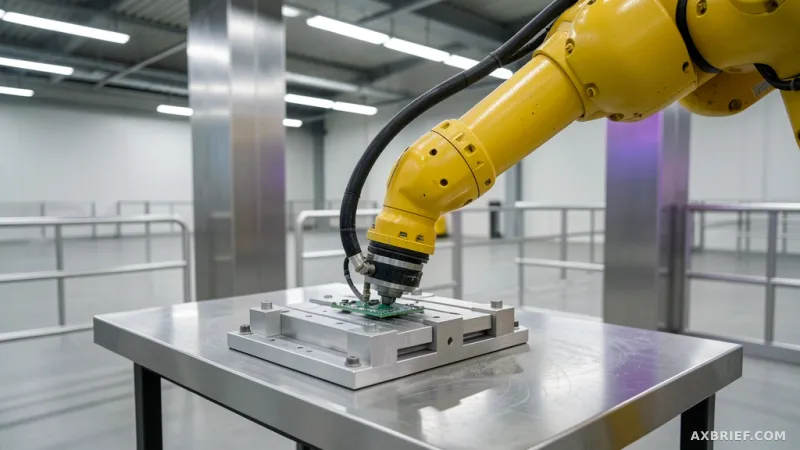
For decades, the industrial factory floor has operated on a principle of rigid precision. Deploying a single industrial robot typically requires a specialized engineer to spend months writing thousands of lines of complex, proprietary code. In this environment, the cost of change is prohibitively high; if a product design shifts by a few millimeters or a production line needs to pivot to a new part, the entire programming cycle often starts over. This friction has kept advanced automation out of reach for smaller manufacturers who cannot afford the luxury of months-long downtime for every iteration.
The Modular Architecture of IntrinsicOS
At the Automate 2026 exhibition in Chicago on May 22, 2026, Intrinsic addressed this bottleneck with the reveal of the Intelligence Cell. This new system moves away from traditional scripting and instead introduces a drag-and-drop interface that allows users to configure robotic tasks visually. The foundation of this capability is IntrinsicOS, a modular software architecture designed to decouple the high-level logic of a task from the low-level hardware commands of the robot.
During the live demonstration at the event, a FANUC robot was tasked with assembling electronic components. Rather than relying on a pre-baked script, the system demonstrated how processes and tools could be reconfigured on the fly. By dragging and dropping functional modules, operators could alter the assembly sequence or swap tools without writing a single line of code. This approach specifically targets high-mix production—the industry term for manufacturing small batches of diverse products—which has historically been the most difficult environment to automate due to the constant need for reprogramming.
Shifting the Bottleneck from Coding to Configuration
The true significance of the Intelligence Cell lies in its transition from robot programming to process orchestration. While traditional automation focuses on the how—the exact coordinates and joint angles of a robotic arm—Intrinsic is shifting the focus to the what. By integrating perception, automated motion planning, and sophisticated grasping and insertion capabilities, the system allows the AI to handle the geometric complexities of the physical world.
To prove this viability at scale, Intrinsic is launching a massive manufacturing pilot project with Foxconn later this year. This partnership aims to move the technology from a controlled exhibition floor to the chaotic reality of global electronics assembly. Simultaneously, Intrinsic is partnering with CNC system integrators, including Trinity Automation and Martin Systems. These collaborations integrate the Intelligence Cell into computer numerical control environments, enabling shop-floor workers to operate precision machining robots directly, bypassing the need for external programming consultants.
However, the most difficult hurdle in physical AI remains dextrous manipulation—the ability to handle non-rigid objects. To solve this, Intrinsic has partnered with Open Robotics to launch the AI for Industry Challenge. With a prize pool of 180,000 dollars, the challenge specifically targets the manipulation of cables and connectors. Because cables are deformable, they cannot be predicted with simple coordinates, making them the final frontier for fully autonomous electronic assembly. By crowdsourcing the solution to this specific problem, Intrinsic is attempting to bridge the gap between rigid industrial movement and human-like dexterity.
The barrier between the engineer's keyboard and the factory floor is finally dissolving.