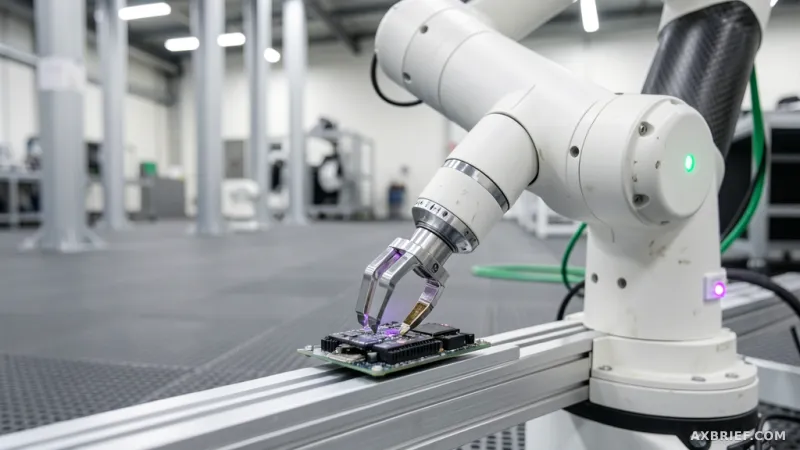
Most of the world currently experiences artificial intelligence as a dialogue trapped behind a glass screen. Whether it is the linguistic dexterity of ChatGPT or the multimodal capabilities of Gemini, the current AI boom is largely a digital phenomenon. However, for AI to move from generating text to assembling components on a factory floor or performing precision surgery in a clinic, it must break the screen barrier. This transition requires a fundamental shift from generative intelligence to physical intelligence, where software can seamlessly interact with the chaotic variables of the material world. To lead this transition and reduce reliance on foreign technology, the South Korean Ministry of Science and ICT has launched the second iteration of the Physical AI Alliance.
The Blueprint for a Sovereign Physical AI Ecosystem
The launch event took place on June 19 at the Grand Ballroom of The Plaza Hotel in Seoul, drawing a crowd of over 200 key stakeholders. The assembly included high-ranking officials such as Deputy Prime Minister Bae Kyung-hoon, members of the National Assembly including Jung Dong-young, Choi Hyung-du, and Hwang Jung-ah, as well as the heads of the Korea Artificial Intelligence and Software Industry Association (KOSA), the National IT Industry Promotion Agency (NIPA), the Institute for Information & Communications Technology Planning & Evaluation (IITP), and the National Information Society Agency (NIA). This gathering signaled a pivot in strategy. While the first iteration of the alliance, launched in September of last year, focused on policy frameworks and identifying industry pain points, the second iteration is designed for execution.
The central ambition of this initiative is the realization of the K-Physical AI Full Stack. In the context of robotics and embodied AI, a single high-performing model is insufficient. A robot requires a cohesive chain of technology to function: optimized AI semiconductors for edge computing, specialized AI models for spatial reasoning, software for actuator control, high-precision sensors, and a robust computing infrastructure to tie it all together. By developing this entire stack domestically, South Korea aims to eliminate the systemic vulnerability that comes with relying on proprietary foreign solutions for critical industrial infrastructure.
To move these technologies from the laboratory to the field, the government is advancing a Total Solution Platform. This is not merely a software development kit but a comprehensive lifecycle support system. The platform encompasses the entire journey from initial installation to long-term operation, integrating data communication networks and the complex system integration (SI) required to make disparate hardware and software components communicate. By incorporating data centers for heavy computation, rigorous security protocols, and standardized certification processes, the platform ensures that a breakthrough in a research lab can be deployed on a factory floor without months of custom reconfiguration.
From Policy Discussion to Vertical Execution
The shift from the first alliance to the second is most evident in the complete overhaul of its operational structure. The leadership has transitioned to a joint-chair system led by the Ministry of Science and ICT and KOSA. This structure is designed to collapse the distance between government policy and market execution, allowing for faster decision-making and a more agile response to industry demands. The most significant change, however, is the consolidation of the organizational hierarchy. The previous system of ten fragmented sub-divisions has been collapsed into three core strategic pillars to eliminate redundancy and accelerate the pace of development.
The first pillar, the K-Physical AI Full Stack Division, is tasked exclusively with achieving technical sovereignty. Its goal is to ensure that every layer of the AI-to-robot pipeline is supported by domestic innovation. The second pillar, the Vertical Industry Bridge Division, acts as the connective tissue between general-purpose AI and specific market needs. Rather than treating AI as a one-size-fits-all tool, this division focuses on vertical markets such as logistics, agriculture, healthcare, national defense, and disaster management, tailoring the full stack to the unique constraints of each sector.
The third pillar, the Foundation Governance Division, handles the invisible but essential infrastructure of standards, security, and regulatory frameworks. Beneath these three pillars, the alliance has established Action Groups. These are tactical units responsible for turning high-level strategic goals into concrete projects that can be implemented immediately in the field. This transition from a discussion-based alliance to an action-oriented one marks the moment where K-Physical AI moves from a theoretical roadmap to a tangible industrial asset.
This ecosystem is supported by a massive coalition of twelve industry associations, including the Korea AI and Software Industry Association, the Korea Physical AI Association, the Korea AI-Robot Industry Association, and the Korea Fabless Industry Association, among others. These organizations provide the specialized expertise needed to solve the hardest problems in physical AI, such as reducing latency in data transmission and ensuring interoperability between hardware from different manufacturers. To further penetrate the manufacturing sector, the alliance is integrating with the M.AX Alliance. While the Physical AI Alliance provides the overarching technical supply and demand matching, the M.AX Alliance ensures these tools are validated on actual production lines, creating a feedback loop where real-world data continuously refines the underlying models.
Proving the Concept with RLDX-1 and MAIED
The viability of this domestic full-stack approach is already being demonstrated through specific technical milestones. Realworld has introduced the RLDX-1 model, which focuses on the precision manipulation capabilities of robots. In a recent demonstration, two robots worked in coordination to package a computer mouse and place it in a designated location. The significance of RLDX-1 lies in its general-purpose design; it is not locked to a specific hardware specification. By implementing real-time control of minute forces at the fingertips, RLDX-1 proves that a single intelligence model can drive diverse robot forms from different manufacturers with the same level of precision.
Simultaneously, Maum AI has unveiled MAIED, an autonomous intelligence module designed for on-device execution. Unlike cloud-dependent AI, MAIED processes all computations locally within the robot's own hardware. This was demonstrated using the Jindo-bot, a four-legged robotic platform. Equipped with MAIED, the robot could perceive its surroundings in real-time, understand user commands instantly, and perform patrol and safety management tasks without needing a constant connection to an external server.
Maum AI's technical pipeline follows a specific trajectory: World Model Training $ ightarrow$ On-device Execution $ ightarrow$ Finished Robot Application. By training a world model that understands fundamental physical laws—such as gravity and friction—and running that model locally, the system eliminates the latency associated with cloud communication. This allows the robot's physical joints to react with near-instantaneous speed to environmental changes. This capability is critical for high-stakes environments like defense or heavy manufacturing, where a millisecond of lag can result in equipment failure or safety hazards.
These developments suggest that the path toward reducing foreign dependency is not just a policy goal but a technical reality. The combination of RLDX-1's general-purpose control and MAIED's independent decision-making modules demonstrates that precision and autonomy can be achieved without being tethered to overseas cloud infrastructures or proprietary hardware ecosystems. By owning the stack, South Korea gains the ability to deploy AI in environments where data security and operational reliability are non-negotiable.
The transition from conversational AI to physical AI represents the final frontier of the current intelligence revolution. The reorganization of the K-Physical AI Alliance into a streamlined, three-pillar execution engine is a strategic move to capture this frontier. The ultimate measure of success will not be the number of associations involved or the sophistication of the policy papers, but the speed at which these integrated domestic platforms can replace foreign solutions in the actual field.