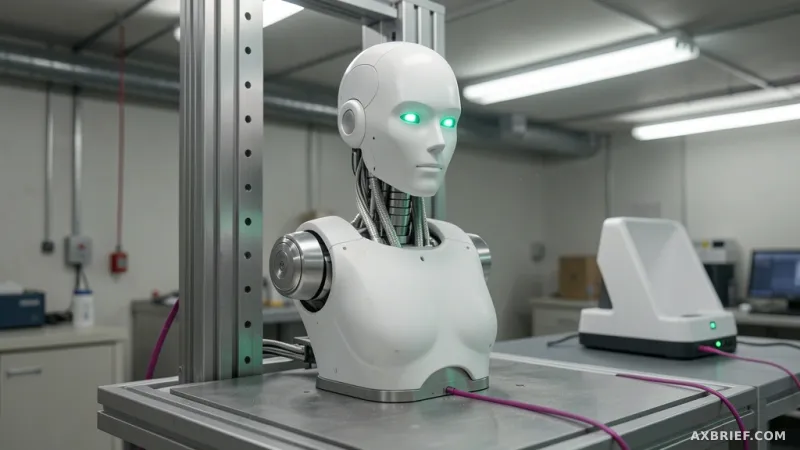
For years, the world has interacted with artificial intelligence through the sterile glow of a monitor. Whether it was the conversational fluency of ChatGPT or the creative sparks of Midjourney, AI remained a digital ghost, trapped in a world of text and pixels. But the boundary between the digital and the physical is dissolving. With the emergence of machines like the Tesla Optimus, AI is gaining a body. We have entered the era of Physical AI, where the intelligence that once lived in a cloud server now inhabits actuators, sensors, and steel, allowing it to navigate the messy, unpredictable reality of a factory floor or a hospital ward.
The Architecture of Embodied Intelligence
Physical AI represents a fundamental shift from traditional robotics. While legacy robots operated on rigid, pre-programmed paths—repeating the same motion with millimetric precision but zero adaptability—Physical AI utilizes foundation models to perceive, reason, and act. These models allow a robot to understand a natural language command, analyze its surroundings via computer vision, and determine the optimal physical movement to achieve a goal. The most potent expression of this technology is the humanoid robot, which is uniquely valuable because it can utilize tools and infrastructure already designed for human proportions.
Building this capability requires a seamless marriage of the brain and the body. The brain consists of AI foundation models trained on massive datasets to handle general-purpose tasks. The body comprises the hardware—sensors for perception, actuators for movement, and controllers for precision. To make this functional, the intelligence must be grounded in real-world data. This is why the global ecosystem is coalescing around a few key players. A recent snapshot of the Nvidia ecosystem highlights the sheer scale of South Korea's potential, listing industrial giants like Samsung, SK, Hyundai Motor, LG, Naver, KT, Doosan, and Hanwha, alongside robotics specialists like Robotis and CMES, and academic powerhouses including KAIST, Seoul National University, POSTECH, GIST, and KISTI.
In South Korea, the responsibility for this integration is split between two primary government entities. The Ministry of Science and ICT (MSIT) focuses on the software brain. Their mandate involves designing AI foundation models, securing the GPU infrastructure necessary for training, and refining the algorithms that allow robots to interpret human intent. Meanwhile, the Ministry of Trade, Industry and Energy (MOTIE) manages the physical body. Their focus is on the supply chain for core components like actuators and reducers, establishing industrial standards for compatibility, and utilizing regulatory sandboxes to test these machines in actual production environments. This division of labor mirrors a strategic attempt to cover the entire stack, from the high-level reasoning of a neural network to the torque of a robotic joint.
The Fragmentation Trap in a Total War
Despite having all the necessary ingredients, South Korea faces a structural crisis that its global rivals have already solved. In the United States and China, Physical AI is being treated as a matter of national security and economic survival, resulting in a total war approach. The US has created a tightly integrated pipeline involving Tesla, Nvidia, Figure AI, Agility Robotics, Apptronik, and Boston Dynamics. China is pursuing a similar trajectory with government-led policies fueling the rapid rise of Unitree, UBTECH, Fourier Intelligence, and Agibot. These nations do not treat AI models, semiconductors, and hardware as separate projects; they treat them as a single, unified organism.
South Korea, by contrast, is suffering from a fragmented R&D structure. The development of AI models, the engineering of robotic parts, and the digital transformation of manufacturing sites are handled by different ministries and agencies in silos. One organization may develop a world-class foundation model, while another develops a high-precision actuator, but there is no overarching national architecture to ensure they work together. This fragmentation means that breakthroughs often remain trapped in academic papers or isolated lab demos rather than being scaled into industrial products.
This disconnect creates a critical bottleneck during the deployment phase. When an AI model is finally ready for a physical body, it often finds that the hardware standards are incompatible. Conversely, when a new component is developed, the researchers lack access to the real-world manufacturing data needed to train the AI to use it, because that data is locked away in a different agency's server. The result is a paradox: South Korea possesses world-leading capabilities in semiconductors, batteries, automotive engineering, and shipbuilding, yet it struggles to synthesize these strengths into a cohesive Physical AI strategy.
The K-Physical AI Manufacturing Grand Challenge
To break this cycle of fragmentation, the government has proposed the K-Physical AI Manufacturing Grand Challenge. This is not another theoretical research project; it is a mission-driven initiative with a hard deadline: full deployment in manufacturing sites within five years. The goal is to move beyond the simulation and tackle the unpredictable variables of the real world. The project will target high-impact environments, including automotive assembly lines, semiconductor back-end processes, electronics production, shipyard welding, logistics picking, hospital assistance, and agricultural automation.
The core philosophy of the Grand Challenge is that the true competitive edge in Physical AI does not come from clean, synthetic datasets, but from raw, unrefined experience data. Robots must be deployed in the field to fail, learn, and iterate. By forcing the AI to interact with the physical world, the project aims to build a robust library of behavior models—the specific calculated paths and methods an AI uses to perform a task. Simultaneously, the initiative will secure the supply chain for critical components, including actuators that convert electrical signals into motion, reducers that increase torque, robotic hands, and high-capacity batteries.
Success depends on the total reconfiguration of R&D. Instead of isolated grants, the government is moving toward integrated projects where the brain (model) and the body (hardware) are developed in tandem, linked by a shared stream of field data. The objective is to transform technical milestones into productivity metrics that can be measured on a factory floor.
Establishing a Unified Control Tower
To ensure this integration actually happens, the MSIT and MOTIE are proposing a joint National Physical AI and Humanoid Industrialization Town Meeting. This is designed to be a strategic war room rather than a traditional seminar. The operational execution will be handled by a partnership between the Physical AI Association (under MSIT) and the Korea AI Robot Industry Association (under MOTIE). The former will manage the models and infrastructure, while the latter handles the components and field application.
This joint structure is intended to act as a bridge, removing the bureaucratic walls that have historically slowed the transition from lab to market. The primary agenda of this control tower is to consolidate fragmented R&D tasks into single, integrated projects to eliminate resource waste. Furthermore, the task force will address the urgent demands of industry practitioners: the creation of clear safety standards and the expansion of regulatory sandboxes. Without these legal and safety frameworks, companies are hesitant to deploy humanoid robots into active production lines, regardless of how intelligent the AI is.
The Korea AI Robot Industry Association is expected to evolve into a private-sector execution platform, connecting demand-side companies with supply-side innovators. By turning field data into a national asset and streamlining the path from policy to deployment, South Korea aims to reclaim its position in the global robotics race.
The transition of AI from a screen-based assistant to a physical entity is an inevitable evolution. The success of K-Physical AI will not be judged by the elegance of its code or the precision of its motors in a controlled environment, but by its ability to function in the chaos of a real factory. The survival of South Korea's industrial edge now depends on whether it can finally merge its digital brain with its physical body.