
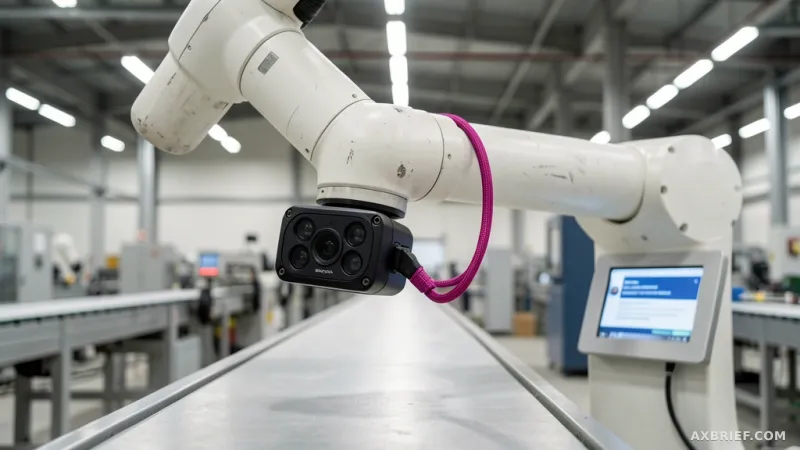
The gap between a successful AI simulation and a functioning robot on a warehouse floor is often a mess of cables, signal latency, and hardware incompatibility. For years, robotics developers have faced a recurring bottleneck known as the hardware integration tax, where the time spent wiring cameras to separate processing units outweighs the time spent refining the actual AI models. This friction has kept many promising autonomous systems trapped in the prototype phase, unable to scale into the chaotic environments of real-world industry.
The Infrastructure of Physical AI
Luxonis is positioning itself as the primary bridge across this gap. The company recently closed a $14 million Series A funding round led by Denali Growth Partners and Taiwania Capital to accelerate the deployment of its robot vision platform. Since its founding in 2019, Luxonis has scaled its footprint rapidly, securing a customer base that includes over 60 Fortune 500 companies and 17 of the 30 firms in the Dow Jones Industrial Average. This institutional adoption signals a broader shift toward Physical AI, where intelligence is embedded directly into the hardware that interacts with the world.
The new capital is earmarked for critical scaling efforts, specifically strengthening supply chain capabilities and expanding research, development, and engineering support teams. The company's target sectors are diverse, spanning agriculture, advanced robotics, defense, industrial automation, heavy equipment, medical technology, and logistics. At the heart of this expansion is the OAK camera series and the DepthAI SDK, an open-source software development kit that provides depth perception and on-device AI capabilities. To date, DepthAI has seen over 6 million downloads, reflecting a massive developer appetite for tools that simplify the transition from a proof-of-concept to a production-ready product.
Collapsing the Distance Between Sensor and Compute
While many vision systems rely on a separate GPU or a central server to process visual data, Luxonis has shifted the architecture by integrating the sensor and the computation into a single device. This on-device processing eliminates the latency and bandwidth issues inherent in sending raw high-resolution video streams across a network. The latest iteration, OAK4, doubles down on this industrial utility by supporting both PoE+ (Power over Ethernet) and USB-C deployments. This flexibility allows developers to choose between the high-speed data transfer of USB or the long-distance power and connectivity required for large-scale factory installations.
The strategic value of this integration is further amplified by Luxonis' official support within NVIDIA Isaac Sim. By allowing developers to test their OAK cameras within a high-fidelity simulation environment, the company has effectively removed the trial-and-error phase of physical deployment. Instead of guessing how a sensor will behave in a specific lighting condition or spatial configuration, engineers can validate their agentic AI workflows in a digital twin before shipping a single piece of hardware. The result is a drastic reduction in the time it takes to move a vision system from a laboratory setting to a live industrial site.
By collapsing the distance between the robot's eye and its brain, Luxonis is transforming the complex task of spatial awareness into a standardized utility.



