
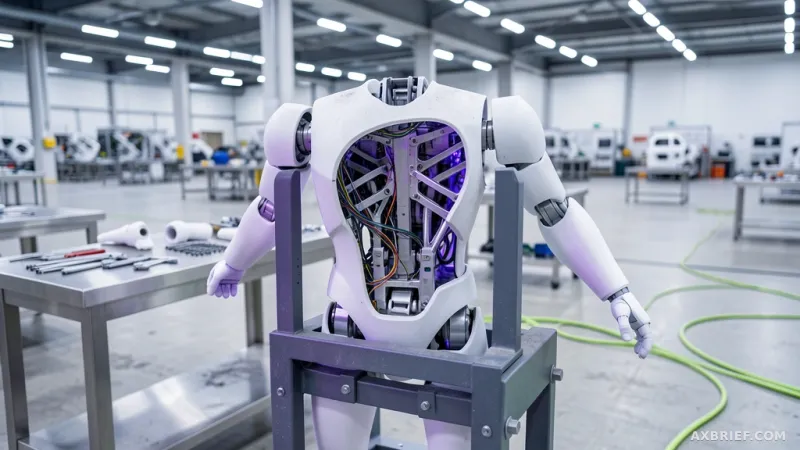
The robotics industry has spent the last few years captivated by the spectacle of the single, high-performing prototype. From Tesla's Optimus to Figure AI, the narrative has centered on the breakthrough of a specific movement or the fluency of a natural language interaction. However, a quiet but critical shift is occurring in the hardware layer. The conversation is moving away from whether a robot can perform a task in a controlled laboratory and toward whether a company can manufacture ten thousand of them without a catastrophic failure rate. This transition from experimental robotics to industrial scale is where the real battle for Physical AI is being fought.
The Blueprint for Humanoid Mass Production
LYiTECH has officially entered this industrial phase with the launch of its intelligent robot super factory in the Beijing Economic-Technological Development Area. This facility represents the first production plant in the Beijing-Tianjin-Hebei region capable of an annual output of 10,000 humanoid units. The speed of the rollout itself serves as a signal of intent; the company began operations on February 9 and produced its first robot by April, meaning the entire process of line construction and debugging took only 2 months and 13 days.
Currently, the manufacturing cycle for a single unit—from the initial assembly of components to the final deployment—takes between 30 and 40 hours. LYiTECH has set an aggressive internal target to reduce this window to 20 hours per robot. The factory is designed for vertical integration, handling every stage of the lifecycle including the fabrication of core components, module assembly, final integration, and rigorous stress testing. This is not a static setup, but a scalable one. The company plans to double its capacity to 20,000 units next year, with a long-term roadmap targeting 500,000 units per year by 2030.
From Lab Performance to Manufacturing Yield
While the raw numbers are impressive, the true technical achievement lies in the factory's agility and its approach to quality control. In traditional hardware manufacturing, changing a production line to accommodate a new model often takes days or weeks of retooling. LYiTECH has bypassed this bottleneck by integrating force sensors and vision-guided precision assembly. This allows the facility to execute a complete model transition in under 15 minutes. In an era where AI models and hardware requirements evolve weekly, the ability to pivot production lines almost instantly is a strategic advantage that prevents hardware from becoming obsolete before it even leaves the factory.
Efficiency extends into the testing phase, where the company has replaced traditional conveyor belts with circular overhead rails. This system allows 6 to 12 robots to undergo simultaneous testing for functionality, motion, communication, and safety without requiring secondary transport. By implementing DC motor drives and an energy feedback system, the plant has reduced energy consumption by 25% compared to standard production lines while minimizing the physical movement of the units.
The most critical layer of this operation is the digital quality management system based on Serial Number (SN) codes. Every single component is assigned a unique identifier that links it to a digital twin. This code tracks the exact torque applied to every screw, the calibration data of every joint module, and the specific motion curves of the machine. When a defect is detected, the system uses a cloud-based closed-loop and AI-driven root cause analysis to optimize quality within 24 hours. By tracking the lifecycle of individual parts, LYiTECH is attempting to eliminate the unpredictability that usually plagues the transition from prototype to mass production.
The gap between a viral demonstration video and actual market penetration is bridged by manufacturing efficiency. By establishing a 10,000-unit capacity and a 15-minute model switch capability, LYiTECH is shifting the value proposition of humanoids from laboratory performance to industrial viability. The success of the robotics industry will no longer be measured by the grace of a single machine, but by the yield rate and supply capacity of the factory.



