
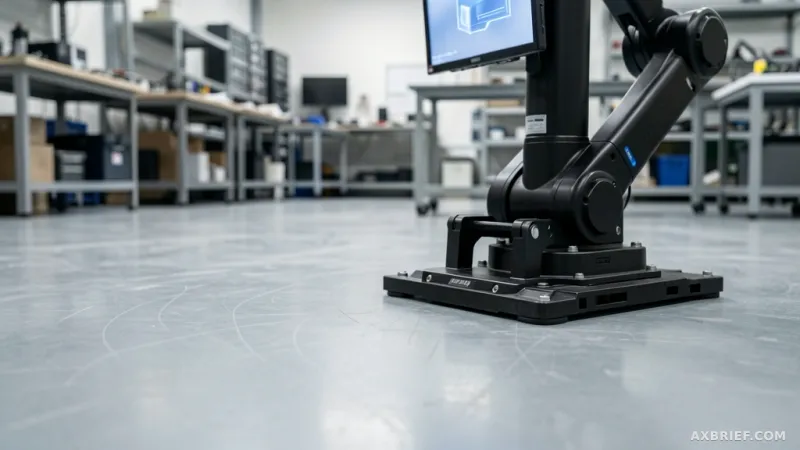
A single millimeter of misalignment in a robotic arm's path can lead to a catastrophic collision, halting an entire production line and costing a manufacturer thousands of dollars per minute in downtime. For years, the industry has relied on a high-stakes cycle of install, crash, and calibrate. This tension between the theoretical design and the physical reality of the factory floor has created a bottleneck in the deployment of complex automation. As the industry pivots toward Physical AI, where intelligence must interact seamlessly with the material world, the cost of these early-stage errors has become unsustainable.
The Architecture of Digital Replication
To address these systemic risks, PCM recently unveiled MELSOFT Gemini, a software solution designed to replicate entire manufacturing environments within a high-fidelity 3D virtual space. The technology was showcased during the Korean Society of Mechanical Engineers Gyeongnam Branch Spring Conference, held from May 25 to May 26, 2026, at the Sono Calm Hotel and Resort in Geoje. The core utility of MELSOFT Gemini lies in its ability to create a comprehensive digital twin that encompasses production facilities, robotic units, and the intricate flow of logistics.
Rather than relying on static blueprints, the software allows engineers to design process layouts and verify robot movements offline. During the event, PCM demonstrated a robot demo kit that illustrated the real-time synchronization between a 3D virtual model and actual hardware. This synchronization serves as the foundation for Digital Transformation (DX), providing a physical replication environment where the behavior of a robot in the virtual world mirrors its real-world counterpart with precision. By mapping every coordinate and movement before a single piece of hardware is bolted to the floor, the software transforms the layout process from a guessing game into a deterministic science.
From Visual Simulation to Logic Verification
While many tools offer 3D visualization, the critical distinction of MELSOFT Gemini is its focus on virtual commissioning. Most simulation software provides a visual approximation of how a factory might look, but virtual commissioning tests how the factory actually thinks. This process involves running the actual control logic and algorithms against the virtual model to identify design flaws long before the physical equipment is powered on. By shifting the debugging phase from the factory floor to a virtual sandbox, PCM enables manufacturers to drastically reduce on-site commissioning time and accelerate the timeline for final product production.
This capability is particularly vital for the stability of Physical AI, specifically regarding the complex control logic required for Autonomous Guided Vehicles (AGV) and intelligent robotic arms. In a traditional setup, testing a new AGV pathing algorithm involves the risk of physical collisions with walls or other machinery. MELSOFT Gemini removes this risk entirely. Engineers can iteratively test and refine control algorithms in a zero-risk environment, ensuring that the logic is flawless before it is uploaded to the physical machine. This transition from visual simulation to logical verification ensures that the integrity of the control system is confirmed, preventing the critical schedule delays that typically plague the installation phase of smart factories.
Ultimately, the operational efficiency of a modern manufacturing site is no longer determined solely by the quality of the hardware, but by the rigor of the virtual verification process that precedes it. The ability to fail fast and fail safely in a digital mirror is what allows Physical AI to move from a theoretical concept to a stable, industrial reality.
The gap between a digital blueprint and a functioning production line is now bridged by a mirror that predicts failure before it happens.



