
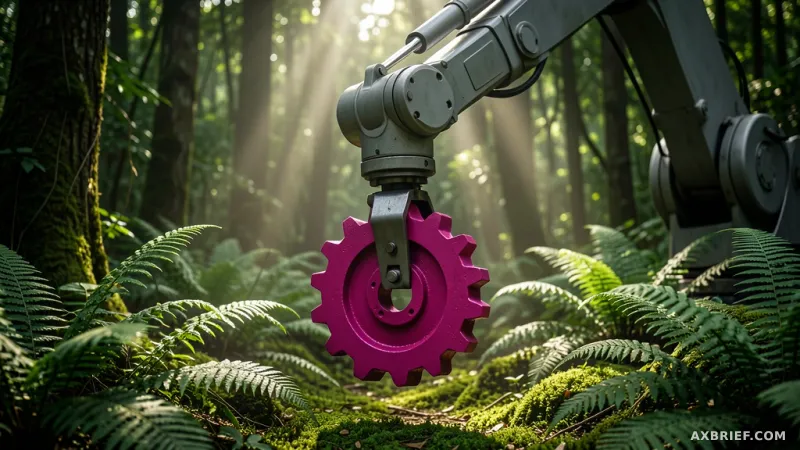
Most of the artificial intelligence breakthroughs dominating the current cultural conversation exist within a digital cage. Whether it is a large language model generating a legal brief or an image generator creating surrealist art, the intelligence remains trapped behind a screen, operating in a world of tokens and pixels. For a developer or a business leader, this digital intelligence is transformative, but it is fundamentally disconnected from the laws of physics. It does not know the weight of a steel beam, the friction of a muddy field, or the precise pressure required to grip a fragile object without crushing it. This gap between digital reasoning and physical action is where the next frontier of robotics begins.
The Four-Way Alliance for Industrial Intelligence
NVIDIA has entered into a strategic collaboration with TorqueAGI, a specialist in robot intelligence, to bridge this gap. This is not a bilateral agreement but a four-way alliance that includes John Deere, the agricultural machinery giant, and Dexterity, a leader in logistics robotics. Together, these companies are pursuing the deployment of Physical AI—intelligence designed specifically to operate within the constraints of the material world—into enterprise-grade robots.
In this ecosystem, the roles are clearly delineated to create a complete industrial supply chain. NVIDIA provides the neural system, supplying the high-performance compute chips and the virtual simulation environments necessary for training. John Deere and Dexterity provide the physical bodies, contributing heavy-duty agricultural machinery and precision logistics hardware, respectively. TorqueAGI serves as the brain, developing the software that translates high-level intelligence into physical movement.
The target is specifically enterprise-grade robots. Unlike consumer robotics, which operate in controlled home environments, enterprise robots must survive in harsh, unpredictable settings like dusty warehouses or uneven farmland. In these environments, a single error can lead to massive economic loss or critical safety failures. To function, these machines require a seamless integration of three elements: a high-performance computing nervous system, a rugged mechanical body, and a real-time decision-making intelligence. By aligning these four companies, the partnership aims to lower the barrier to entry for deploying AI that can actually touch and move the world.
One of the primary hurdles in robotics is the simulation-to-reality gap. A robot that performs perfectly on a clean laboratory floor often fails the moment it encounters the dust of a shipping center or the slopes of a cornfield. This alliance addresses this by combining NVIDIA's simulation technology with John Deere's vast field data and Dexterity's precision control mechanisms. The goal is to create a system where the software learns to handle unpredictable obstacles or unfamiliar objects without requiring a human engineer to manually rewrite the code. More details on this approach can be found at TorqueAGI.
From Scripted Motion to Adaptive Improvisation
To understand why this shift matters, one must look at how industrial robots have operated for decades. Traditional robotics relies on If-Then logic. A developer programs a specific set of coordinates and conditions: if the sensor detects an object at point X, then move the arm to point Y. This method is incredibly efficient for a highly controlled assembly line where every part is in the exact same place every time. However, the moment a box is shifted by two inches or a tool is slightly misaligned, the robot stops or crashes. It is an actor following a rigid script, unable to react to anything not written in the screenplay.
Physical AI replaces this scripted motion with adaptive intelligence. Instead of following a coordinate map, the robot processes a constant stream of sensory data—visual, tactile, and spatial—and converts it into immediate action. This process centers on the actuator, the mechanical component that drives motors and joints. Physical AI analyzes sensor inputs in real-time to determine exactly how much force to apply and in which direction to rotate a joint. It mimics the human ability to feel the weight of an object through fingertips and adjust grip strength instantaneously.
This intelligence is not learned on the job, where mistakes are costly, but in massive virtual simulations. A robot might spend the equivalent of thousands of years in a virtual environment, repeating the act of walking or grasping millions of times while subject to simulated gravity, friction, and mass. Once the AI has mastered the physics of the virtual world, that learned intelligence is transferred to the physical hardware. The result is a machine that no longer needs a script. It becomes an improviser, capable of reading the context of its environment and adjusting its movements on the fly.
This transition transforms the robot from a precise machine into a context-aware worker. When a robot arm in a warehouse handles boxes of varying sizes and weights, it is no longer just repeating a loop; it is calculating the center of gravity and surface texture of each unique object. In the field, a tractor is not just following a GPS line; it is analyzing soil density and crop health to adjust its trajectory and chemical application in real-time. The productivity of the entire operation is no longer limited by the hardware's speed, but by the AI's ability to perceive and react to the physical world.
For practitioners in manufacturing and robotics, particularly in high-tech hubs like South Korea, this signals a critical shift in strategy. The era of focusing solely on hardware precision is ending. The competitive advantage now lies in the integration of high-performance compute—such as NVIDIA's AI chips—with software that can optimize data processing for specific mechanical constraints. If the optimization between the chip and the actuator is lagging, the robot's reaction time slows, and the advantage of Physical AI vanishes.
Industrial leaders must now move beyond building better machines and start building intelligent platforms. The ability to integrate a robot's motor and sensor data into a real-time learning loop is what will separate the next generation of autonomous systems from the static automation of the past. We are moving toward a world where the intelligence is not just in the cloud, but in the muscle and bone of the machines that power the global economy.
This convergence of compute, hardware, and physical reasoning is turning the industrial landscape into a living laboratory for embodied intelligence.



