For years, the bottleneck in surgical robotics has not been the mechanical precision of the arms, but the latency of the simulation. Developers training AI surgeons have lived through a frustrating disconnect where the generative speed of the environment cannot keep pace with the control inputs. This lag creates a temporal gap between a command and its visual manifestation, making real-time closed-loop training nearly impossible without massive server farms. The industry has long sought a world model that can predict the next state of a surgical field instantly, allowing an AI agent to fail, learn, and iterate in a virtual space that feels physically immediate.
The Architecture of Real-Time Generative Simulation
NVIDIA has addressed this latency crisis with Cosmos-H-Dreams, an action-conditioned generative simulator capable of delivering 160 frames per second (fps) on a single NVIDIA RTX PRO 6000 GPU. To put this in perspective, the standard Cosmos-H-Surgical-Simulator typically operates at roughly 10fps. By achieving a 16-fold increase in inference speed, NVIDIA has moved surgical simulation from the realm of offline rendering to real-time interaction. The system functions by taking an initial RGB image frame and a stream of robot kinematics—specifically the angles and positions of the robot joints—to generate a sequence of subsequent frames that update continuously based on action blocks.
The technical foundation of this speed is a distillation process. NVIDIA utilized a teacher-student framework where the heavy lifting of the Cosmos-H-Surgical-Simulator (the teacher) was distilled into a Causal Student model. This student model is a lightweight version designed to sequentially predict the next state based on the previous one. To ensure the model could handle diverse robotic hardware, NVIDIA implemented a 44-dimensional unified action representation. For the dVRK (da Vinci Research Kit) tabletop suturing tasks, this representation maps dual-arm action content, including the relative movement and rotation of the end-effectors and the state of the grippers, into a standardized format the model can process.
Validation of this system occurred across high-fidelity platforms, including the dVRK tabletop setup and the Versius surgical controller platform. Through collaborations with CMR Surgical and Cambridge Consultants, NVIDIA integrated the Versius controller to prove that the model could operate within the constraints of actual surgical hardware. The training data relied on the JHU dVRK tabletop mixed dataset, which is critical because it includes not only successful demonstrations but also failure cases, such as dropped needles or failed knots. By training on these out-of-distribution episodes, the simulator learns the causal consequences of incorrect movements, making it a viable tool for evaluating the robustness of surgical policies.
Solving the Drift with Self-Forcing and FlashDreams
Speed alone is useless if the image degrades over time. In most generative world models, small errors in the first few frames accumulate, leading to a phenomenon known as long rollout drift where the scene eventually blurs or the tools vanish into digital noise. NVIDIA solved this by implementing self-forcing distillation. In this approach, the student model feeds its own generated context back into itself as input, forcing the output to align with the data distribution of the teacher model. This prevents the amplification of recursive errors and ensures that the position of tool tips and the overall structure of the surgical scene remain stable over long durations.
To further stabilize long-term predictions, the team employed a staged expansion of the temporal horizon. They began by training the model to predict a window of 12 frames, gradually increasing this limit to 72 frames. By using the weights from the previous stage as the starting point for the next, the model learned to maintain temporal consistency without suffering from the instability that usually accompanies sudden jumps in prediction length.
The leap to 160fps was finalized through a combination of structural pruning and the FlashDreams acceleration library. FlashDreams is a specialized streaming inference library designed for autoregressive world models and video models. It optimizes hardware utilization by implementing a streaming KV cache, which drastically reduces the number of memory access operations required for each frame. On the compute side, the model is stripped down to require only two denoising steps per latent frame, maintaining the domain knowledge of the teacher model while slashing the operational cost.
Further efficiency was squeezed out of the hardware using CUDA Graph capturing and model compilation. By converting high-level model definitions into machine code optimized for the specific GPU architecture, NVIDIA eliminated the overhead of the execution path. This synergy between the distilled Causal Student architecture and the FlashDreams software stack transforms the GPU from a rendering engine into a real-time physics-approximate world model.
Closed-Loop Verification and the R&D Boundary
This real-time capability unlocks a new paradigm for policy verification via WebRTC and WebXR. Developers can now use a browser client via WebRTC to send keyboard commands and receive generated frames instantly. For those using Meta Quest headsets, WebXR allows controller motions to be mapped directly to robot actions, providing a VR environment where a human can manipulate joint angles and see the visual feedback in real-time. This creates a seamless bridge between human intuition and AI training.
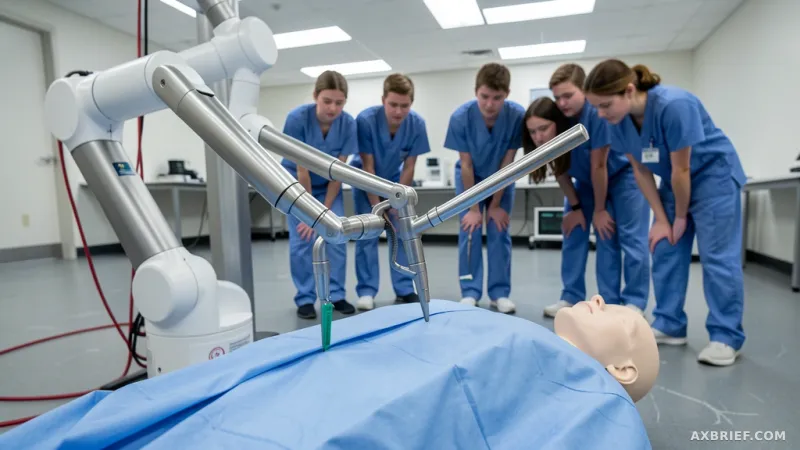
When a trained surgical policy is connected to Cosmos-H-Dreams, it creates a closed-loop control system. The policy receives a visual observation generated by the world model, decides on an action, and feeds that action back into the model to generate the next observation. This cycle allows researchers to stress-test AI agents in edge-case scenarios—such as accidentally piercing tissue or dropping a needle—without risking expensive hardware or endangering patients. It effectively turns the simulation into a scalable gym for reinforcement learning and imitation learning, drastically shortening the development cycle by removing the need for constant physical robot occupancy.
Despite these capabilities, NVIDIA has drawn a hard line regarding the application of Cosmos-H-Dreams. The system is strictly an R&D platform. It is explicitly forbidden for use as a diagnostic system to judge patient status or as a real-time replacement for actual surgical video feeds. Furthermore, it cannot be used as a direct controller for live surgical robots. Because the generated images are physical approximations rather than absolute truths, relying on them for actual surgical intervention would be a critical safety violation.
The true value of the system lies in its role as a risk-mitigation layer. By providing a high-fidelity, 160fps environment for closed-loop verification, NVIDIA allows developers to identify and fix policy failures in a virtual void before a single piece of metal touches a physical patient.