
Most users are familiar with the iterative dance of prompting a chatbot. You ask a question, the AI provides an answer, and you spend the next ten minutes refining your request through a series of tweaks and corrections to get the exact result you need. This manual loop is a friction point in productivity. However, the industry is shifting toward Agentic AI, where the AI does not just answer but acts. In an agentic workflow, the AI breaks a complex goal into sub-tasks, selects the right tools, executes them, and iterates internally until the objective is met. What was once a manual conversation between a human and a machine becomes a high-speed relay race of internal system calls.
The Architecture of Agentic Scale
This shift from single-turn chat to multi-step agency places an unprecedented strain on compute infrastructure. According to recent data from the AgentPerf benchmark released by Artificial Analysis, the NVIDIA GB300 NVL72 is fundamentally redefining the cost of this agency. The benchmark reveals that the GB300 NVL72 can drive up to 20 times more agents per megawatt of power compared to the previous NVIDIA HGX H200. This is not a marginal gain but a generational leap in power efficiency that directly impacts the bottom line for any enterprise deploying autonomous agents at scale.
To arrive at these figures, the benchmark utilized DeepSeek V4 Pro, a model built on a Mixture of Experts (MoE) architecture. MoE models increase efficiency by activating only a small subset of their total parameters for any given token, allowing for massive model capacity without a linear increase in compute cost. The GB300 NVL72 is specifically engineered to maximize the strengths of MoE. By optimizing how these expert networks are accessed and executed, NVIDIA has ensured that the energy cost per agent task is drastically reduced.
This efficiency is already being validated in production. Leading inference providers including Baseten, DeepInfra, and Together AI have integrated Blackwell-based infrastructure to power DeepSeek V4 Pro services. For these providers, the critical metric is no longer simply how many GPUs they can fit in a data center, but how many concurrent agentic workloads they can sustain per megawatt. Because agentic workloads are computationally more complex than standard chatbots, the ability to maximize throughput per unit of power is the primary determinant of infrastructure ROI.
Beyond Raw Compute: The Efficiency Pivot
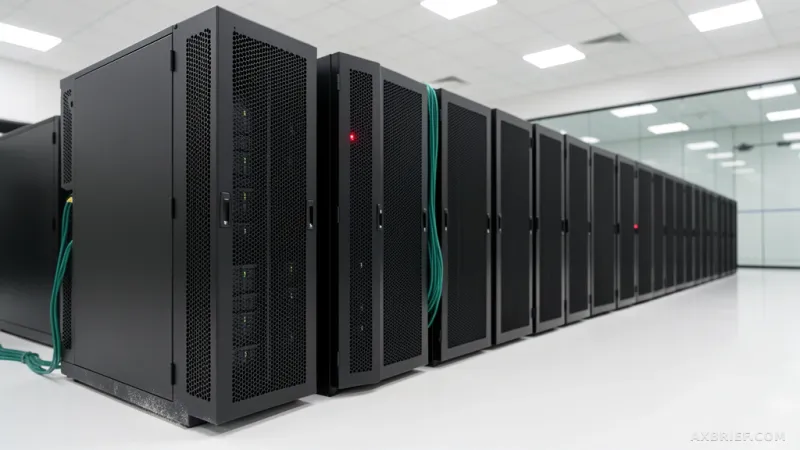
The 20x efficiency jump is not the result of a faster clock speed alone; it is the product of a tight integration between rack-scale hardware and low-level software optimization. The GB300 NVL72 connects 72 GPUs into a single, massive rack-scale system. Rather than treating the rack as a collection of individual servers, this architecture treats the entire unit as one giant GPU. This allows the system to distribute the parameters of a massive MoE model across 72 units with minimal latency, effectively eliminating the bottlenecks that occur when data must travel between separate server nodes.
At the software level, the efficiency is driven by the CUDA kernel. NVIDIA has optimized these kernels to allow for the overlapping of communication and computation. In traditional setups, the GPU often sits idle while waiting for data to move between different expert networks in an MoE model. By overlapping these processes, the GB300 NVL72 uses those idle cycles to perform actual calculations. The communication overhead is essentially absorbed into the computation time, ensuring that the hardware is never waiting for the network.
Complementing this is the NVIDIA TensorRT LLM library, which introduces a critical separation between the input processing (prefill) and output generation (decode) phases. These two phases have entirely different computational profiles. By optimizing them independently, TensorRT LLM reduces the bottlenecks that typically occur when an agent is looping—calling a tool, analyzing the result, and deciding the next step. This ensures that as the number of concurrent sessions grows, the system does not collapse under the weight of its own coordination overhead.
This technical shift is mirrored by a shift in how we measure AI performance. For years, the industry relied on tokens per second for a single call. AgentPerf changes this by measuring the trajectory of an agent. An agentic trajectory involves dozens or hundreds of linked LLM calls, where the context grows cumulatively at each step. When you add the latency of code compilation, database queries, and web browsing, the system load increases exponentially rather than linearly. AgentPerf tracks these real-world trajectories, using data from public code repositories across more than 12 programming languages to simulate the actual paths an AI takes when reading files, modifying code, and executing commands.
To ensure the benchmark measures the GPU's performance and not the speed of a third-party API, tool execution is simulated using representative CPU processing times. This isolates the accelerated computing performance, calculating exactly how many agent trajectories a platform can handle while maintaining strict responsiveness and output token speed standards.
From Theory to Production
The practical value of this infrastructure is already evident in high-stakes developer tools. Together AI provides Blackwell-based real-time inference for Cursor, an AI coding agent. Unlike a simple autocomplete tool, Cursor's agents perform deep debugging, feature generation, and structural refactoring in real-time. These tasks require the agent to maintain a massive context window and execute complex loops of analysis and correction. The hardware acceleration of Blackwell allows these agents to intervene directly in the developer's workflow without introducing perceptible lag.
Similarly, DeepInfra has deployed Blackwell-based agents for Pam.ai, an AI workforce platform for automotive dealerships. These agents handle high-pressure business operations, including service appointment management, phone response, and outbound sales campaigns. In a customer-facing environment, latency is the enemy of quality. The high throughput of the GB300 NVL72 ensures that these agents can handle simultaneous customer interactions with the immediacy of a human operator, proving that rack-scale efficiency translates directly into business utility.
For AI engineers and infrastructure architects, the era of counting individual GPUs is over. The emergence of the NVIDIA Vera Rubin architecture, which is now entering full production, further signals this transition. Rubin is designed specifically to handle the long sequence lengths and complex tool-calling patterns inherent in agentic AI. The competitive advantage in the next phase of AI deployment will not be found in the number of accelerators owned, but in the efficiency of the rack-scale connectivity and the power-to-throughput ratio.
For those building large-scale agent services, the priority must shift toward the connectivity of the rack. Simply adding more GPUs to a cluster cannot solve the exponential compute demands of agentic workloads. The ability to distribute model execution across 72 GPUs as a single unit is what enables the responsiveness and concurrency required for autonomous agents to move from experimental demos to reliable enterprise software.
The friction of the manual prompt-and-tweak cycle is disappearing, replaced by the autonomous iteration of the agent. By leveraging 72 GPUs in a single rack and utilizing CUDA kernel overlapping, the NVIDIA GB300 NVL72 provides a 20x increase in agent capacity per megawatt over the HGX H200. In the economy of agentic AI, the only metric that truly matters is how many autonomous tasks can be completed per watt of power.



