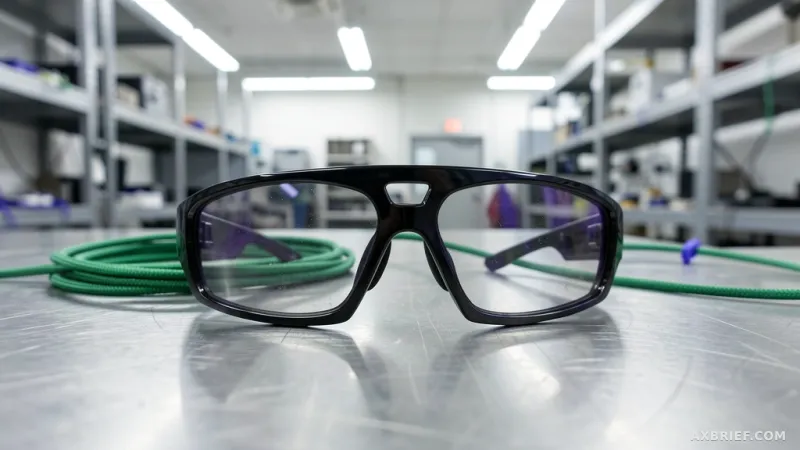
A technician stands in a high-voltage substation wearing a pair of advanced AR glasses, yet they are still clutching a grease-stained paper manual in one hand. Despite the hardware on their face, the AI is little more than a floating text box, capable of reading a PDF or sending a notification, but completely blind to the actual transformer humming in front of the worker. This disconnect defines the current state of wearable enterprise tech: the hardware is present, but the intelligence is trapped behind a screen, unaware of the physical geometry and urgent context of the real world.
The Architecture of Spatial Intelligence
NVIDIA is attempting to bridge this gap with the introduction of NVIDIA XR AI, a specialized developer library designed to transform AR and XR devices from simple display screens into active AI agents. Unlike standard LLM implementations that operate in a vacuum, NVIDIA XR AI creates a unified pipeline connecting device inputs, AI models, proprietary enterprise data, and software tools. The objective is to move AI out of the chat window and into the physical workflows of laboratories, factories, and surgical suites.
At the core of this system is an agentic runtime that allows an AI to perceive, reason, and act within a specific physical space. For this to be viable in a professional setting, the system prioritizes two non-negotiable metrics: low latency and spatial awareness. In a precision manufacturing environment or a medical theater, a two-second delay in AI response is not just a nuisance; it is a safety hazard. NVIDIA leverages its accelerated computing stack to minimize the time between sensor input and agent output, ensuring that the AI's guidance aligns perfectly with the user's line of sight and the physical orientation of the equipment.
To achieve this, NVIDIA XR AI employs a four-stage technical pipeline. First is Multimodal Perception, which ingests real-time video, audio, and sensor data. This stage converts analog environmental data into digital signals that the AI can interpret as situational context. Second is Enterprise Retrieval, which moves beyond general web knowledge to query secure internal databases, such as specific machine maintenance logs or proprietary part numbers. Third, Reasoning Models process this retrieved data against the current spatial context to determine the optimal next step, generating a logical execution plan for the worker. Finally, Agent Orchestration ties these elements together, allowing the AI to call external APIs or software tools to guide the user through a complex task in real-time.
The Hardware Moat and the Edge Imperative
While the software pipeline provides the logic, the actual utility of NVIDIA XR AI depends on a fundamental shift in where the computation happens. The integration of the NVIDIA NeMo Agent Toolkit allows developers to design complex workflows where multiple specialized agents collaborate to solve a single problem. One agent might handle the visual recognition of a faulty valve, while another retrieves the torque specifications from a secure server, and a third orchestrates the step-by-step visual overlay on the AR glasses.
However, the real distinction lies in the underlying inference infrastructure. NVIDIA is positioning DGX Spark, DGX Station, and RTX PRO systems as the backbone of this ecosystem. By deploying these resources at the edge—physically close to the user—NVIDIA eliminates the round-trip latency inherent in centralized cloud computing. This edge-centric approach is what enables the 0.1-second response times required for high-stakes environments.
This creates a hybrid deployment model that solves the tension between performance and security. Sensitive corporate data can be processed locally on RTX PRO systems within a company's own firewall, while less critical, general-purpose computations are offloaded to the cloud. This ensures that the AI agent remains responsive and secure, regardless of the network stability of the factory floor. The transition here is from AI as a service to AI as an integrated piece of industrial infrastructure.
For organizations looking to implement this, the criteria for success have shifted. The primary question is no longer how fast the AI can answer a question, but whether it can maintain context awareness. If a task requires the AI to understand exactly what a worker is looking at and manipulate internal software tools to resolve a problem, the combination of the NeMo toolkit and edge-based DGX/RTX hardware becomes a requirement rather than an option.
The era of the smart glass as a mere notification hub is ending, replaced by a partner that understands the physical world as well as the digital one. The practical value of these agents will be decided by the precision of the handshake between high-speed hardware and deep enterprise data.