
The modern AI user experience is currently defined by a frustrating tension. We have models capable of PhD-level reasoning, yet the actual interaction often feels like waiting for a slow typist. For developers building autonomous agents, this latency is a systemic failure. When an agent must reason, call a tool, review the output, and correct its course, every millisecond of delay compounds. The industry has long accepted a brutal tradeoff: you can have high throughput to serve thousands of users, or you can have low latency for a snappy experience, but you cannot have both. This bottleneck has effectively capped the complexity of real-time AI agents.
The Architecture of the Jalapeño Inference Engine
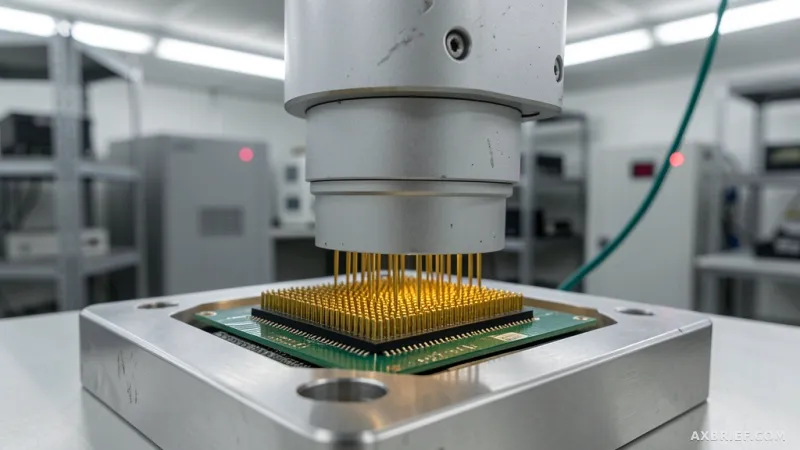
OpenAI is attempting to break this tradeoff with Jalapeño, its first custom-designed inference chip. The primary objective of this silicon is to collapse end-to-end latency, with measured reductions ranging from 1.7x to 3.6x compared to existing hardware systems. This is not merely a marginal gain; it is a fundamental shift in how AI services respond. By optimizing the hardware for the specific rhythms of Large Language Model (LLM) workloads, OpenAI has pushed the Pareto frontier of inference, improving both speed and efficiency simultaneously.
From a power perspective, Jalapeño is designed with a rated power of 700W, though actual sustained power consumption remains below 550W. In terms of efficiency, the chip delivers a 1.5x to 1.9x increase in AI operations per watt during peak throughput. The gains are even more pronounced in highly interactive workloads—the kind of rapid-fire exchanges typical of human-AI collaboration—where performance jumps by 2.1x to 4.1x. This efficiency allows OpenAI to scale its infrastructure without a linear increase in electricity costs, creating a more sustainable path toward massive deployment.
To achieve these numbers, OpenAI redesigned the relationship between the processor, memory, and network. LLM inference is split into two distinct phases: Prefill and Decode. The Prefill stage is compute-intensive, as the chip processes the entire initial prompt. The Decode stage, however, is memory-bound, as the chip generates tokens one by one, often leaving compute cores idle while they wait for data to move from memory. Jalapeño addresses this by explicitly placing the KV (Key-Value) cache locally. By keeping the model state nearest to the computation, the system minimizes the communication lag that typically plagues large-scale inference.
This integrated network design ensures that the entire workload is treated as a single connected system rather than a collection of discrete components. By reducing the time wasted on data movement, Jalapeño maximizes the utilization of every transistor. This is the first generation of a multi-generational roadmap; while Gen 1 is slated for deployment by the end of this year, Gen 2 is already in deep development and the architecture for Gen 3 is beginning to take shape.
The AI-Driven Silicon Loop and Full-Stack Validation
What makes Jalapeño a pivot point for the industry is not just the hardware itself, but how it was built. Traditionally, the journey from initial design to tape-out takes years of meticulous human engineering. OpenAI compressed this entire cycle into just nine months. They achieved this by using AI to explore implementation paths, automate the verification loops, and optimize the arithmetic circuits. The result is a higher compute density than human engineers could have mapped in the same timeframe.
This synergy between AI and hardware design extended into the software stack. Using Codex and GPT-Astra, OpenAI optimized three open-weight models in just two months—a task that would normally require months of manual kernel writing. In specific Attention and Mixture-of-Experts (MoE) blocks, the AI-generated implementations outperformed human-written code by 1.5x to 1.8x. This creates a recursive loop: AI is used to design the hardware, which is then optimized by AI, which in turn enables more powerful AI.
To validate these claims, OpenAI utilized the InferenceX benchmark from SemiAnalysis, testing the chip against a variety of model scales. The results were consistent across GPT-OSS 120B, DeepSeek R1 670B, and Kimi K2.5 1T. The performance gap widened as the models grew larger. For the Kimi K2.5 1T model, the most demanding of the group, Jalapeño achieved a 1.5x increase in peak performance per watt and a staggering 3.4x reduction in end-to-end latency. This proves that the chip's architecture is not over-fitted to a single model but is a generalized accelerator for the frontier of large-scale AI.
This technical victory translates directly into economic leverage. In the cloud business, operating leverage occurs when revenue grows faster than the costs required to support it. By increasing the number of inferences possible per watt and per server, OpenAI lowers the marginal cost of every token generated. This economic headroom allows the company to introduce high-precision agentic features—which require multiple internal reasoning loops—without making the service prohibitively expensive or painfully slow.
OpenAI is not abandoning its partners in this transition. The company is moving toward a hybrid infrastructure, continuing to use NVIDIA accelerators for training and specific inference tasks while deploying Jalapeño where system-wide efficiency and latency are paramount. By balancing specialized external chips with their own vertically integrated silicon, OpenAI is building a flexible foundation that can adapt as model architectures evolve.
Ultimately, Jalapeño decouples model intelligence from operational cost. By breaking the linear relationship between parameter count and latency, OpenAI is clearing the path for agents that can think deeper and act faster without breaking the bank.



