
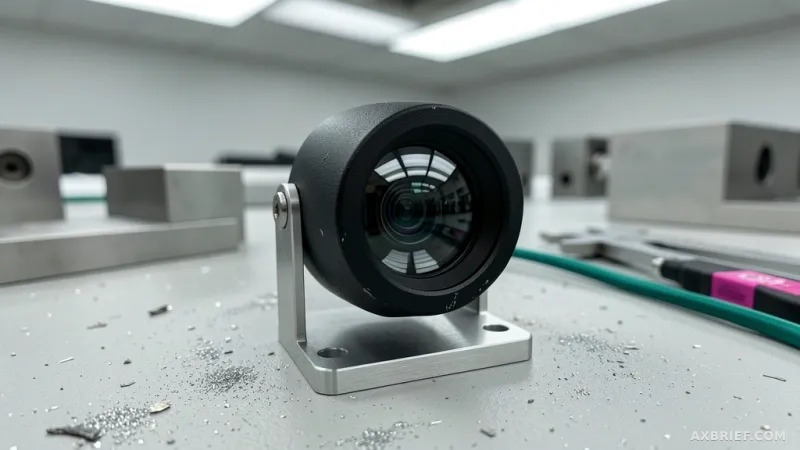
The current race to develop Physical AI often hits a mechanical wall long before it hits a computational one. For months, AI researchers and robotics engineers have operated under a costly assumption: to collect high-fidelity interaction data, one must first deploy and maintain a fleet of expensive robots. This creates a bottleneck where the cost of hardware maintenance and the fragility of field deployments dictate the pace of model training. The industry has essentially been paying a robot tax, spending more time fixing actuators and calibrating joints than actually refining the neural networks that drive them.
The Hardware Stack for Robot-Free Data
Orbbec is attempting to decouple data acquisition from mechanical complexity with the launch of a dedicated hardware platform designed specifically for Physical AI training. Instead of relying on a fully articulated robot to move sensors through a space, this platform provides the necessary sensory infrastructure to capture environmental and interaction data independently. The ecosystem is built around three primary product lines: the EGO, UMI, and WristCam series. These tools are designed to capture the precise spatial and visual data required for AI models to understand physical manipulation and environmental navigation without the overhead of a robotic chassis.
Beyond providing off-the-shelf hardware, Orbbec is integrating itself into the industrial supply chain through Contract Manufacturing (CM) and Joint Design Manufacturing (JDM) services. This approach allows Physical AI startups and robot OEMs to move from prototype to production-grade data collection tools without building their own manufacturing facilities. By offering these services, Orbbec enables companies to customize their sensor arrays to specific use cases while maintaining the precision required for large-scale dataset generation. Detailed technical specifications for these series are available through the official Orbbec website.
Solving the Spatial-Temporal Gap
The critical challenge in removing the robot from the data collection process is maintaining the integrity of the data. In traditional setups, the robot's own kinematics provide a known reference point for where a sensor is in 3D space. Without the robot, the system must find another way to ensure that data from multiple sources is coherent. Orbbec addresses this through a hardware-level integration of multi-sensor calibration and synchronization technologies.
Multi-sensor calibration ensures that data streams from various cameras and sensors are mapped onto a single, consistent spatial coordinate system. This prevents the spatial drift that typically plagues fragmented sensor setups. Simultaneously, the synchronization technology eliminates the temporal gaps between sensors, ensuring that a visual frame from one camera aligns perfectly in time with a depth map from another. The result is a high-quality interaction dataset that mimics the precision of robot-led collection but removes the mechanical failure points. The shift here is fundamental: Orbbec is treating data collection as an infrastructure problem rather than a robotics problem. By isolating the sensor stack, AI companies can now control the cost and timing of their data pipelines without being held hostage by the uptime of a physical robot.
This transition allows algorithm-focused firms and data operators to optimize their pipelines for throughput rather than maintenance. When the hardware is purpose-built for data rather than movement, the cost per sample drops significantly, and the speed of iteration increases.
Orbbec has effectively turned the physical limitations of data collection into a scalable infrastructure advantage. This platform provides a viable path for enterprises to achieve high-precision environmental data while slashing the operational costs of AI training.



