
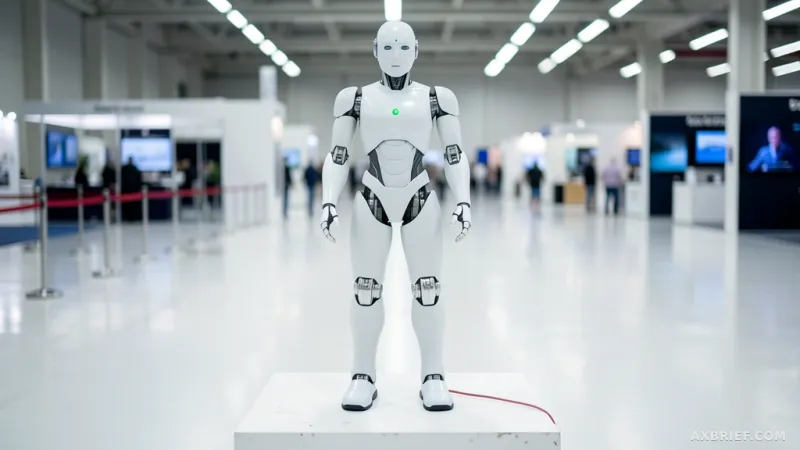
The artificial intelligence revolution is currently migrating from the chat box to the chassis. For the past few years, the industry has been obsessed with the digital brain—large language models that can write poetry or code in seconds—but the frontier has shifted toward the physical body. The current tension in the developer community is no longer about whether an AI can think, but whether it can move, sense, and interact with the physical world without failing the moment a camera is obscured or a light is dimmed. This shift toward embodied intelligence is creating a massive vacuum in the global supply chain for specialized hardware that can keep up with the speed of AI software.
The Infrastructure of the 2026 Physical AI Superconnect
This urgency culminated in the 2026 Silicon Valley Physical AI Superconnect, a strategic gathering held on June 24 and 25 at the Computer History Museum and the KOTRA Silicon Valley Trade Center. The event served as a high-density nexus for 41 South Korean Physical AI companies to interface directly with the North American market. This was not a casual networking event but a coordinated effort by the Ministry of Trade, Industry and Energy and the Ministry of SMEs and Startups, with KOTRA leading the organization. The operational heavy lifting was handled by KAIST GCC (Global Technology Commercialization Center), the lead agency for the robotics and advanced manufacturing sectors of the Deep-tech Innovative Startup Project (DIPS), in collaboration with KETI (Korea Electronics Technology Institute) for the future mobility sector.
In total, over 400 industry stakeholders converged, including representatives from 150 US-based companies and investment firms. The scope of the discussions spanned the entire Physical AI ecosystem, covering industrial and service robotics, specialized robot components, drones, mobility solutions, AI infrastructure, semiconductors, and the emerging concept of the AI factory. The primary objective for the participating Korean firms was to move beyond simple technical demonstrations and secure actual export channels, attract venture capital, recruit global talent, and establish frameworks for technology commercialization.
Among the attendees were engineers and decision-makers from the world's most influential tech entities. NVIDIA, Amazon, Tesla, Google, Lucid, and Uber all participated, reviewing solutions that could potentially be integrated into their existing hardware platforms or software ecosystems. The scale of the engagement was significant, resulting in approximately 300 individual business consultations that bridged the gap between laboratory-grade prototypes and industrial-scale application.
Beyond Vision: The Sensory Pivot of Physical AI
While most current robotics efforts rely heavily on computer vision, the companies at the Superconnect highlighted a critical flaw in the vision-centric approach: the blind spot. Vision sensors struggle in zero-light environments or when physical obstacles block the line of sight. To solve this, USN K introduced Robot-Ears, an auditory sensor technology that allows robots to perceive their surroundings by analyzing sound origin and waveforms. By expanding the robot's cognitive channels beyond sight, USN K provides a fail-safe for environments where cameras are useless. This specific capability drew immediate interest from several robotics firms and San Jose State University, leading to requests for samples and the initiation of Proof of Concept (PoC) projects.
Taking the vision-free concept further, Softionics demonstrated sensing technology based on electric fields. Unlike traditional cameras or LiDAR, this Vision-free Sensing approach measures changes in electrical force around charged particles. This allows a robot to detect objects behind obstacles or at extremely close ranges where a lens cannot focus. By removing the requirement for a clear line of sight, Softionics is addressing one of the most persistent hurdles in autonomous navigation and precision manipulation. Local US engineers spent the event analyzing how this electric field sensing could be integrated into existing robotic arms and autonomous mobile robots (AMRs).
On the hardware side, the focus shifted to human augmentation. FRT Robotics showcased a wearable robot solution designed for long-term industrial use. The tension in wearable robotics has always been the trade-off between power and weight; a suit that is too heavy becomes a burden rather than a tool. FRT Robotics focused on lightweight materials and field-applicability, resulting in sales negotiations with over five potential customers and the signing of multiple Memorandums of Understanding (MOUs). These discussions are now transitioning into follow-up PoC agreements with North American distributors and buyers.
These technologies represent a fundamental shift in how Physical AI is conceived. By integrating auditory and electric field signals, these companies are filling the gaps left by visual-dependency. This multi-modal sensory approach is the necessary foundation for robots to operate in complex, unpredictable industrial environments where lighting changes and physical obstructions are the norm rather than the exception.
The Data-Driven Path to the Global Supply Chain
What distinguished this event from a standard trade show was the rejection of the brochure-distribution model. Instead, KAIST GCC implemented a precision-matching strategy. Before the event, the technical capabilities, business models, global readiness levels, and specific collaboration needs of each Korean company were digitized. This data was then used to create a curated matching list, ensuring that companies were paired with partners based on actual technical synergy rather than random foot traffic.
This structured approach transformed the consultations into a rigorous validation process. The discussions were categorized into four pillars: technical cooperation, joint R&D, investment attraction, and global supply chain integration. Global tech giants did not just look at the products; they analyzed whether specific modules or components could enhance the performance of their own internal supply chains. In some cases, the conversations reached the level of joint R&D to establish the original source technologies for next-generation Physical AI standards.
The commercial viability of these technologies was evidenced by the specific outcomes for individual firms. Libotics conducted over 20 meetings with buyers and investors, with several resulting in plans for on-site visits and a follow-up trip in July to formalize business agreements. Secore Robotics reported an even more granular success rate: out of 28 meetings with companies and investors, they secured one PoC request, three expressions of intent for collaboration, and three inquiries regarding investment scale from venture capital firms. Additionally, eight companies requested follow-up meetings, signaling that their technical maturity had successfully crossed the entry barrier for the North American market.
To ensure these leads did not go cold, KAIST GCC partnered with Crest Ventures to run a capacity-building program. This program provided the necessary framework for Korean startups to negotiate specifications, pricing, and application scopes directly with US counterparts. The strategic roadmap identified for these companies follows a strict linear progression: confirming local market demand, validating technical applicability, executing a PoC, and finally entering the global supply chain.
For companies like Eflow, Seoul Dynamics, Daim Research, and Dogu Robotics, the event provided a map of where their specific modules fit within the broader North American ecosystem. For component-level providers, this precision matching is the only way to reach the original equipment manufacturers (OEMs) who control the final product assembly. The process concludes with a post-event management system where KAIST GCC analyzes investor feedback to help companies refine their products before the next round of meetings.
The transition of AI from a screen-based intelligence to a physical entity has moved past the stage of theoretical possibility and into the stage of commercial validation. The true value of a robot's auditory sensor or electric field sensing is not determined by a demo, but by how precisely it solves a pain point for a company like Tesla or NVIDIA. For the Korean robotics sector, the metric of success is no longer the number of consultations, but the speed and depth of their entry into the PoC phase. The path to global dominance in Physical AI now runs through the rigorous, data-driven validation of the Silicon Valley supply chain.



