
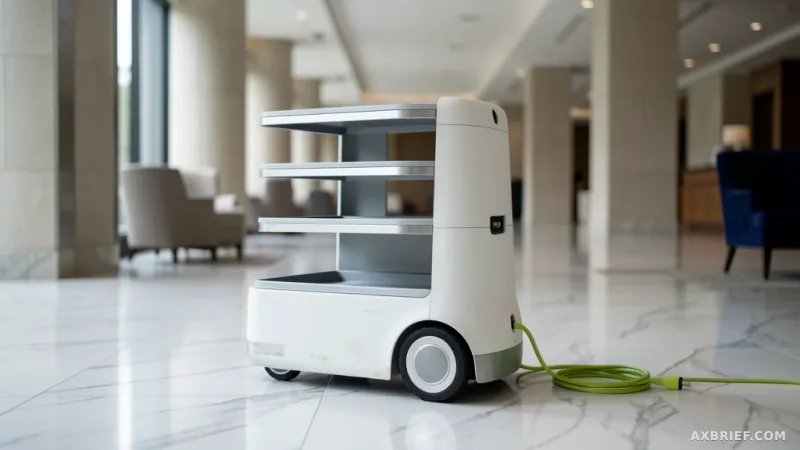
The hum of a delivery robot navigating a crowded cafe is no longer a novelty that stops diners in their tracks. For a few years, these machines served as high-tech ornaments, designed more to attract social media attention than to fundamentally alter the balance sheet of a business. However, a quiet shift is occurring in the way these machines are integrated into the workforce. The industry is moving past the era of the gimmick and entering the era of Physical AI, where the primary metric of success is not how the robot looks, but how it performs under the pressure of a lunch rush.
The Davos Blueprint for Physical AI
At the Davos Tech Summit 2026, Pudu Robotics presented a series of operational case studies that move the conversation from theoretical capability to actual deployment. The company focused its demonstrations on three primary environments: retail spaces, hospitality venues, and public areas. Unlike the sterile, controlled environments of a robotics lab, these demonstrations highlighted robots operating in the chaos of real-world business settings. The core challenge addressed was the unpredictability of human behavior, specifically the ability of autonomous systems to navigate around erratic pedestrians and sudden obstacles without interrupting the flow of service.
This transition to Physical AI represents a broader trend where artificial intelligence is no longer confined to a screen or a cloud server but is embedded into hardware that interacts with the physical world in real time. By deploying these units in high-traffic retail and hospitality sectors, Pudu Robotics aims to prove that autonomous navigation can handle the volatility of public spaces. Detailed deployment examples and product specifications are available through their official portal at pudurobotics.com/en.
The Gap Between Technical Novelty and Operational Value
There is a profound difference between a robot that can perform a task in a demo and a robot that can reduce the operational overhead of a business. For years, the robotics industry suffered from the demo trap, where companies showcased impressive videos of robots performing isolated tasks that failed to translate into scalable business value. A robot that can carry a tray is a technical achievement, but a robot that can reliably reduce the workload of a strained staff during a labor shortage is an operational asset.
This is where the tension between engineering and economics becomes clear. The true value of Pudu Robotics' current approach lies in the integration of robots into existing business processes rather than treating them as standalone additions. When a robot is treated as an operational tool, the focus shifts from the sophistication of the sensors to the tangible reduction in labor costs and the increase in throughput. The success of commercial service robots now depends on their ability to solve specific management crises, such as the global shortage of hospitality workers and the rising cost of manual labor.
By prioritizing productivity data over flashy promotional footage, the focus moves toward the actual ROI of the machine. The insight here is that technical precision is a baseline requirement, not the end goal. The real innovation is the ability to transform a piece of hardware into a predictable, cost-saving component of a business's infrastructure. This shift forces a re-evaluation of how companies judge the efficacy of AI, moving the goalposts from what the AI can do to what the AI can save.
The benchmark for the next generation of service robotics is no longer measured by the fluidity of its movement, but by the stability of the margins it helps maintain.



