The current race to build a functional humanoid robot is not being won by those with the best actuators or the sleekest chassis, but by those who can feed their models the most high-quality data. For most developers, this process is a logistical nightmare. To train a single robot to perform a complex task, a team typically needs to purchase multiple robot bodies, each costing tens of thousands of dollars, and then spend countless hours in a controlled environment using teleoperation to record movements. This hardware-centric approach creates a massive bottleneck where the cost of the physical machine dictates the speed of the AI's intelligence. The industry has been stuck in a cycle where scaling data meant scaling the fleet of expensive hardware, making the path to general-purpose embodied AI prohibitively expensive for all but the largest labs.
The Hardware-Free Data Pipeline
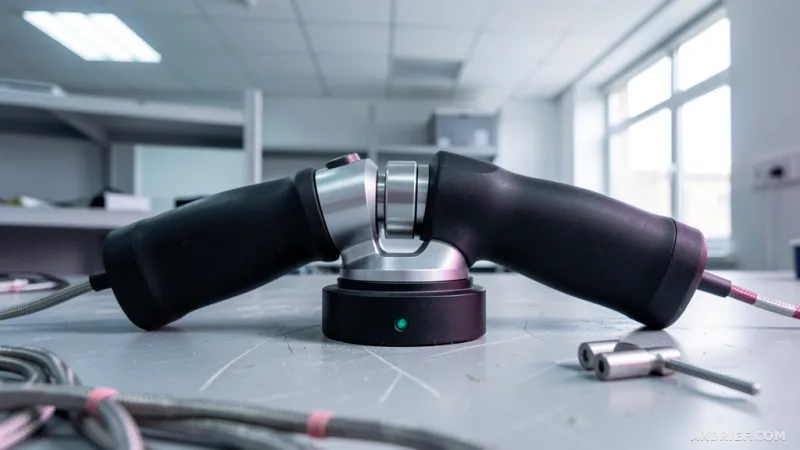
Founded in 2023, X SQUARE ROBOT is attempting to break this dependency by decoupling data collection from the physical robot body. The company recently unveiled QUANXTA Zero, a specialized solution designed to gather the necessary training data for embodied AI without requiring the actual robot to be present during the recording phase. By removing the physical constraints of the robot body, the company claims a 2.33x increase in data collection efficiency compared to traditional remote-control methods. This leap is achieved by shifting the focus from robot-operated teleoperation to human-centric data capture, which significantly lowers the cost of entry and accelerates the iteration cycle.
To accommodate different levels of data granularity, the QUANXTA Zero series is divided into three distinct hardware configurations. The most comprehensive version, QUANXTA Zero-G0, utilizes a VR headset, a specialized backpack, and dual grippers to capture full-body spatial awareness and precise hand movements. For tasks requiring less immersion, the QUANXTA Zero-G1 provides a headband and dual grippers. The most streamlined option, QUANXTA Zero-E0, consists solely of a headband, focusing on visual and head-tracking data.
This hardware ecosystem is integrated into a one-stop data service that manages the entire lifecycle of the training set. The process begins with data collection and moves through a rigorous pipeline of cleaning, automatic labeling, quality control, and data augmentation. The goal is to transform raw human movement into a high-value asset that can be immediately injected into a model's training loop. This pipeline concludes with inference testing on actual robot bodies, ensuring that the data collected via the Zero series translates accurately to physical execution.
Reverse Engineering the Intelligence Stack
While the hardware efficiency is a significant gain, the true shift lies in how X SQUARE ROBOT approaches the relationship between the model and the data. In traditional robotics development, the process is linear: a robot is built, and then researchers figure out what data is needed to make it work. X SQUARE ROBOT has inverted this logic through a reverse-engineering methodology. They first define the specific requirements of the embodied model and then design the data collection tools to meet those exact needs. This ensures that no time is wasted collecting redundant information and that the resulting dataset is perfectly aligned with the model's learning objectives.
This strategic alignment is further realized in the company's architectural choices. Most current robotics AI relies on a modular design where vision, language, and action are handled by separate networks. However, this modularity often leads to information loss, as the nuances of a visual scene are filtered or compressed before they reach the action-control module. To solve this, X SQUARE ROBOT introduced the WUM (World-Understanding-Model) architecture.
Their latest model, WALL-B, implements this WUM architecture to integrate vision, language, and action into a single, unified network. By eliminating the boundaries between these modalities, WALL-B achieves a level of multimodal fusion that allows the AI to understand the world and act within it simultaneously. The result is a system that does not just follow a sequence of commands but understands the spatial and semantic context of its environment. The tension between hardware limitations and model requirements is resolved by making the hardware a flexible extension of the model's needs, rather than a constraint.
This transition marks a fundamental pivot in the development of physical AI. The industry is moving away from a period where the scale of the hardware fleet determined the intelligence of the agent, moving instead toward a data-centric paradigm where the precision of the collection tool and the unity of the model architecture drive performance.